Castlelyons connects a medieval Carmelite foundation with two important strands of modern Irish history: Peadar Ó Laoghaire's writing and the Kent family's involvement in 1916.
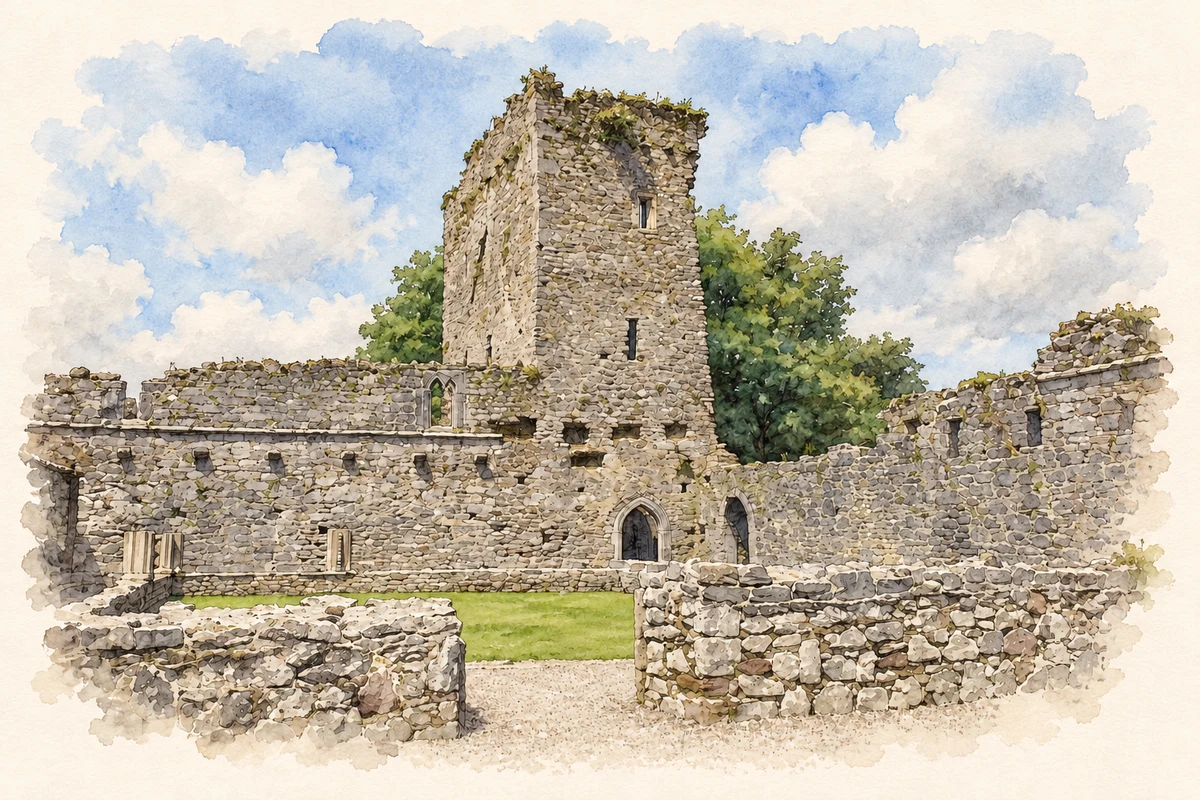
Illustration, cloister and central tower remains, Castlelyons Friary
⊕Recorded locationCastlelyons52.09046° N · 8.23867° WInteractive map supplied by OpenStreetMap.
These Irish name elements are associated with this record in the Logainm glossary.
An element’s translation is a clue, rather than a complete explanation of the name. Its form and meaning depend on local history and the full Irish name.
Recorded forms
Caisleán Ó Liatháin· Irish · main form · validated name
Castlelyons· English · main form
Place & story
A Carmelite foundation
John de Barry founded the Carmelite priory at Castlelyons in the early fourteenth century. His family already had a substantial record of supporting religious houses in Cork. The surviving remains belong largely to the fifteenth century. After the Reformation the property passed to Richard Boyle, first Earl of Cork, who granted it to his daughter Alice. The Office of Public Works undertook conservation in the 1930s, preserving the remains as a national monument.[2]
Windows, a school and a ball alley
The priory's later history was unusually varied. In 1638 windows were taken from Castlelyons for the Earl of Cork's renovation of Lismore Cathedral. The site also became a hedge school. By the middle of the nineteenth century, the antiquarian John Windele found the nave being used by villagers as a ball alley. These changes carried the old religious buildings into the everyday life of later Castlelyons, with learning and recreation occupying spaces originally made for worship.[3][2]
People & connections
An tAthair Peadar at Castlelyons
Peadar Ó Laoghaire served as parish priest from 1891 until his death in 1920. Known nationally as an tAthair Peadar, he became an important writer in the Irish-language revival, encouraged by the Gaelic League and by Seosamh Laoide. In Castlelyons he spoke Irish with older parishioners who still used the language. His literary work thus developed alongside his everyday parish duties. He died in the parochial house on 21 March 1920 and was buried in the churchyard of Saint Nicholas.[4]
Thomas Kent's return home
The Kent family's home at Bawnard, near Castlelyons, became the scene of an armed confrontation with police in May 1916. Head Constable Rowe was killed; David Kent was wounded, and Richard Kent was fatally shot while attempting to escape after the surrender. Thomas Kent was court-martialled and executed at Cork Detention Barracks on 9 May. In 2015 his remains were identified through DNA testing. His state funeral took place at Saint Nicholas's Church on 18 September, followed by reinterment in the adjacent family plot.[5][6]
Both counts use the 2016 settlement boundary, allowing like-for-like comparison. CSO supplies the 2022 count on this older boundary for comparison only. The official 2022 Built Up Area has different boundaries.
View population figures
Castlelyons — Census 2016 settlement footprint — census population
These are the historical areas published in the 2006 census report. Boundaries may differ between censuses and from modern settlements. Legal towns, environs and suburbs are shown separately; none has been combined into a modern settlement total.
View population figures
Castlelyons, Cork — Census town, CSO 2006 report — census population
These are the historical areas published in the 1996 census report. Boundaries may differ between censuses and from modern settlements. Legal towns, environs and suburbs are shown separately; none has been combined into a modern settlement total.
View population figures
Castlelyons, Cork — Census town, CSO 1996 report — census population
Figures cover the historical town area printed in the 1986 report. Boundaries may have changed between censuses. Legal town, environs and suburb totals remain separate and differ from modern settlement boundaries.
View population figures
Castlelyons, Cork — Census town, CSO 1986 report — census population
These figures use different area definitions. Read the boundary note before comparing them.
Castlelyons, Cork
Published census settlement populations
374people · 2016
Settlement boundaries changed during this period. Differences may reflect boundary changes as well as population change. Where a 2011 legal-town-and-environs count is shown, it has not been recalculated onto the 2016 settlement boundary.
Cloister and central tower remains, Castlelyons Friary illustration: based on a Castlelyons Abbey - cloister and central tower by Jonathan Thacker. AI-assisted watercolour and ink adaptation; cream paper margins added, incidental clutter omitted and fine details simplified. Licence: CC BY-SA 2.0.
 placenames