Ballingeary's Irish-language history reaches from Máire Bhuí Ní Laoghaire's songs to the teacher-training college opened in 1904 and a community museum project in its original building.
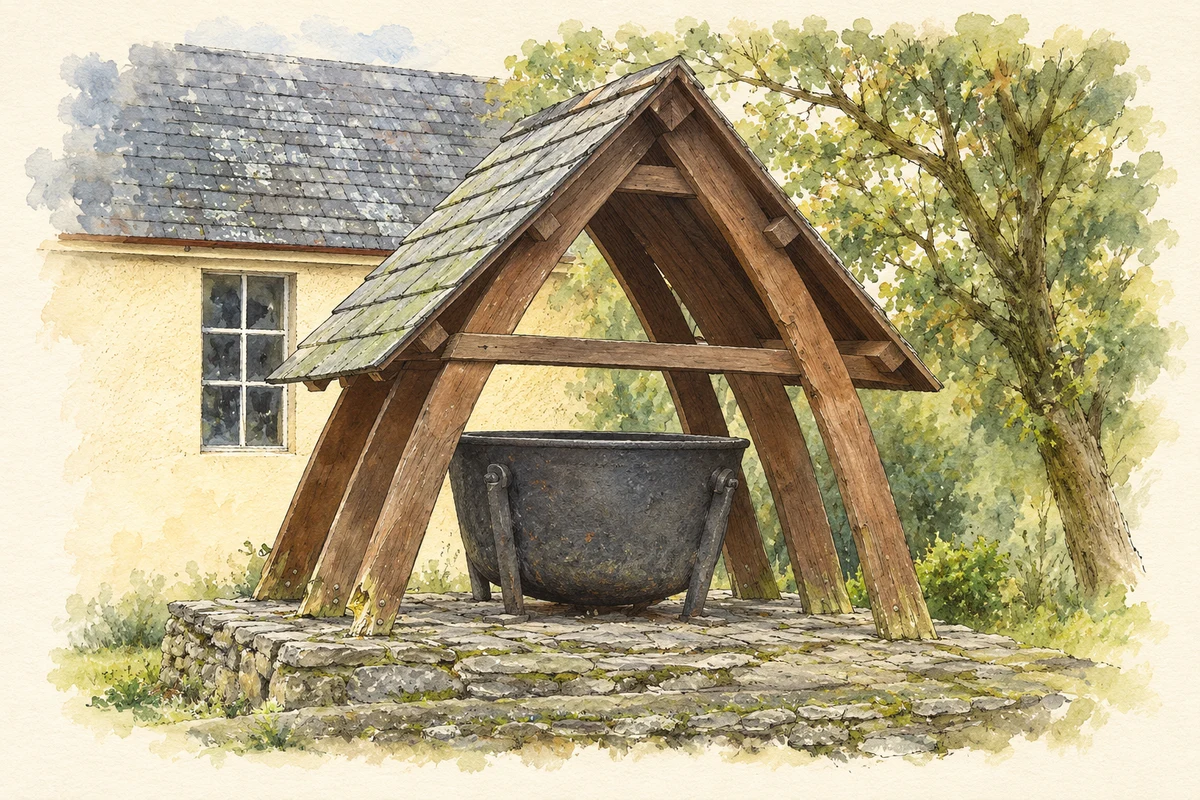
Illustration, Coolmountain Soup Pot, Ballingeary
⊕Recorded locationBallingeary51.84887° N · 9.23447° WInteractive map supplied by OpenStreetMap.
These Irish name elements are associated with this record in the Logainm glossary.
An element’s translation is a clue, rather than a complete explanation of the name. Its form and meaning depend on local history and the full Irish name.
Recorded forms
Béal Átha an Ghaorthaidh· Irish · main form · validated name
Ballingeary· English · main form
Place & story
Training the teachers of Irish
Coláiste Múinteoireachta na Mumhan was founded in 1903 and opened at Ballingeary on 4 July 1904. Its main purpose was to train teachers in teaching Irish, through courses held in July and August. Certificates, including interim certificates, were awarded to participants. The National Library's Shán Ó Cuív papers preserve college accounts and documents about its financing and management. Ó Cuív served on its management committee, while Liam de Róiste worked as secretary from offices in Cork city. The village college thus formed part of a wider organised language movement.[2]
People & connections
Máire Bhuí's songs from the surrounding district
Máire Bhuí Ní Laoghaire was born in 1774 at Túirín na nÉan in the Ballingeary district. Without learning to read or write, she became an accomplished poet within an oral culture. Her work included love songs, religious songs, humorous pieces and laments, and displayed knowledge of classical references. Songs associated with her include An Cruiscín Lán. She died around 1848 and was buried at Inchigeelagh. Her local connection gives Ballingeary's language history a substantial creative presence before the later college and revival organisations.[3]
Students, photographs and a community museum
An Súgán's historical project traces Patrick Pearse's visit to Ballingeary in 1902 and records Terence MacSwiney as a college student in 1913. Its archive gathers contemporary photographs alongside historical journals and other material about the language revival. In 2020 the community acquired the original college building through a local family's gift, with the aim of creating a museum of the Gaelic Revival and Irish language. The project returns attention to the place where early teaching courses helped connect learners, teachers and the surrounding Irish-speaking community.[4][5]
Béal Átha An Ghaorthaidh — Census 2016 settlement footprint
Population within 2016 settlement boundaries
242people · 2022
Both counts use the 2016 settlement boundary, allowing like-for-like comparison. CSO supplies the 2022 count on this older boundary for comparison only. The official 2022 Built Up Area has different boundaries.
View population figures
Béal Átha An Ghaorthaidh — Census 2016 settlement footprint — census population
Béal Átha an Ghaorthaidh, Cork — Census town, CSO 2006 report
2002–2006: census town
234people · 2006
These are the historical areas published in the 2006 census report. Boundaries may differ between censuses and from modern settlements. Legal towns, environs and suburbs are shown separately; none has been combined into a modern settlement total.
View population figures
Béal Átha an Ghaorthaidh, Cork — Census town, CSO 2006 report — census population
Béal Átha an Ghaorthaidh, Cork — Census town, CSO 1996 report
1991–1996: census town
220people · 1996
These are the historical areas published in the 1996 census report. Boundaries may differ between censuses and from modern settlements. Legal towns, environs and suburbs are shown separately; none has been combined into a modern settlement total.
View population figures
Béal Átha an Ghaorthaidh, Cork — Census town, CSO 1996 report — census population
Figures cover the historical town area printed in the 1986 report. Boundaries may have changed between censuses. Legal town, environs and suburb totals remain separate and differ from modern settlement boundaries.
View population figures
Ballingeary, Cork — Census town, CSO 1986 report — census population
These figures use different area definitions. Read the boundary note before comparing them.
Béal Átha an Ghaorthaidh, Cork
Published census settlement populations
235people · 2016
Settlement boundaries changed during this period. Differences may reflect boundary changes as well as population change. Where a 2011 legal-town-and-environs count is shown, it has not been recalculated onto the 2016 settlement boundary.
View population figures
Béal Átha an Ghaorthaidh, Cork — census population
 placenames