Blacklion's stone market house stands at the village crossroads. Its restoration and the commemoration of poet Cathal Buí connect local trade, community effort and the landscape around Lough MacNean.
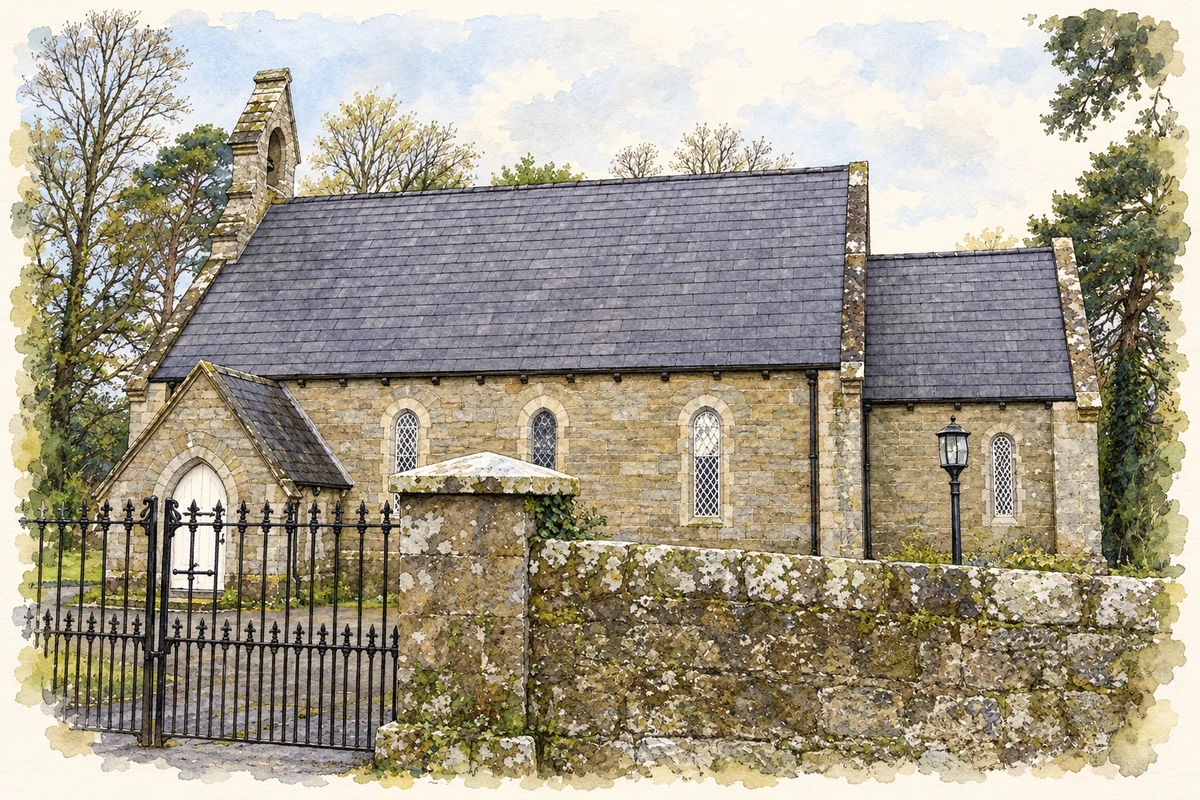
Illustration, Killinagh Church of Ireland, near Blacklion
⊕Recorded locationBlacklion54.29050° N · 7.87874° WInteractive map supplied by OpenStreetMap.
A reliable full-name meaning has not been established here. The recorded Irish and English forms are given without an unsupported translation.
Recorded forms
An Blaic· Irish · main form · validated name
Blacklion· English · main form
Place & story
The market house at the crossroads
Blacklion's market house was built around 1830. Its corner site, substantial sandstone walls and carefully finished openings gave commerce a conspicuous place at the village junction. The gable carries a clock, while broad arched openings survive beneath the upper-storey windows. Restoration around 2000 brought the building into use as a tourist centre and shop. Its architectural details preserve the dignity of an institution which once organised the village's economic life.[2]
People & connections
Cathal Buí beside the market house
Cathal Buí Mac Giolla Ghunna, the eighteenth-century Irish-language poet associated with west Bréifne, is commemorated in Blacklion's village trail. His best-known poem, An Bonnán Buí, laments a bittern unable to drink when the water is frozen, traditionally associated here with Lough MacNean. In 2020 a sculpture by Séamus Dunbar was installed near the market house. Killinagh Community Council commissioned it with support from Cavan County Council and the late parish priest John O'Donnell. The monument places the poet's regional connection in the centre of village life.[4][5]
The 1849 Methodist chapel
The Methodist church's porch bears a stone plaque identifying it as a Wesleyan chapel and giving the date 1849. Built on Francis Charles Hassard's estate, the modest building has pointed windows and a gabled entrance. Historic pews, timber wall boarding and leaded glass retain parts of its earlier interior. A photograph displayed in the porch records a former central flue, evidence of the stove which once heated the congregation. The chapel preserves another strand of Blacklion's nineteenth-century community history.[3]
A community route into the landscape
In a 2026 interview, Michael Fitzpatrick recalled the formation of the West Cavan Community Council more than fifty years earlier. It developed into Killinagh Community Council and promoted projects including the Cavan Way, linking Blacklion and Dowra through the Burren and Shannon Pot. He also identified the market house's revival as an important achievement. His account shows local organisation connecting the village's restored building with a wider landscape of walking routes and archaeological sites.[6]
Both counts use the 2016 settlement boundary, allowing like-for-like comparison. CSO supplies the 2022 count on this older boundary for comparison only. The official 2022 Built Up Area has different boundaries.
View population figures
Blacklion — Census 2016 settlement footprint — census population
These are the historical areas published in the 2006 census report. Boundaries may differ between censuses and from modern settlements. Legal towns, environs and suburbs are shown separately; none has been combined into a modern settlement total.
View population figures
Blacklion, Cavan — Census town, CSO 2006 report — census population
These are the historical areas published in the 1996 census report. Boundaries may differ between censuses and from modern settlements. Legal towns, environs and suburbs are shown separately; none has been combined into a modern settlement total.
View population figures
Blacklion, Cavan — Census town, CSO 1996 report — census population
These figures use different area definitions. Read the boundary note before comparing them.
Blacklion, Cavan
Published census settlement populations
194people · 2016
Settlement boundaries changed during this period. Differences may reflect boundary changes as well as population change. Where a 2011 legal-town-and-environs count is shown, it has not been recalculated onto the 2016 settlement boundary.
Killinagh Church of Ireland, near Blacklion, County Cavan illustration: based on a St Patrick's Church of Ireland, Blacklion by Kenneth Allen. AI-assisted watercolour and ink adaptation; cream paper margins added, incidental clutter omitted and fine details simplified. Licence: CC BY-SA 2.0.
 placenames