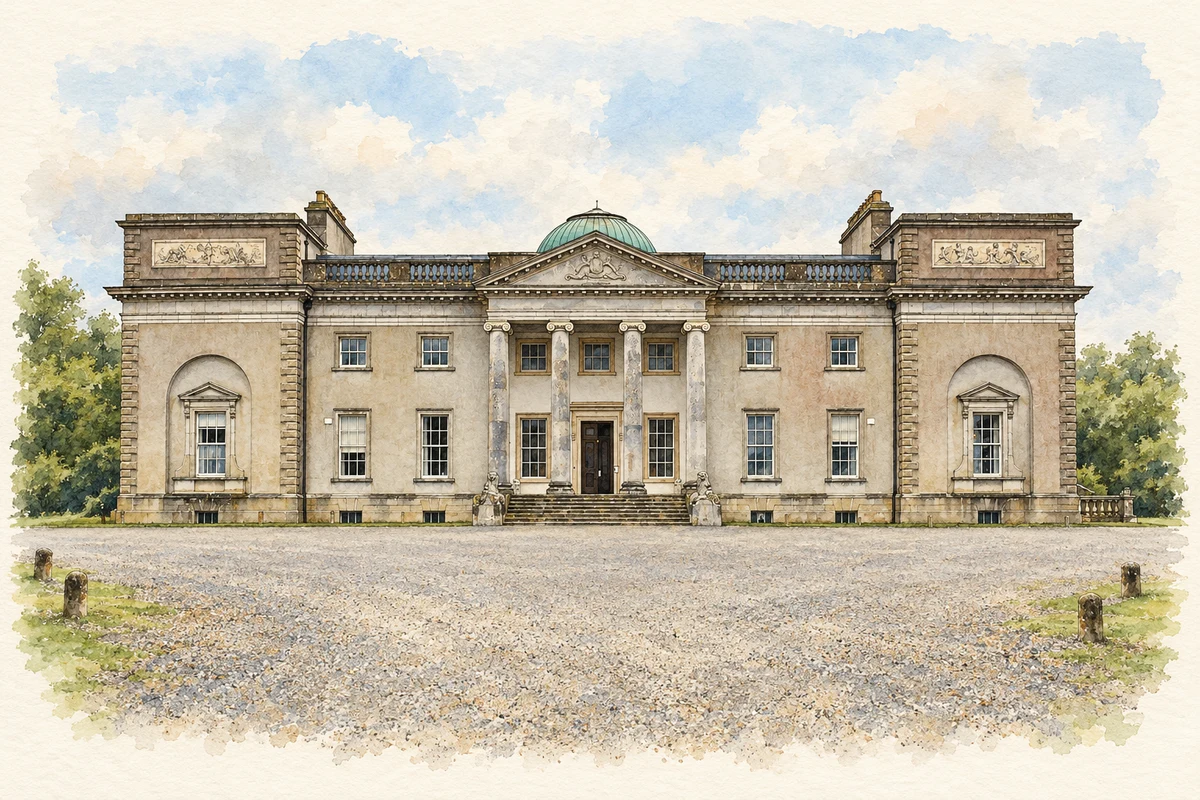
Emo Court, near the village, passed from the earls of Portarlington to the Jesuits and later to public ownership. Its history survives in grand interiors, service rooms and Frank Browne’s photographs.
Illustration, Emo Court
⊕Recorded locationEmo53.09471° N · 7.21579° WInteractive map supplied by OpenStreetMap.
A reliable full-name meaning has not been established here. The recorded Irish and English forms are given without an unsupported translation.
Recorded forms
Ioma· Irish · main form · validated name
Emo· English · main form
Place & story
A long building history
James Gandon began work on Emo Court in 1790, but the house took decades to complete. The neoclassical mansion became the seat of the earls of Portarlington. After institutional use in the twentieth century, Major Cholmeley-Harrison restored the property and opened its gardens to visitors. He presented the estate to the State in 1994. The house stands near Emo village within a designed landscape of gardens, woodland and a lake.[2]
St Mary’s, Emo
The Jesuits acquired Emo Court in 1930 and opened their novitiate that August. Bedrooms became dormitories, and the rotunda and adjoining library were combined to form a chapel. Architectural fittings removed during the conversion were stored in the basement rather than discarded. Outside, the grounds included a working farm, orchard and playing fields. More than five hundred novices trained here before the community left in 1969. The house’s institutional life therefore required substantial practical changes to rooms originally designed for an aristocratic household.[3]
People & connections
Frank Browne’s photographic work
Photographer and Jesuit priest Frank Browne was among the early residents of the new community at Emo. He photographed life in the house while also travelling around Ireland to give parish missions. His room served as a place to develop photographs, linking the country house to his much broader record of Irish social life. The OPW’s account notes that an exhibition devoted to his work opened at Emo Court in 2012.[3]
The work below stairs
The OPW opened Emo Court’s basement interiors to visitors in 2025. Kitchens, pantries, stores and passages reveal the labour that supported the formal rooms overhead. Conservation work included furnishing the spaces with period-appropriate domestic objects, making clear their role as an interpretation of working life. Preparing the basement also required cooperation with the National Parks and Wildlife Service because bats had made parts of it their habitat. The project joined the preservation of a historic household’s service spaces with care for present-day wildlife.[4]
Both counts use the 2016 settlement boundary, allowing like-for-like comparison. CSO supplies the 2022 count on this older boundary for comparison only. The official 2022 Built Up Area has different boundaries.
View population figures
Emo — Census 2016 settlement footprint — census population
These are the historical areas published in the 2006 census report. Boundaries may differ between censuses and from modern settlements. Legal towns, environs and suburbs are shown separately; none has been combined into a modern settlement total.
View population figures
Emo, Laois — Census town, CSO 2006 report — census population
These are the historical areas published in the 1996 census report. Boundaries may differ between censuses and from modern settlements. Legal towns, environs and suburbs are shown separately; none has been combined into a modern settlement total.
View population figures
Emo, Laois — Census town, CSO 1996 report — census population
These figures use different area definitions. Read the boundary note before comparing them.
Emo, Laois
Published census settlement populations
257people · 2016
Settlement boundaries changed during this period. Differences may reflect boundary changes as well as population change. Where a 2011 legal-town-and-environs count is shown, it has not been recalculated onto the 2016 settlement boundary.
 placenames