A reliable full-name meaning has not been established here. The recorded Irish and English forms are given without an unsupported translation.
Recorded forms
An Chathair· Irish · main form · validated name
Caher· English · main form
Cahir· English · main form · local name
Place & story
A castle built around a river island
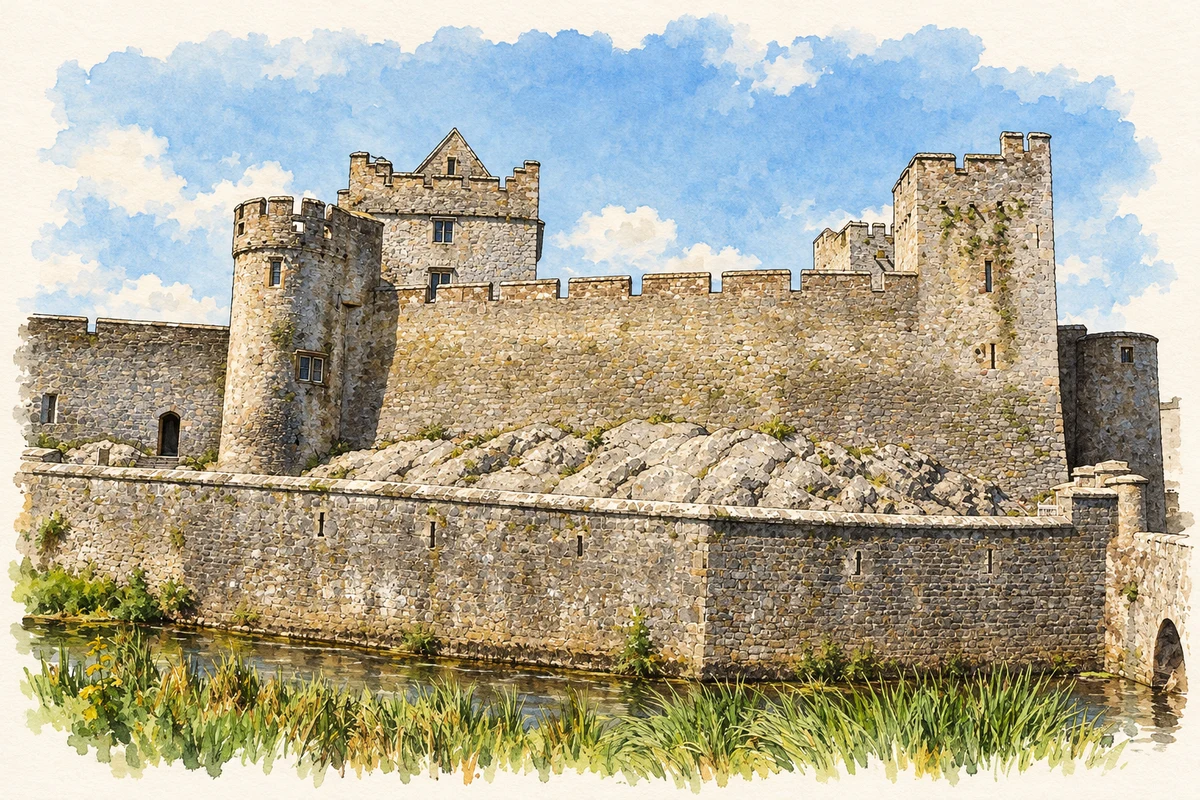
Cahir Castle occupies a rocky island in the River Suir. Its thirteenth-century builders used that setting to strengthen a fortress that later served the Butler family. Much of its medieval structure survives, making the relationship between river, walls and courtyards unusually clear. In 1599 the Earl of Essex brought heavy artillery against the defences and captured the castle. Further sieges followed during the Irish Confederate Wars. Its substantial surviving fabric has also made it a film location, including for Excalibur and The Tudors.[2]
People & connections
The Swiss Cottage and Richard Butler
Richard Butler, first Earl of Glengall, commissioned the Swiss Cottage in the early nineteenth century as an ornamental retreat. The Office of Public Works attributes its design to John Nash, while acknowledging that attribution as a belief rather than a documented certainty. The cottage was intended for picnics, small parties and leisure associated with fishing and hunting. Its Alpine-sounding name came from a perceived resemblance to a Swiss cottage. The building presents a deliberately picturesque vision of rural life, very different from the defensive purpose of the castle upriver.[3]
A Victorian house inside the walls
The castle's outer ward contains another, less conspicuous Butler-era building: a two-storey, L-shaped cottage dating to about 1845. The Office of Public Works considers it likely to be the work of William Tinsley, who was involved in remodelling Cahir. Born in Clonmel in 1804, Tinsley worked as a builder and architect before becoming architect to the diocese of Lismore in 1843. He later settled in Cincinnati. The house's slate roof, projecting bay and timber windows add a domestic nineteenth-century layer inside the medieval enclosure.[4]
Both counts use the 2016 settlement boundary, allowing like-for-like comparison. CSO supplies the 2022 count on this older boundary for comparison only. The official 2022 Built Up Area has different boundaries.
View population figures
Cahir — Census 2016 settlement footprint — census population
Cahir, South Tipperary — Census town, CSO 2006 report
2002–2006: census town
3,381people · 2006
These are the historical areas published in the 2006 census report. Boundaries may differ between censuses and from modern settlements. Legal towns, environs and suburbs are shown separately; none has been combined into a modern settlement total.
View population figures
Cahir, South Tipperary — Census town, CSO 2006 report — census population
Cahir, South Tipperary — Census town, CSO 1996 report
1991–1996: census town
2,236people · 1996
These are the historical areas published in the 1996 census report. Boundaries may differ between censuses and from modern settlements. Legal towns, environs and suburbs are shown separately; none has been combined into a modern settlement total.
View population figures
Cahir, South Tipperary — Census town, CSO 1996 report — census population
Figures cover the historical town area printed in the 1986 report. Boundaries may have changed between censuses. Legal town, environs and suburb totals remain separate and differ from modern settlement boundaries.
View population figures
Cahir, Tipperary — Census town, CSO 1986 report — census population
These figures use different area definitions. Read the boundary note before comparing them.
Cahir, South Tipperary
Published census settlement populations
3,593people · 2016
Settlement boundaries changed during this period. Differences may reflect boundary changes as well as population change. Where a 2011 legal-town-and-environs count is shown, it has not been recalculated onto the 2016 settlement boundary.
Cahir Castle, County Tipperary illustration: based on a Exterior of Cahir Castle, 2010 by Marcus Meissner. AI-assisted watercolour and ink adaptation; cream paper margins added, incidental clutter omitted and fine details simplified. Licence: CC BY 2.0.
 placenames