These Irish name elements are associated with this record in the Logainm glossary.
An element’s translation is a clue, rather than a complete explanation of the name. Its form and meaning depend on local history and the full Irish name.
Recorded forms
An Clochán· Irish · main form · validated name
Clifden· English · main form
Place & story
People & connections
John D'Arcy's new town
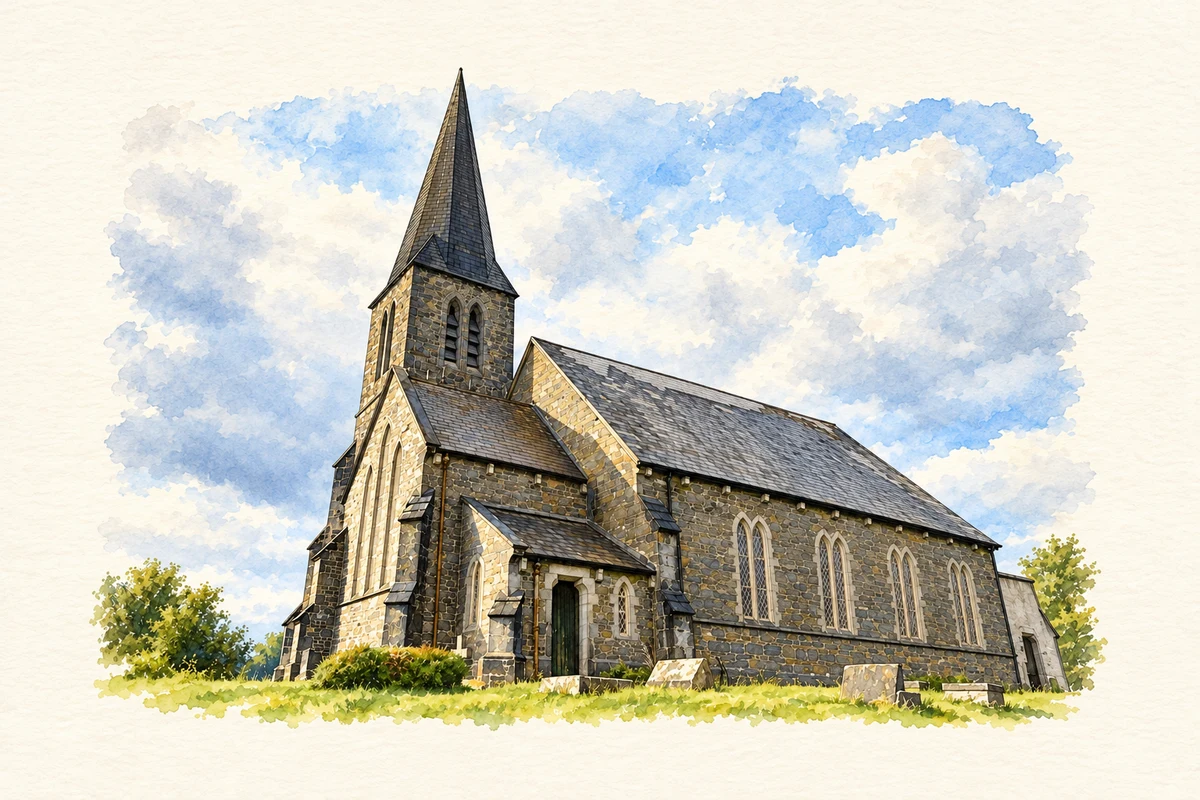
John D'Arcy founded Clifden in 1812 on the family's Connemara estate. Its early growth was substantial: the 1821 census recorded 46 houses and 290 people, rising to 196 houses and 1,257 inhabitants in 1831. Churches and schools occupied the higher ground, while a brewery, distillery and mill stood beside the Owenglin River and its waterfall. By D'Arcy's death in 1839, the new settlement had become an administrative and commercial centre for the surrounding coast and countryside.[2]
Relief and the sale of an estate
The Great Famine transformed Clifden's role. It became a centre for relief in Connemara, drawing people seeking employment, food and eventual admission to the workhouse. Overcrowded housing contributed to the spread of cholera in 1849. The crisis also undermined the D'Arcy estate. John's son Hyacinth was forced to sell the town and family lands in the 1850s. Thomas and Charles Eyre of Bath eventually purchased the Clifden property, ending the founding family's ownership within a generation.[2]
The Atlantic flight lands nearby
On 15 June 1919 John Alcock and Arthur Whitten Brown brought their Vickers Vimy down in Derrygimlagh Bog, near the Marconi wireless station south of Clifden. They had taken off from St John's, Newfoundland, the previous afternoon and completed the first non-stop transatlantic flight. Darkness, cloud and bad weather had made the journey hazardous. Their success secured the Daily Mail's £10,000 prize. The landing connected the town's surroundings with an international achievement, shortly followed by celebrations during the aviators' journey through Galway and Dublin.[3]
Both counts use the 2016 settlement boundary, allowing like-for-like comparison. CSO supplies the 2022 count on this older boundary for comparison only. The official 2022 Built Up Area has different boundaries.
View population figures
Clifden — Census 2016 settlement footprint — census population
These are the historical areas published in the 2006 census report. Boundaries may differ between censuses and from modern settlements. Legal towns, environs and suburbs are shown separately; none has been combined into a modern settlement total.
View population figures
Clifden, Galway — Census town, CSO 2006 report — census population
These are the historical areas published in the 1996 census report. Boundaries may differ between censuses and from modern settlements. Legal towns, environs and suburbs are shown separately; none has been combined into a modern settlement total.
View population figures
Clifden, Galway — Census town, CSO 1996 report — census population
Figures cover the historical town area printed in the 1986 report. Boundaries may have changed between censuses. Legal town, environs and suburb totals remain separate and differ from modern settlement boundaries.
View population figures
Clifden, Galway — Census town, CSO 1986 report — census population
These figures use different area definitions. Read the boundary note before comparing them.
Clifden, Galway
Published census settlement populations
1,597people · 2016
Settlement boundaries changed during this period. Differences may reflect boundary changes as well as population change. Where a 2011 legal-town-and-environs count is shown, it has not been recalculated onto the 2016 settlement boundary.
 placenames