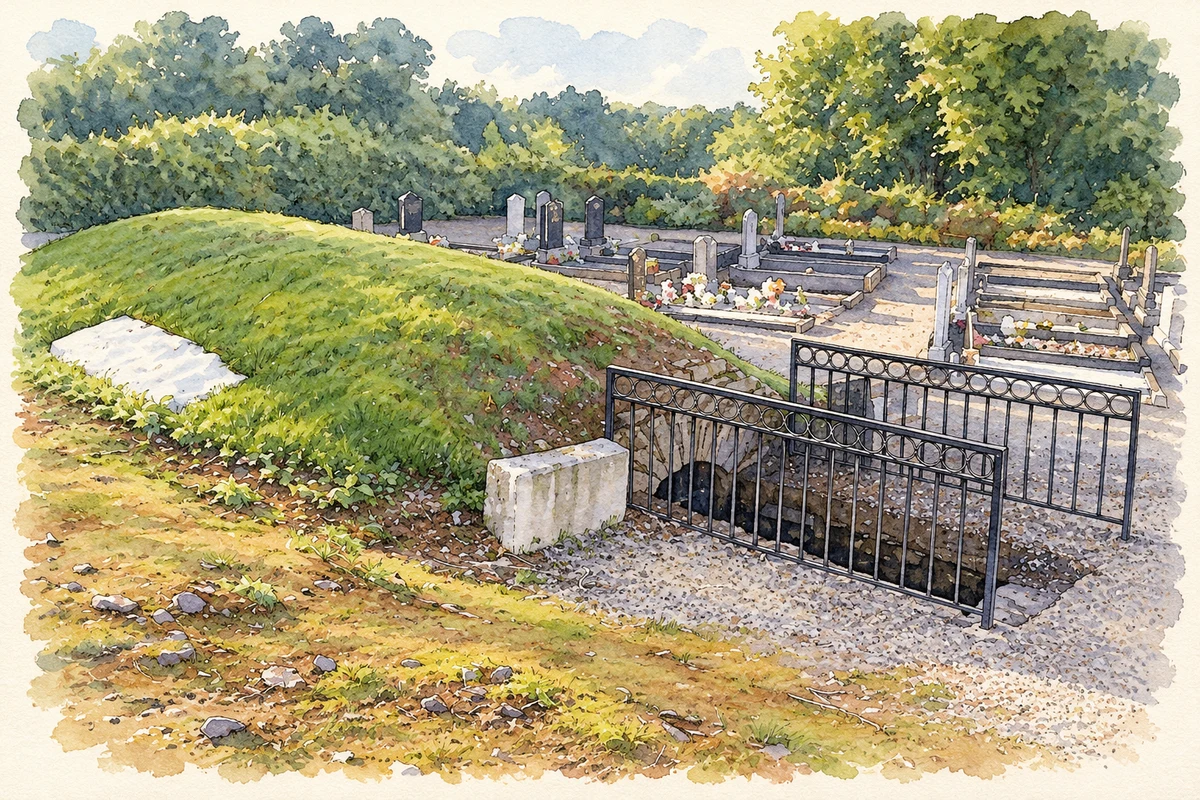
Knockraha’s history includes Irish-language scholarship and a discreet support role during the War of Independence, with a burial vault converted into a prison.
Illustration, Sing Sing vault at Kilquane cemetery, near Knockraha
⊕Recorded locationKnockraha51.95870° N · 8.34114° WInteractive map supplied by OpenStreetMap.
These Irish name elements are associated with this record in the Logainm glossary.
An element’s translation is a clue, rather than a complete explanation of the name. Its form and meaning depend on local history and the full Irish name.
Recorded forms
Cnoc Rátha· Irish · main form · validated name
Knockraha· English · main form
Place & story
People & connections
Domhnall Ó Colmáin and Irish prose
Domhnall Ó Colmáin, probably born in the Knockraha area during the seventeenth century, wrote Párliament na mBan for his pupil James Cotter. The work adapted material from Erasmus into Irish and survives in numerous manuscripts. His biographer identifies him as a learned figure familiar with classical authors and scripture, while acknowledging uncertainty over parts of his life. His association with Knockraha links the district to the circulation of Irish prose and teaching at a time when learning often depended on personal patronage.[2]
A quiet support area
During the War of Independence, IRA command used Knockraha as a support area for storing weapons and training volunteers. The local Independence Way project records arms hidden in the gallery of Saint Mary's Church, with the help of its sacristan, Mrs Gleeson. The gallery was removed during later changes to the church. Avoiding attacks in the immediate locality was intended to reduce searches and protect these activities. The absence of a major engagement in the village therefore does not mean it lay outside the conflict.[3]
The prison called Sing Sing
A vault in Kilquane graveyard became a makeshift prison, nicknamed Sing Sing after the prison in New York. Initially used for people accused of civil offences, it became Cork No. 1 Brigade's prison during 1920 and remained in use until the July 1921 truce. Cork County Council's historical account notes that some captives, including suspected informants and military personnel, were later executed. The site represents confinement and wartime violence as well as clandestine organisation; an accusation recorded in these accounts does not establish a prisoner's guilt.[4][5]
Both counts use the 2016 settlement boundary, allowing like-for-like comparison. CSO supplies the 2022 count on this older boundary for comparison only. The official 2022 Built Up Area has different boundaries.
View population figures
Knockraha — Census 2016 settlement footprint — census population
These are the historical areas published in the 2006 census report. Boundaries may differ between censuses and from modern settlements. Legal towns, environs and suburbs are shown separately; none has been combined into a modern settlement total.
View population figures
Knockraha, Cork — Census town, CSO 2006 report — census population
These figures use different area definitions. Read the boundary note before comparing them.
Knockraha, Cork
Published census settlement populations
371people · 2016
Settlement boundaries changed during this period. Differences may reflect boundary changes as well as population change. Where a 2011 legal-town-and-environs count is shown, it has not been recalculated onto the 2016 settlement boundary.
 placenames