 placenames
Lurgan
An Lorgain
Lurgan's long main street grew around plantation landholding and the linen trade. Brownlow House gives the town an unmistakable skyline, while an old saying and the life of James Logan carry its name into other kinds of history.
The name
These Irish name elements are associated with this record in the Logainm glossary.
An element’s translation is a clue, rather than a complete explanation of the name. Its form and meaning depend on local history and the full Irish name.
Recorded forms
- An Lorgain · Irish · main form · validated name
- Lurgan · English · main form
Place & story
A town along a ridge
John and William Brownlow established the modern plantation town in 1610. Development followed a long ridge, with buildings lining the main street on either side. Linen manufacture expanded in the eighteenth century and became increasingly industrial during the nineteenth, bringing workers, businesses and new building to the settlement. The townscape heritage scheme identifies the resulting streetscape as an important record of that prosperity. Its mix of architectural styles is held together by the scale and materials of adjoining buildings, preserving evidence of the craftsmen and commercial patrons who shaped the town. [2]
Brownlow House and its drawings
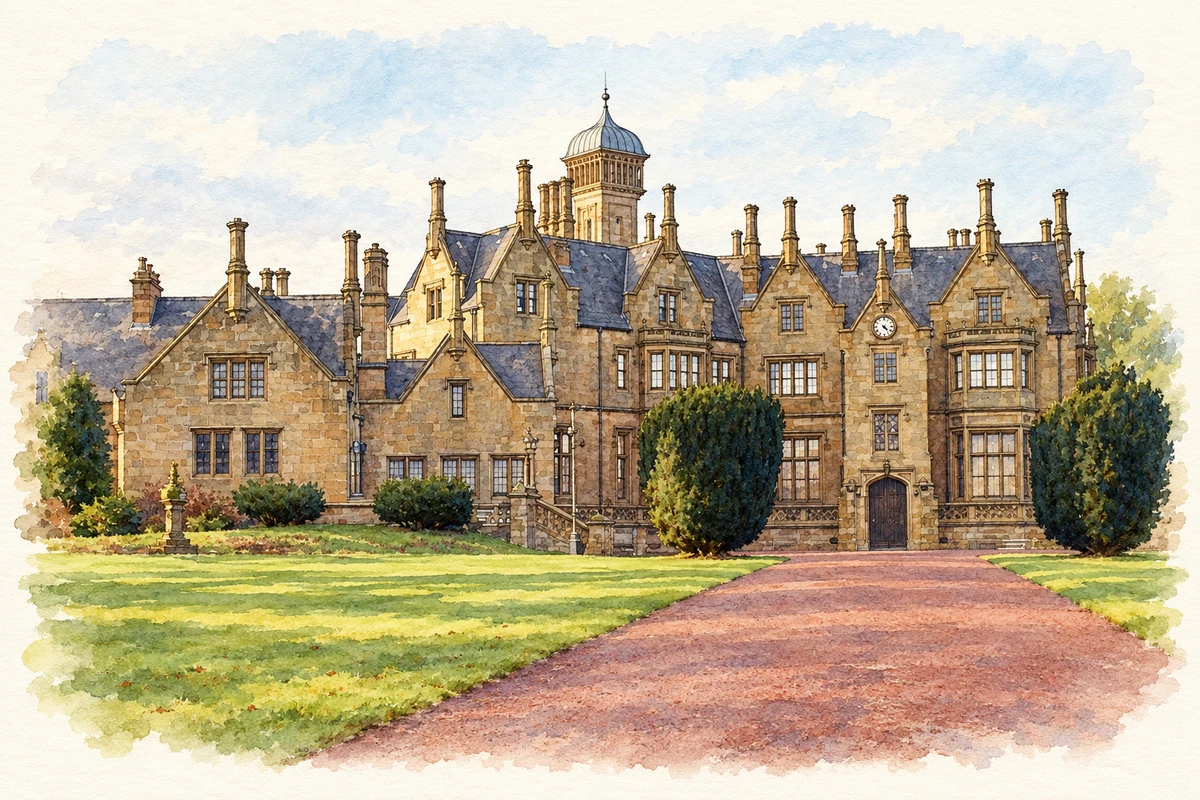
Charles Brownlow commissioned William Henry Playfair to design the mansion known as Brownlow House. Scottish sandstone, a slender tower and elaborate chimney forms give it a particularly recognisable silhouette. Inside, decorative treatments imitate marble and expensive woods, while heraldic glass records family connections. The house is unusually well documented: the historical society identifies a collection of 383 architectural drawings at Edinburgh University. That archive provides evidence for studying the building's design in addition to the fabric visible around the staircase, reception rooms and exterior. [3]
James Logan's Lurgan beginning
James Logan was born in Lurgan on 20 October 1674. His father Patrick, a former Church of Scotland minister who became a Quaker, taught him before much of his later self-education. Logan briefly apprenticed with a Dublin linen merchant, then moved with his family to Scotland and Bristol during the upheavals of the Jacobite wars. He subsequently taught in a Quaker school. William Penn later invited him to America, where he became a public servant and scientist. His early life connects Lurgan's religious and trading networks with a much wider Atlantic career. [4]
A face as long as a Lurgan spade
John Johnson Marshall recorded the saying 'a face on them as long as a Lurgan spade' in his 1924 collection, explaining that it described a gloomy or depressed appearance. He favoured an agricultural explanation: light local soils allowed a longer-bladed spade than heavy clay required, and buyers supposedly asked for that form by the town's name. Marshall presented this as an explanation offered for the expression. His account preserves both the familiar comparison and one early attempt to connect it with local working tools. [5]
Geographic information
- Place type
- Town
- County
- Armagh
- Barony
- Oneilland East
- Civil parish
- Shankill
- Coordinates
- 54.45892, -6.33444 (approximate)
- Logainm ID
- 1166423 ↗
Sources & further reading
- Logainm.ie — Lurgan. Place names and geographic record, licensed under CC BY 4.0.
- Lurgan · Lurgan Townscape Heritage
- Brownlow House · Craigavon Historical Society, Clendinning
- Logan, James · Patrick M. Geoghegan, Dictionary of Irish Biography
- A Lurgan Spade, Popular Rhymes and Sayings of Ireland,1924 · John Johnson Marshall
- Brownlow House forecourt frontage, Lurgan illustration: based on a Brownlow House, Windsor Avenue, Lurgan by P Flannagan. AI-assisted watercolour and ink adaptation; cream paper margins added, incidental clutter omitted and fine details simplified. Licence: CC BY-SA 2.0.
Name record retrieved 2026-10-25 · Source record modified 2021-12-20. How this page was prepared.