A reliable full-name meaning has not been established here. The recorded Irish and English forms are given without an unsupported translation.
Recorded forms
An tOspidéal· Irish · main form · validated name
Hospital· English · main form
Place & story
The Knights of Saint John
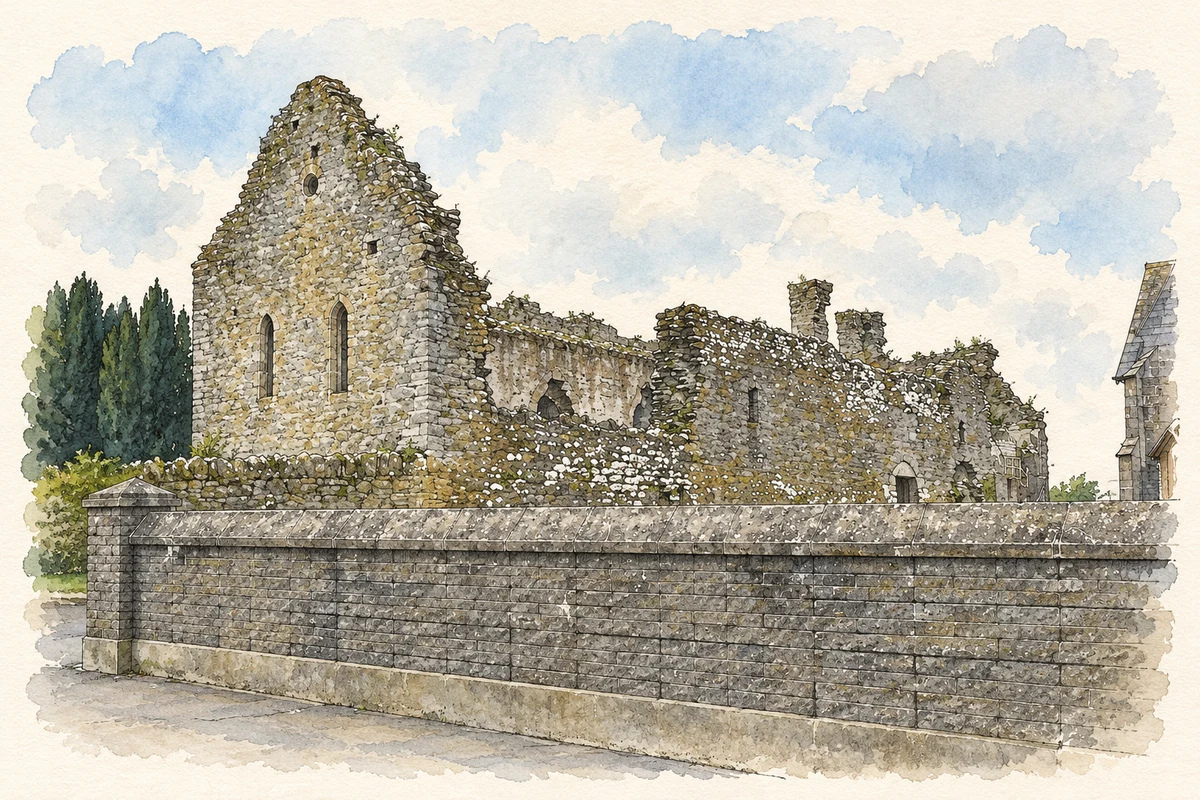
Hospital's name is associated with a commandery of the Knights Hospitaller dedicated to Saint John the Baptist. The foundation is linked to Geoffrey de Marisco in the early thirteenth century. A modern archaeological study places it between 1215 and 1226, reflecting the range found in historical accounts. The religious order's landholding and institutional presence preceded the later town. The surviving church stands beside the modern parish church, but the two buildings belong to different periods and should not be treated as a single continuous structure.[2]
Tombs in the medieval church
The National Library's record of a 1993 local-history photographic survey describes three effigies inside the old church. One is a double tomb showing a knight and his wife; another has traditionally been associated with the founder. That identification is a belief recorded by the survey, rather than a securely named inscription. The record also follows the property's history after the religious house was dissolved, when it was leased to William Apsley and later associated with the Browne family. The surviving sculpture provides material evidence alongside those documentary accounts.[3]
Hospital in Lewis’s 1837 account
Samuel Lewis described a town extending for about half a mile, with cattle fairs held four times a year and a constabulary station. His account records 179 houses in 1831, while noting that some had since been removed and their sites cultivated. He also mentions a Catholic chapel due to be rebuilt and a small private school. These details present Hospital as a nineteenth-century centre serving an agricultural district. They belong to a much later phase of its history than the medieval institution from which its name developed.[4]
Both counts use the 2016 settlement boundary, allowing like-for-like comparison. CSO supplies the 2022 count on this older boundary for comparison only. The official 2022 Built Up Area has different boundaries.
View population figures
Hospital — Census 2016 settlement footprint — census population
These are the historical areas published in the 2006 census report. Boundaries may differ between censuses and from modern settlements. Legal towns, environs and suburbs are shown separately; none has been combined into a modern settlement total.
View population figures
Hospital, Limerick — Census town, CSO 2006 report — census population
These are the historical areas published in the 1996 census report. Boundaries may differ between censuses and from modern settlements. Legal towns, environs and suburbs are shown separately; none has been combined into a modern settlement total.
View population figures
Hospital, Limerick — Census town, CSO 1996 report — census population
Figures cover the historical town area printed in the 1986 report. Boundaries may have changed between censuses. Legal town, environs and suburb totals remain separate and differ from modern settlement boundaries.
View population figures
Hospital, Limerick — Census town, CSO 1986 report — census population
These figures use different area definitions. Read the boundary note before comparing them.
Hospital, Limerick
Published census settlement populations
653people · 2016
Settlement boundaries changed during this period. Differences may reflect boundary changes as well as population change. Where a 2011 legal-town-and-environs count is shown, it has not been recalculated onto the 2016 settlement boundary.
Medieval Hospital Church, Hospital illustration: based on a Hospital church by Epzcaw. AI-assisted watercolour and ink adaptation; cream paper margins added, incidental clutter omitted and fine details simplified. Licence: CC BY-SA 4.0.
 placenames