 placenames
Ballykinler
Baile Coinnleora
Ballykinler’s military camp became a major place of internment during the War of Independence, leaving letters, craftwork and a prisoners’ journal.
The name
These Irish name elements are associated with this record in the Logainm glossary.
An element’s translation is a clue, rather than a complete explanation of the name. Its form and meaning depend on local history and the full Irish name.
Recorded forms
- Baile Coinnleora · Irish · main form · validated name
- Campa Bhaile Coinnleora · Irish · main form
- Ballykinler · English · main form
- Ballykinler Camp · English · main form
Place & story
Internment in 1920
British authorities established an internment camp at Ballykinlar in 1920, converting an existing military camp to hold men suspected of IRA activity. The National Museum of Ireland records that it held up to two thousand prisoners. Conditions were harsh, and men died in custody, including three who were shot. The camp therefore became part of a national system of imprisonment during the War of Independence. [2]
A community behind wire
Prisoners organised a cultural life alongside the restrictions of confinement. They made arts and crafts, staged plays and produced a journal called The Barbed Wire. They also used their own money tokens. A Seanad discussion in 2008 identified surviving contemporary material in the National Library’s Seán O’Mahony collection, together with research notes and letters about the camp. Such objects preserve activities that official administrative records alone might overlook. [3]
Peter Byrne’s letters
One prisoner whose voice survives was Peter Byrne, a Dublin carpenter and veteran of the Boland’s Mill garrison in 1916. Arrested again in November 1920, he was sent through Arbour Hill and Belfast to Ballykinlar. He wrote dozens of letters to his wife Frances about conditions and events in the camp. Preserved by Kilmainham Gaol Museum, these letters later informed plans by Down County Museum to reconstruct a camp hut. [4]
Geographic information
- Place type
- Population centre
- County
- Down
- Barony
- Lecale Upper
- Civil parish
- Ballykinler
- Coordinates
- 54.25276, -5.80562 (approximate)
- Logainm ID
- 1167018 ↗
Sources & further reading
- Logainm.ie — Ballykinler. Place names and geographic record, licensed under CC BY 4.0.
- Internment, Imprisonment and Escape · National Museum of Ireland
- Museum Projects, Seanad Éireann,5 November2008,p1075 · Houses of the Oireachtas
- Searching for information on Peter Byrne, Ballykinlar Camp internee1920–21,25 March2019 · Office of Public Works, Kilmainham Gaol Museum
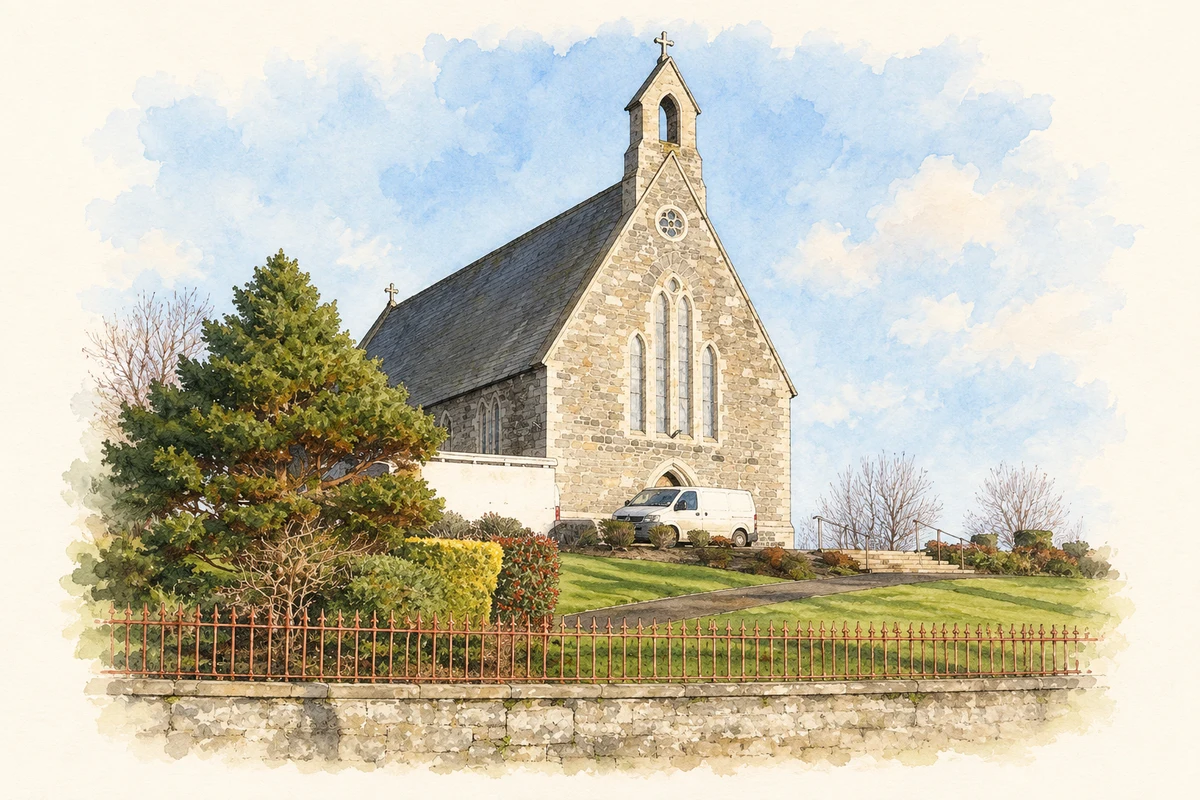
- St Patrick and St Joseph's Church, Ballykinler, County Down illustration: based on a St Patrick and St Joseph's Catholic Church, Tyrella, Ballykinler (12 November 2010) by Eric Jones. AI-assisted watercolour and ink adaptation; cream paper margins added, incidental clutter omitted and fine details simplified. Licence: CC BY-SA 2.0.
Name record retrieved 2026-10-25 · Source record modified 2019-10-08. How this page was prepared.