These Irish name elements are associated with this record in the Logainm glossary.
An element’s translation is a clue, rather than a complete explanation of the name. Its form and meaning depend on local history and the full Irish name.
Recorded forms
Baile na Lorgan· Irish · main form · validated name
Castleblayney· English · main form
Place & story
The Blayney estate and the town
Castleblayney developed around the Blayney estate beside Lough Muckno. Its late eighteenth-century expansion owed much to the eleventh Lord Blayney, who promoted the linen trade and developed a market house and market place. The council’s public-realm history dates his new neoclassical residence to 1799 and identifies its architect as Robert Woodgate, an assistant of John Soane. The house later became known as Hope Castle.[2]
Market Square and the lake entrance
The Market House expresses the town’s commercial and civic history; it was later used for court business. Nearby estate buildings include Hope Castle, its stables and the paired gate lodges at the lake entrance. Their relationship to the square helps explain Castleblayney’s layout, with town business and estate approaches occupying the same central space. Lough Muckno gives these buildings a landscape setting immediately beside the streets.[2]
People & connections
Country music and Big Tom
Country music supplied Castleblayney with another public identity. Local tourism records its associations with Big Tom McBride and showband musician Paddy Cole, commemorated in the town’s musical heritage displays. Big Tom’s connection also extends to nearby Oram, where a memorial garden honours him. The distinction matters when following his life through the district: the town and neighbouring village each preserve part of that musical story.[3]
President Michael D. Higgins visited Castleblayney in September 2018 to unveil the statue of Big Tom. The memorial made a performer familiar through records, broadcasts and dance halls a permanent presence in the town’s public space. It is a twentieth-century cultural connection set against the older market-house and estate landscape.[4]
Both counts use the 2016 settlement boundary, allowing like-for-like comparison. CSO supplies the 2022 count on this older boundary for comparison only. The official 2022 Built Up Area has different boundaries.
View population figures
Castleblayney — Census 2016 settlement footprint — census population
These are the historical areas published in the 2006 census report. Boundaries may differ between censuses and from modern settlements. Legal towns, environs and suburbs are shown separately; none has been combined into a modern settlement total.
View population figures
Castleblayney Legal Town, Monaghan — Legal town, CSO 2006 report — census population
Castleblayney Environs, Monaghan — Town environs only, CSO 2006 report
2002–2006: town environs only
1,302people · 2006
These are the historical areas published in the 2006 census report. Boundaries may differ between censuses and from modern settlements. Legal towns, environs and suburbs are shown separately; none has been combined into a modern settlement total.
View population figures
Castleblayney Environs, Monaghan — Town environs only, CSO 2006 report — census population
These are the historical areas published in the 1996 census report. Boundaries may differ between censuses and from modern settlements. Legal towns, environs and suburbs are shown separately; none has been combined into a modern settlement total.
View population figures
Castleblayney Legal Town, Monaghan — Legal town, CSO 1996 report — census population
Castleblayney Environs, Monaghan — Town environs only, CSO 1996 report
1991–1996: town environs only
924people · 1996
These are the historical areas published in the 1996 census report. Boundaries may differ between censuses and from modern settlements. Legal towns, environs and suburbs are shown separately; none has been combined into a modern settlement total.
View population figures
Castleblayney Environs, Monaghan — Town environs only, CSO 1996 report — census population
Figures cover the historical town area printed in the 1986 report. Boundaries may have changed between censuses. Legal town, environs and suburb totals remain separate and differ from modern settlement boundaries.
View population figures
Castleblayney, Monaghan — Legal town, CSO 1986 report — census population
Castleblayney, Monaghan — Town environs only, CSO 1986 report
1981–1986: town environs only
878people · 1986
Figures cover the historical town area printed in the 1986 report. Boundaries may have changed between censuses. Legal town, environs and suburb totals remain separate and differ from modern settlement boundaries.
View population figures
Castleblayney, Monaghan — Town environs only, CSO 1986 report — census population
These figures use different area definitions. Read the boundary note before comparing them.
Castleblayney, Monaghan — 2011 legal town and environs; 2016 census settlement
Published census settlement populations
3,607people · 2016
Settlement boundaries changed during this period. Differences may reflect boundary changes as well as population change. Where a 2011 legal-town-and-environs count is shown, it has not been recalculated onto the 2016 settlement boundary.
View population figures
Castleblayney, Monaghan — 2011 legal town and environs; 2016 census settlement — census population
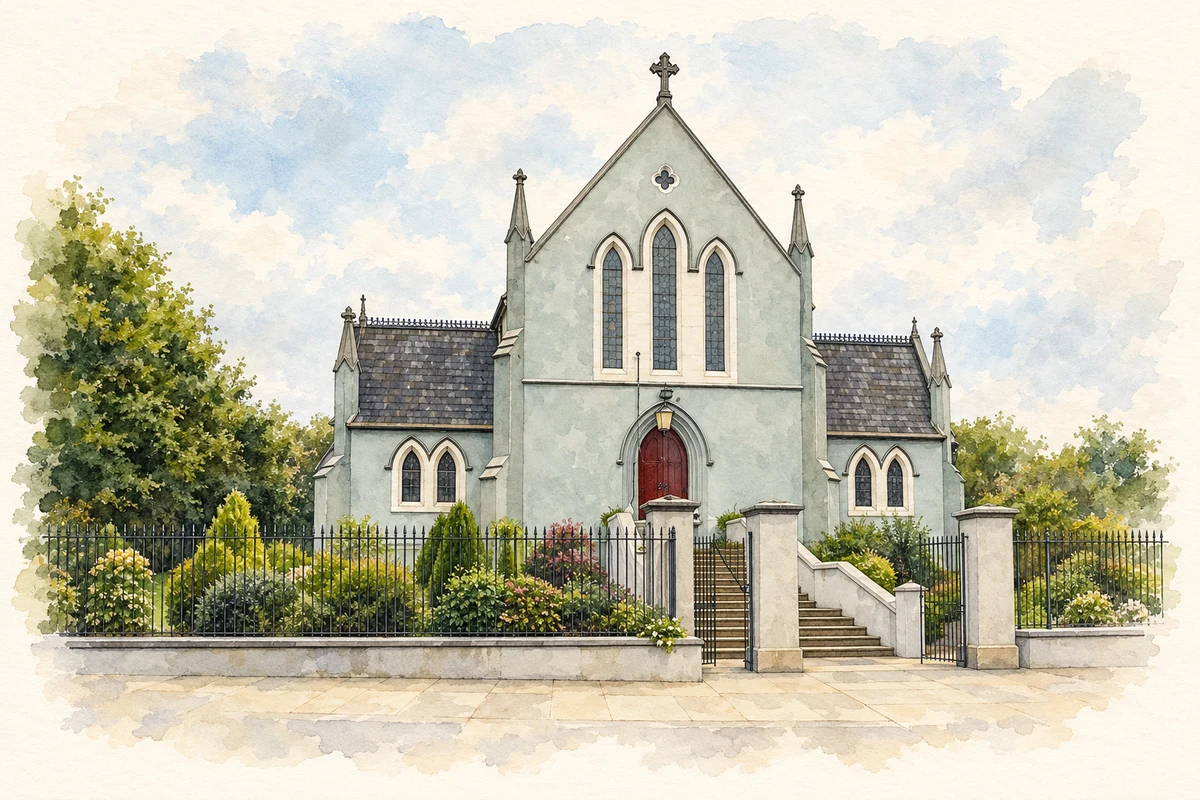
Saint Mary's Catholic Church, Castleblayney illustration: based on a St Mary's RC Church, Castleblaney by Kenneth Allen. AI-assisted watercolour and ink adaptation; cream paper margins added, incidental clutter omitted and fine details simplified. Licence: CC BY-SA 2.0.
 placenames