 placenames
Baily
Dún Criofainn
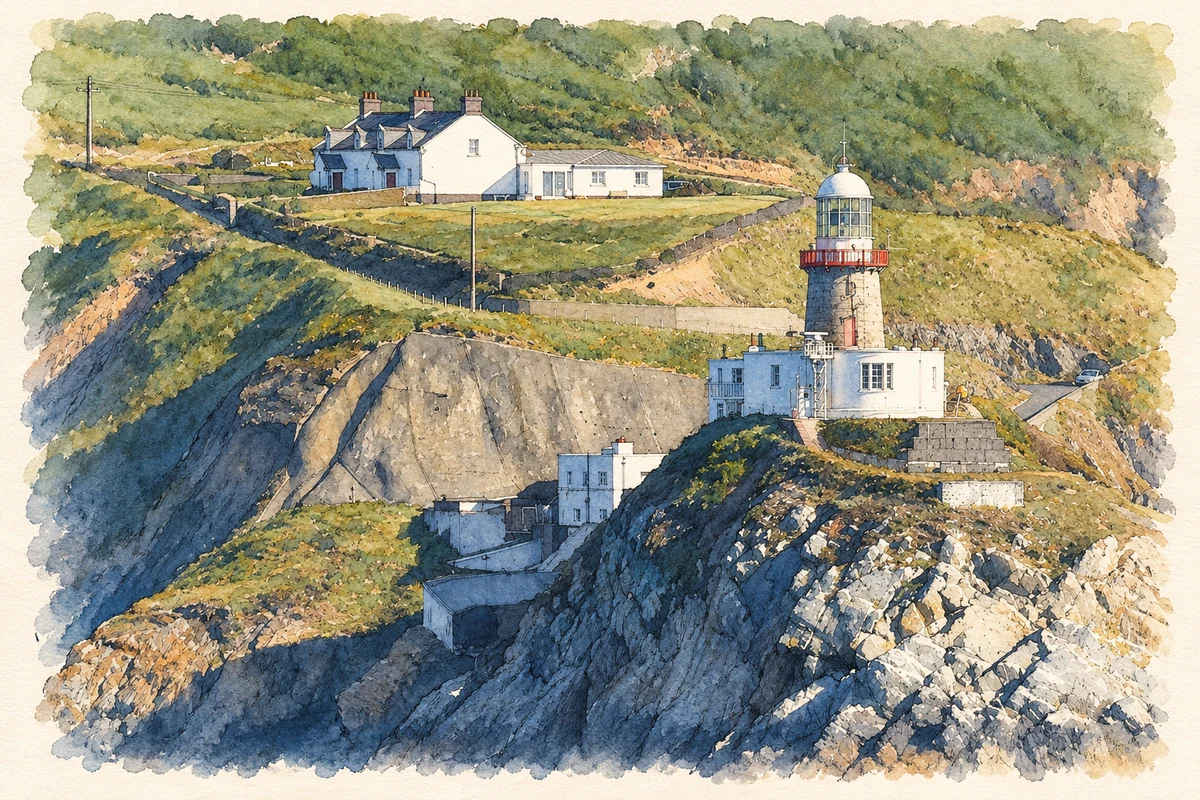
Baily’s headland has carried a warning light for shipping since the seventeenth century. Its lighthouse history includes a move down the cliff, experiments in gas illumination and the final withdrawal of resident keepers from an Irish lighthouse.
The name
These Irish name elements are associated with this record in the Logainm glossary.
An element’s translation is a clue, rather than a complete explanation of the name. Its form and meaning depend on local history and the full Irish name.
Recorded forms
- Dún Criofainn · Irish · main form · validated name
- Baily · English · main form
- Bailey · English · main form · local name
Place & story
A lower light beneath the cloud
The first lighthouse on Howth Head, established around 1667, combined a cottage with a coal-burning beacon. A replacement oil light followed in 1790, but its high position left it vulnerable to mist and cloud. George Halpin designed a new tower and keeper’s dwelling lower down at Little Baily. The light began operating there on 17 March 1814, using twenty-four oil lamps and reflectors. Its granite tower was originally painted white; the stone’s natural colour was exposed in 1910. [2]
Testing gas and fog signals
Baily became a testing ground for lighting technology when John R. Wigham began experiments with gas illumination in 1865. Gas was produced at the station, first from oil, then shale and finally cannel coal. The system’s success encouraged its adoption at nine other lighthouses. Sound signals also evolved: an air trumpet installed in 1871 gave way to a siren in 1879 and a diaphone in 1926. These changes addressed the limits of a visual warning during poor visibility. [2]
The old optic across the bay
The large optic that entered service at Baily on 1 January 1902 survives in the National Maritime Museum in Dún Laoghaire. Removed during modernisation in 1972, it retains its lens, pedestal and weight-driven clockwork mechanism. Irish Lights staff helped move and reassemble it at the museum. Its considerable weight required reinforcement beneath its display position. The exhibit preserves the machinery behind the flashes that once swept across Dublin Bay. [3]
The keepers’ departure
On 24 March 1997, Baily’s permanent keepers departed as the station passed to automatic control. Reporting from the occasion, Lorna Siggins described principal keeper Eugene O’Sullivan lowering the Commissioners’ flag shortly before noon. Former colleagues and lifeboat crews attended the changeover. The event marked the end of permanent lighthouse keeping on the Irish coast, giving this particular headland a place in the wider history of maritime work. [4]
Geographic information
Sources & further reading
- Logainm.ie — Baily. Place names and geographic record, licensed under CC BY 4.0.
- Baily Lighthouse: station history · Commissioners of Irish Lights
- The Baily Optic · National Maritime Museum of Ireland
- No one left to watch over us at lighthouse on our coasts, 25 March 1997 · Lorna Siggins, The Irish Times
- Baily Lighthouse on Howth Head, Dublin illustration: based on a Baily Lighthouse by David Dixon. AI-assisted watercolour and ink adaptation; cream paper margins added, incidental clutter omitted and fine details simplified. Licence: CC BY-SA 2.0.
Name record retrieved 2026-10-25 · Source record modified 2024-06-28. How this page was prepared.