 placenames
Greystones
Na Clocha Liatha
A fishing settlement became a seaside town after the railway arrived in 1855. Greystones' later development involved estate landowners, an adventurous mountaineer and a surprisingly difficult campaign to establish a free library.
The name
These Irish name elements are associated with this record in the Logainm glossary.
An element’s translation is a clue, rather than a complete explanation of the name. Its form and meaning depend on local history and the full Irish name.
Recorded forms
- Na Clocha Liatha · Irish · main form · validated name
- Greystones · English · main form
Place & story
The railway changes the coast
The railway reached Greystones in 1855, bringing a fishing settlement within much easier reach of Dublin. George Wilkinson designed the station, and the tender of Crowe and Sons for constructing the Greystones and Wicklow stations was accepted in April that year. Railway investment continued as the town developed: a new turntable followed in 1914, a creosoting plant in 1918 and electric lighting in 1921. The station's changing equipment records an operating railway as well as the transport connection which helped create the resort. [2] [3]
New streets above the harbour
The La Touche family laid out roads on land extending between Rathdown Upper and the station. Houses developed on Church Road, Trafalgar Road and Bayswater Terrace from the 1860s, giving the expanding town streets oriented around both railway and harbour. Earlier accounts had described a much smaller settlement: in 1830 the visiting minister Dr Urwick remembered about two dozen cottages and a coastguard station. The Victorian streets therefore represent a substantial change in scale, with new homes and visitor accommodation growing beside an older fishing waterfront. [3]
Lizzie Le Blond of Killincarrick
Elizabeth Hawkins-Whitshed grew up at Killincarrick House and inherited it when her father died in 1871. Later known as Lizzie Le Blond, she became a mountaineer, photographer and author. After first visiting Chamonix in 1881, she climbed extensively in the Alps and subsequently in Norway and Lapland. Her continental travels coexisted with a lasting connection to Greystones and its estate development. In 1909 a sale of Killincarrick's contents marked her move to England; the advertised objects included the camera used for her Alpine photographs. [4]
A free library meets resistance
Greystones' Carnegie library opened on 17 June 1912 after years of disagreement. Patrick Kinlen had promoted the project, Mrs Le Blond supplied a site at nominal rent and Carnegie supported the building. In 1908 seventy ratepayers petitioned against it, disputing both its necessity and its maintenance costs. Construction proceeded, but books and staffing lagged behind. Ellen Kirby became the librarian, and Lord Justice Cherry performed the opening ceremony. The building's 1910 date plaque thus records an earlier stage than the day readers were finally admitted. [5]
Geographic information
Sources & further reading
- Logainm.ie — Greystones. Place names and geographic record, licensed under CC BY 4.0.
- Notes on how the railway came to Greystones, continued 3 · Aileen Short, Greystones Archaeological and Historical Society, Journal2,1995
- The History of Greystones · Rathdown Heritage, County Wicklow Heritage
- Elizabeth Hawkins-Whitshed of Killincarrick · County Wicklow Heritage
- The Library That Wasn't Welcome · County Wicklow Heritage
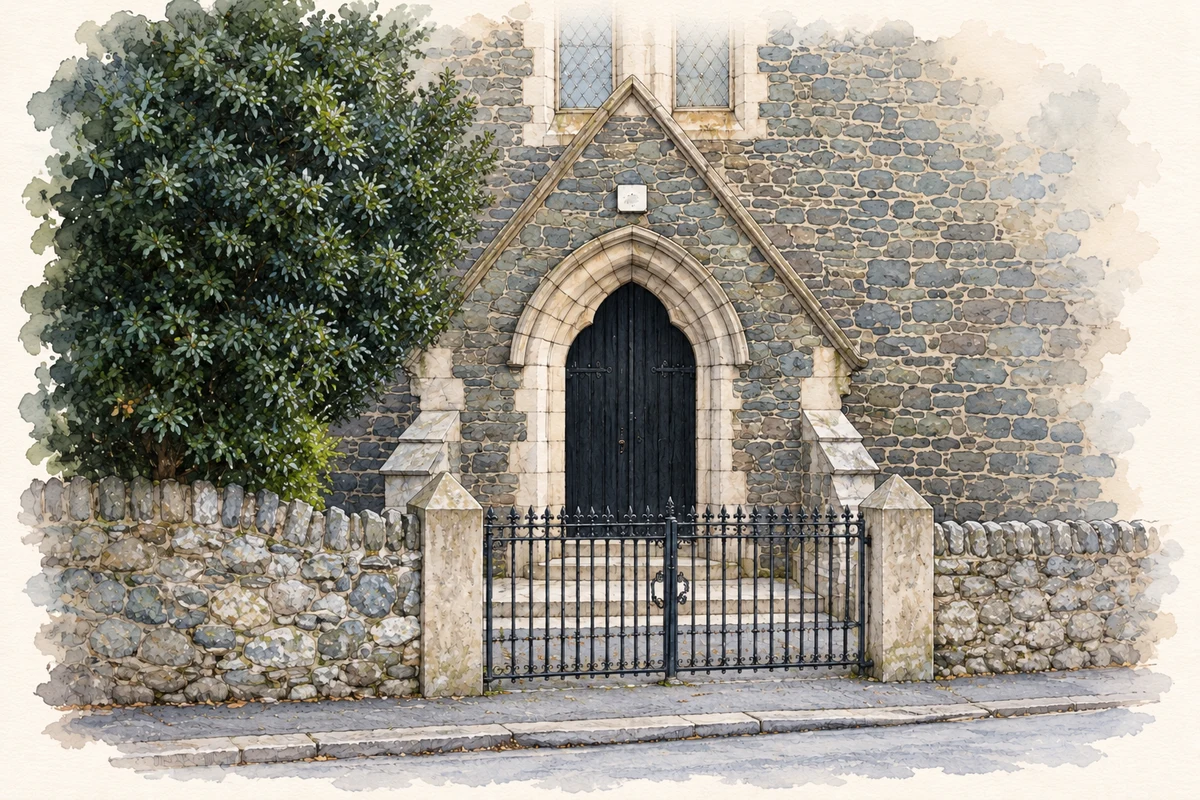
- Entrance and gates of Saint Patrick's Church, Greystones illustration: based on a GreystonesChurch by William Murphy. AI-assisted watercolour and ink adaptation; cream paper margins added, incidental clutter omitted and fine details simplified. Licence: CC BY-SA 2.0.

Name record retrieved 2026-10-25 · Source record modified 2025-01-10. How this page was prepared.