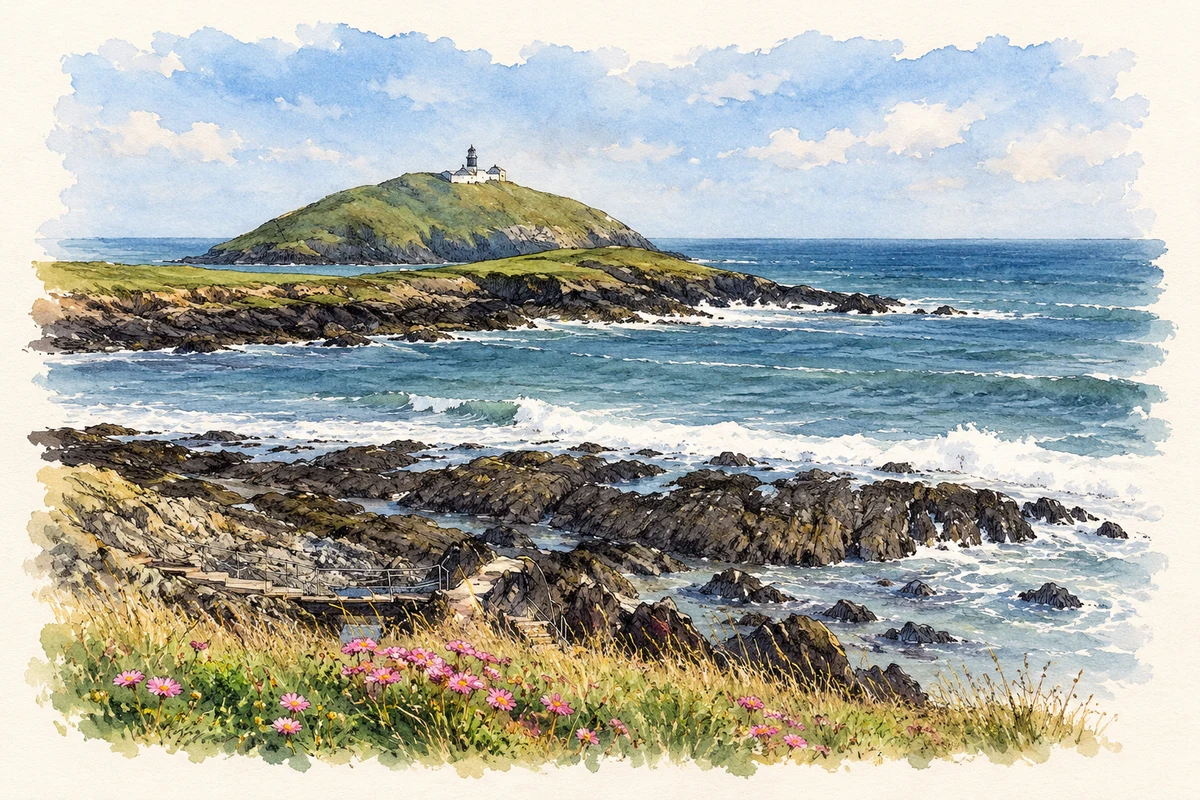
Ballycotton's island lighthouse grew from demands for safer coastal navigation. The village's lifeboat crew later carried out the celebrated rescue of the Daunt Rock lightship's eight men.
Illustration, Ballycotton Island and lighthouse
⊕Recorded locationBallycotton51.82929° N · 8.01279° WInteractive map supplied by OpenStreetMap.
These Irish name elements are associated with this record in the Logainm glossary.
An element’s translation is a clue, rather than a complete explanation of the name. Its form and meaning depend on local history and the full Irish name.
Recorded forms
Baile Choitín· Irish · main form · validated name
Ballycotton· English · main form
Place & story
A shipwreck and the demand for a light
In January 1847 the steamship Sirius struck Smith's Rock south-west of Ballycotton in dense fog and became a wreck after an attempt to bring it into harbour. The loss strengthened demands for improved lights along this part of the coast. Merchants and shipowners had already pressed for safer navigation, and the official inquiry drew attention to the need for new lighthouses. Ballycotton's light was first exhibited on 1 June 1851, the same day as the light at Mine Head.[2]
Why the lighthouse is black
The lighthouse tower originally retained the colour of its stone, while the compound walls were whitewashed. A black band was added in 1892 to distinguish it from the beacon on Capel Island. In 1902 the whole tower was painted black for the same reason. The tower itself is about fifteen metres high, but its island position raises the light to about fifty-nine metres above high water. The station became automatic in March 1992, ending the keepers' regular presence there.[2]
People & connections
Patrick Sliney and the lightship crew
During the severe February storm of 1936, Coxswain Patrick Sliney and the Mary Stanford's crew went to the aid of the Comet, the lightship stationed at Daunt Rock. It had broken from its moorings with eight men aboard. Attempts to tow it failed when the cable snapped. The lifeboat eventually went alongside the rolling vessel so that the men could be brought across. The last two, too exhausted to jump, were pulled aboard by the rescuers. All eight survived. The service earned Sliney the RNLI Gold Medal and became a defining event in Ballycotton's lifeboat history.[3]
Both counts use the 2016 settlement boundary, allowing like-for-like comparison. CSO supplies the 2022 count on this older boundary for comparison only. The official 2022 Built Up Area has different boundaries.
View population figures
Ballycotton — Census 2016 settlement footprint — census population
These are the historical areas published in the 2006 census report. Boundaries may differ between censuses and from modern settlements. Legal towns, environs and suburbs are shown separately; none has been combined into a modern settlement total.
View population figures
Ballycotton, Cork — Census town, CSO 2006 report — census population
These are the historical areas published in the 1996 census report. Boundaries may differ between censuses and from modern settlements. Legal towns, environs and suburbs are shown separately; none has been combined into a modern settlement total.
View population figures
Ballycotton, Cork — Census town, CSO 1996 report — census population
Figures cover the historical town area printed in the 1986 report. Boundaries may have changed between censuses. Legal town, environs and suburb totals remain separate and differ from modern settlement boundaries.
View population figures
Ballycotton, Cork — Census town, CSO 1986 report — census population
These figures use different area definitions. Read the boundary note before comparing them.
Ballycotton, Cork
Published census settlement populations
497people · 2016
Settlement boundaries changed during this period. Differences may reflect boundary changes as well as population change. Where a 2011 legal-town-and-environs count is shown, it has not been recalculated onto the 2016 settlement boundary.
Ballycotton Island lighthouse seen from rocky coast illustration: based on a View from Ballycotton by Robert Ashby. AI-assisted watercolour and ink adaptation; cream paper margins added, incidental clutter omitted and fine details simplified. Licence: CC BY-SA 2.0.
 placenames