These Irish name elements are associated with this record in the Logainm glossary.
An element’s translation is a clue, rather than a complete explanation of the name. Its form and meaning depend on local history and the full Irish name.
Recorded forms
Baile na Leasán· Irish · main form · validated name
Ballylesson· English · main form
Place & story
A new home for Drumbo parish
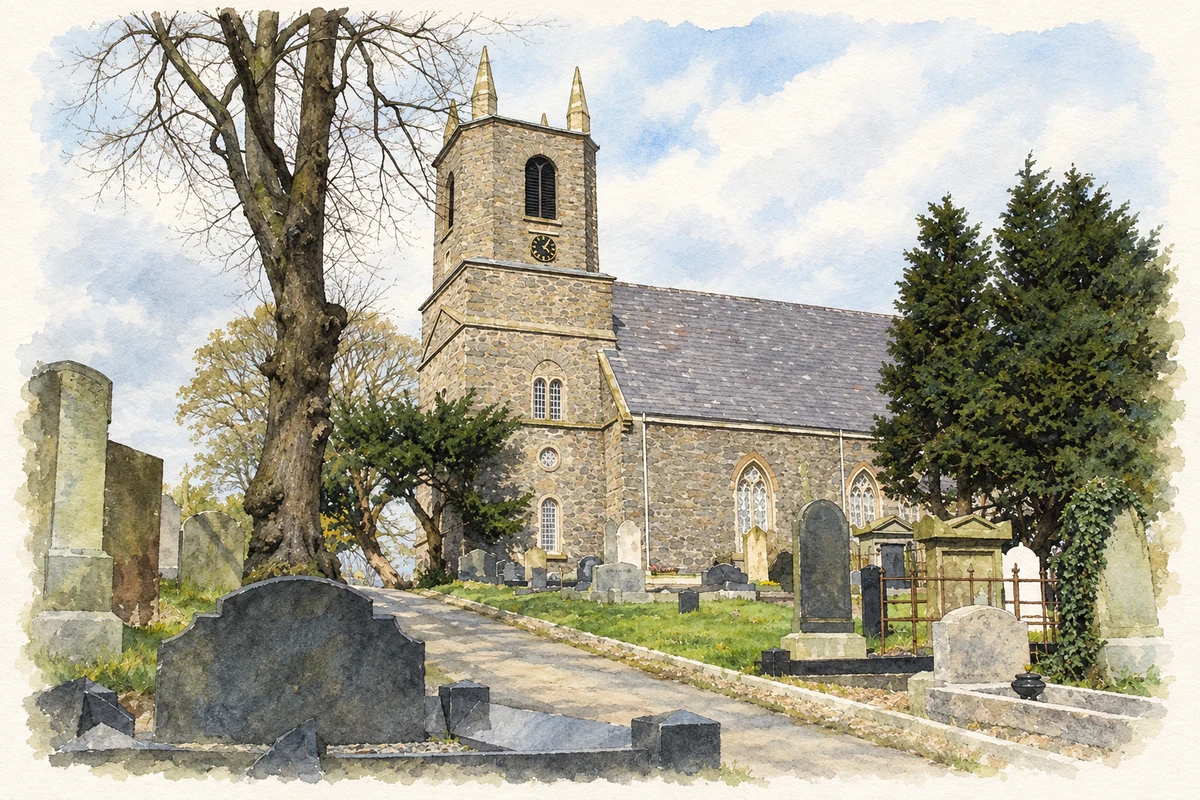
Holy Trinity Church was built at Ballylesson between 1789 and 1791, on a site chosen at the instigation of Wills Hill, first Marquess of Downshire. James Beers gave the land to Drumbo’s parishioners, and Charles Lilly designed the building. The church’s own account records Horatio Maunsell as the first rector after full parochial status was granted in 1834. This explains why a church standing in Ballylesson is also known through the older parish name of Drumbo.[2]
Enlargement and Victorian craftsmanship
The church acquired a chancel and southern transept in 1862–63 to designs by Welland and Gillespie, reopening on Good Friday 1863; the northern transept followed in 1864. Further work by William James Watson in 1873–74 brought a new roof, larger nave windows and new pews, with Thomas McKeown carrying out the contract. The Irish Architectural Archive also records two southern-transept windows by Ward and Hughes depicting David and Jonathan. These separately documented commissions show how several designers and craftspeople shaped the church over the nineteenth century.[3]
From school to parish hall
The former school on Ballylesson Road, north of the church, carries a stone dated 1840 identifying it as Drumbo Parochial School. Its original teaching space and master’s accommodation were enlarged with a higher schoolroom by W. J. Watson in 1889. The historic buildings survey records that it remained a primary school until 1950, when it became a parish hall. A new hall in 1991 released the older buildings for conversion to a residence. Decorated timberwork around the schoolroom’s gable and porch preserves an architectural reminder of those earlier public uses.[4]
Both censuses use the same 2015 settlement boundary. These exact counts cover usual residents in the settlement, rather than local government districts or historic counties. Other NISRA tables may use approximate counts.
View population figures
BALLYLESSON — Settlement 2015 (N11000416) — census population
Holy Trinity Church, Ballylesson illustration: based on a Holy Trinity Drumbo, Ballylesson (1) by Rossographer. AI-assisted watercolour and ink adaptation; cream paper margins added, incidental clutter omitted and fine details simplified. Licence: CC BY-SA 2.0.
 placenames