Ballinasloe’s markets and institutions grew around the Suck crossing, while Ada English’s long hospital career added a distinctive medical and political history.
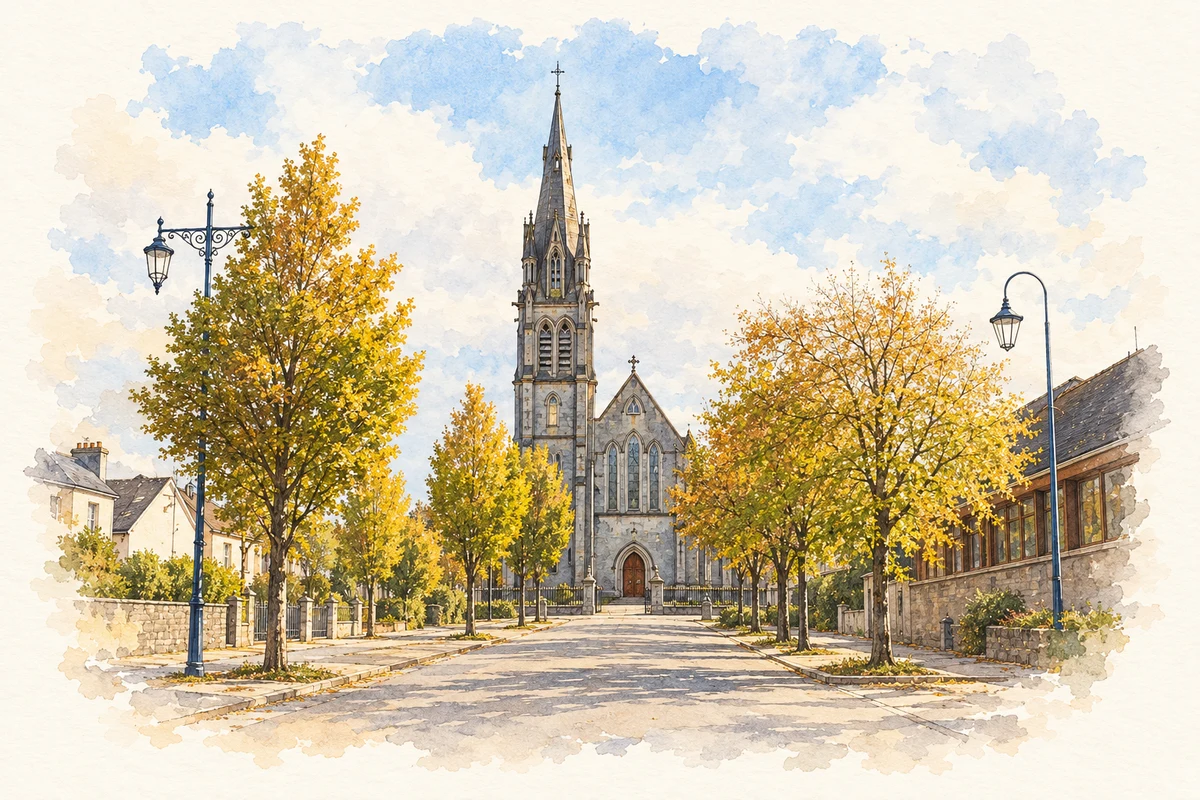
Illustration, Saint Michael's Church from Saint Michael's Square, Ballinasloe
⊕Recorded locationBallinasloe53.33136° N · 8.21999° WInteractive map supplied by OpenStreetMap.
These Irish name elements are associated with this record in the Logainm glossary.
An element’s translation is a clue, rather than a complete explanation of the name. Its form and meaning depend on local history and the full Irish name.
Recorded forms
Béal Átha na Sluaighe· Irish · main form · validated name
Ballinasloe· English · main form
Place & story
A town across the Suck
Lewis’s 1837 account places Ballinasloe partly in Galway and partly in Roscommon, joined by bridges and causeways across the Suck and its islands. Much of the town had expanded recently: he records 265 houses built during the preceding decade. The Earl of Clancarty supported schools, while livestock and wool fairs brought traders into the town. The castle remains stood on the Roscommon bank.[2]
The asylum opened in 1833
The Connacht asylum opened at Ballinasloe in 1833. Lewis describes a limestone building on an X-shaped plan with a cupola and enclosed grounds. Its original capacity of 150 people gives a measure of its beginnings, before the institution grew substantially. The hospital became a major presence in the town’s employment and daily life.[2]
People & connections
Ada English and her patients
Ada English, born in Caherciveen and raised in Mullingar, joined the Ballinasloe institution after qualifying in medicine in 1903. She became a lecturer in mental diseases at University College Galway in 1914. Her work included introducing occupational therapy and supporting activities for patients. She remained committed to Ballinasloe when offered a senior post elsewhere.[3]
English also joined Sinn Féin and Cumann na mBan and represented the National University of Ireland in the second Dáil. After a brief parliamentary career she concentrated on hospital work, eventually becoming resident medical superintendent. She died in Ballinasloe in 1944 and, at her request, was buried beside former patients in Creagh cemetery. Her local connection rests on decades of professional service as well as national politics.[3]
Both counts use the 2016 settlement boundary, allowing like-for-like comparison. CSO supplies the 2022 count on this older boundary for comparison only. The official 2022 Built Up Area has different boundaries.
View population figures
Ballinasloe — Census 2016 settlement footprint — census population
These are the historical areas published in the 2006 census report. Boundaries may differ between censuses and from modern settlements. Legal towns, environs and suburbs are shown separately; none has been combined into a modern settlement total.
View population figures
Ballinasloe Legal Town, Galway — Legal town, CSO 2006 report — census population
Ballinasloe Environs, Galway and Roscommon — Town environs only, CSO 2006 report
2002–2006: town environs only
254people · 2006
These are the historical areas published in the 2006 census report. Boundaries may differ between censuses and from modern settlements. Legal towns, environs and suburbs are shown separately; none has been combined into a modern settlement total.
View population figures
Ballinasloe Environs, Galway and Roscommon — Town environs only, CSO 2006 report — census population
These are the historical areas published in the 1996 census report. Boundaries may differ between censuses and from modern settlements. Legal towns, environs and suburbs are shown separately; none has been combined into a modern settlement total.
View population figures
Ballinasloe Legal Town, Galway — Legal town, CSO 1996 report — census population
Ballinasloe Environs, Galway and Roscommon — Town environs only, CSO 1996 report
1991–1996: town environs only
89people · 1996
These are the historical areas published in the 1996 census report. Boundaries may differ between censuses and from modern settlements. Legal towns, environs and suburbs are shown separately; none has been combined into a modern settlement total.
View population figures
Ballinasloe Environs, Galway and Roscommon — Town environs only, CSO 1996 report — census population
Figures cover the historical town area printed in the 1986 report. Boundaries may have changed between censuses. Legal town, environs and suburb totals remain separate and differ from modern settlement boundaries.
View population figures
Ballinasloe, Galway — Legal town, CSO 1986 report — census population
These figures use different area definitions. Read the boundary note before comparing them.
Ballinasloe, Galway — 2011 legal town and environs; 2016 census settlement
Published census settlement populations
6,662people · 2016
Settlement boundaries changed during this period. Differences may reflect boundary changes as well as population change. Where a 2011 legal-town-and-environs count is shown, it has not been recalculated onto the 2016 settlement boundary.
View population figures
Ballinasloe, Galway — 2011 legal town and environs; 2016 census settlement — census population
 placenames