 placenames
Ballinamuck
Béal Átha na Muc
The defeat of Humbert’s French and Irish forces in 1798 left Ballinamuck with a history that successive generations have commemorated in stone, performance and film.
The name
These Irish name elements are associated with this record in the Logainm glossary.
An element’s translation is a clue, rather than a complete explanation of the name. Its form and meaning depend on local history and the full Irish name.
Recorded forms
- Béal Átha na Muc · Irish · main form · validated name
- Ballinamuck · English · main form
Place & story
The battle of 8 September 1798
General Humbert reached Ballinamuck after marching east from the French landing in Mayo and the victory at Castlebar. He hoped to reach further United Irish forces near Granard, but British troops pursued him after an overnight halt at Cloone. At Ballinamuck his stretched-out column regrouped, was outflanked and surrendered. The French survivors became prisoners, while their Irish allies suffered extensive killing. Ballinamuck was the last major land engagement of the rebellion, though resistance elsewhere did not immediately cease. [2]
A barracks becomes a place of remembrance
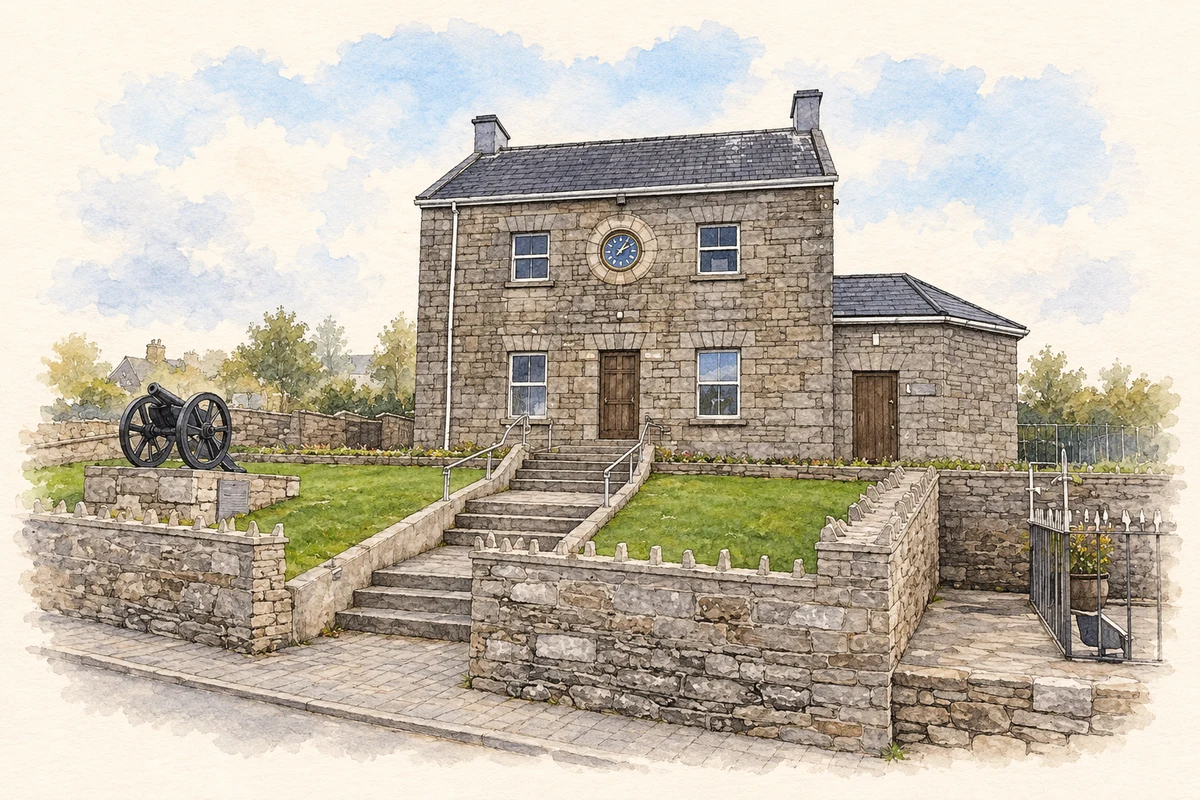
The former Royal Irish Constabulary barracks became the ’98 Memorial Hall in 1948. Its later role as the visitor centre gave the building another purpose: explaining the battle through accounts by local witnesses and officers on both sides. President Mary McAleese officially opened the centre in July 1999. The building therefore carries layers of police, community and commemorative history. [2] [3]
Acting out the bicentenary
RTÉ’s report of 6 September 1998 records a large bicentenary reenactment involving members of Longford’s 17th Infantry Battalion and historical groups from around Ireland. About 350 participants played French troops, British forces and pikemen, watched by thousands. Organisers stressed peace as well as commemoration, and the village’s new remembrance garden formed part of that approach to the anniversary. [4]
The story on film
The 225th Commemoration Committee later worked with Longford filmmakers Harp Media on a documentary about the battle and its aftermath. Narrated by Seamus O’Rourke, it brought historians’ interviews together with recreations involving local people. The project extended a long-established practice of retelling Ballinamuck’s history through community participation. [5]
Geographic information
Sources & further reading
- Logainm.ie — Ballinamuck. Place names and geographic record, licensed under CC BY 4.0.
- The Battle of Ballinamuck: history and commemoration · Ballinamuck Community Enterprise Group
- Ballinamuck Visitor Centre · Fáilte Ireland
- History Acted Out 1998: report broadcast6 September1998 · RTÉ Archives / Eileen Magnier
- Ballinamuck: The Documentary · Ballinamuck Community Enterprise Group
- Ballinamuck Memorial Hall illustration: based on a Memorial Hall, Ballinamuck by Oliver Dixon. AI-assisted watercolour and ink adaptation; cream paper margins added, incidental clutter omitted and fine details simplified. Licence: CC BY-SA 2.0.
Name record retrieved 2026-10-25 · Source record modified 2025-01-10. How this page was prepared.