These Irish name elements are associated with this record in the Logainm glossary.
An element’s translation is a clue, rather than a complete explanation of the name. Its form and meaning depend on local history and the full Irish name.
Recorded forms
Teach an Scotaigh· Irish · main form · validated name
Scotshouse· English · main form
Place & story
Hilton Park’s transformation
Hilton Park, just outside Scotshouse, acquired much of its present appearance through nineteenth-century remodelling. The architectural inventory records extensive changes around 1872–75: the exterior was refaced, a portico added and earth excavated around the basement to expose another full storey. The regional partnership’s heritage account associates William Hague’s work with owner John Madden. The result was a substantially transformed house, rather than an entirely new Victorian building.[2][4]
People & connections
Butler’s church and King’s glass
The Church of the Immaculate Conception was built in 1924–25 to designs by Rudolf Maximilian Butler. Its rounded door and window openings give it a Romanesque character, with rough limestone walls contrasting with smoother dressings. Inside, round-headed arcades divide the nave from the aisles. The architectural survey identifies a stained-glass window by Richard King of Harry Clarke Stained Glass Limited, showing Saint Anne and Saint Joachim beside the Virgin Mary. The glass is therefore associated with King and the studio, rather than attributed to Harry Clarke personally.[3]
Folklore & tradition
How Lisabuck Lake appeared
The Ballybay–Clones Erne East Partnership records a legend attached to nearby Lisabuck. Finn McCumhaill, angry at the fort, supposedly hurled a great stone into neighbouring Corconnolly. Water filled the hollow left behind, creating Lisabuck Lake. The tale gives a familiar giant a role in shaping the local landscape; it is presented as place lore, rather than a geological account of the lake’s formation.[4]
Residents shape a shared space
A more recent chapter began with consultation about land beside the community centre, bought by Monaghan County Council for a community park. Residents helped design the amenity during discussions in 2016–17. A public meeting in January 2018 and a subsequent needs survey broadened that process into a community plan, with local groups contributing their priorities. The council’s account documents residents taking part in planning the village’s shared facilities.[5]
Both counts use the 2016 settlement boundary, allowing like-for-like comparison. CSO supplies the 2022 count on this older boundary for comparison only. The official 2022 Built Up Area has different boundaries.
View population figures
Scotshouse — Census 2016 settlement footprint — census population
These figures use different area definitions. Read the boundary note before comparing them.
Scotshouse, Monaghan
Published census settlement populations
220people · 2016
Settlement boundaries changed during this period. Differences may reflect boundary changes as well as population change. Where a 2011 legal-town-and-environs count is shown, it has not been recalculated onto the 2016 settlement boundary.
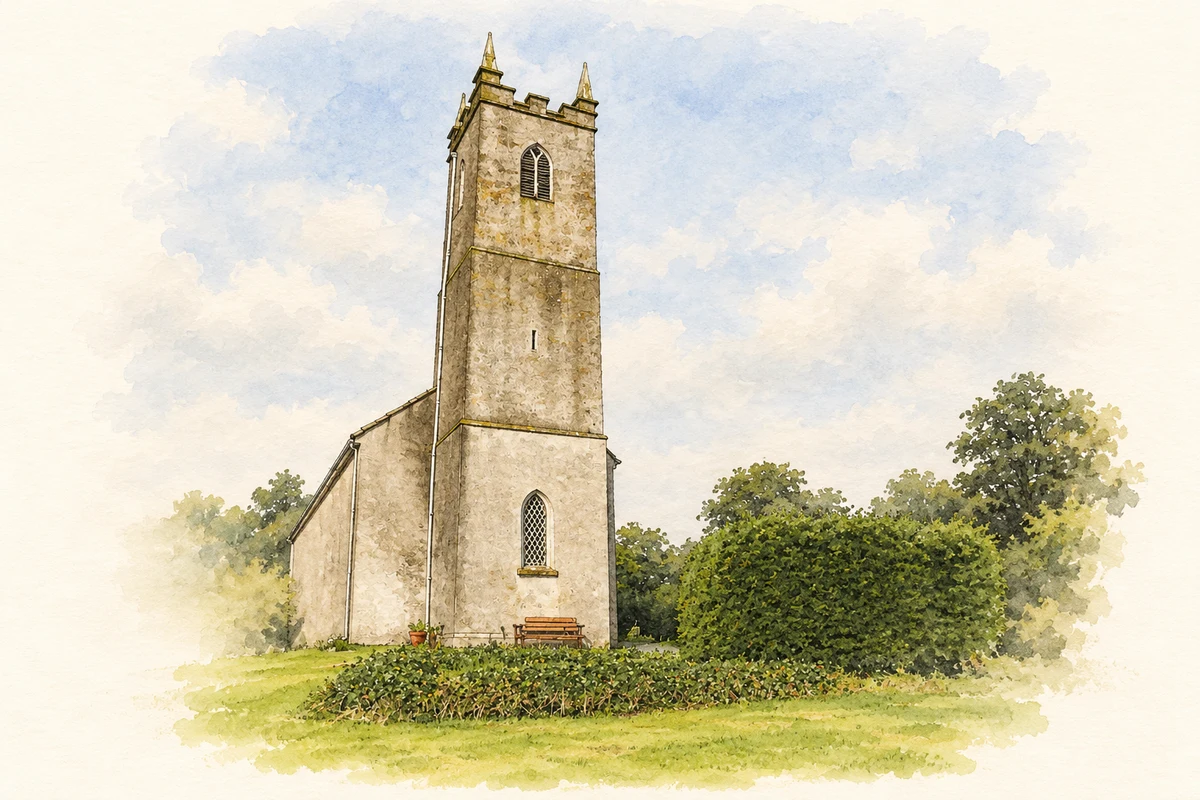
Saint Andrew's Church tower, Scotshouse illustration: based on a St Andrew's Church of Ireland, Scotshouse by Kenneth Allen. AI-assisted watercolour and ink adaptation; cream paper margins added, incidental clutter omitted and fine details simplified. Licence: CC BY-SA 2.0.
 placenames