 placenames
Eglish
An Eaglais
Eglish’s churchyard preserves carved stones and a raised enclosure that point to a history extending far beyond the present church.
The name
These Irish name elements are associated with this record in the Logainm glossary.
An element’s translation is a clue, rather than a complete explanation of the name. Its form and meaning depend on local history and the full Irish name.
Recorded forms
- An Eaglais · Irish · main form · validated name
- Eglish · English · main form
Place & story
The raised churchyard at Roan
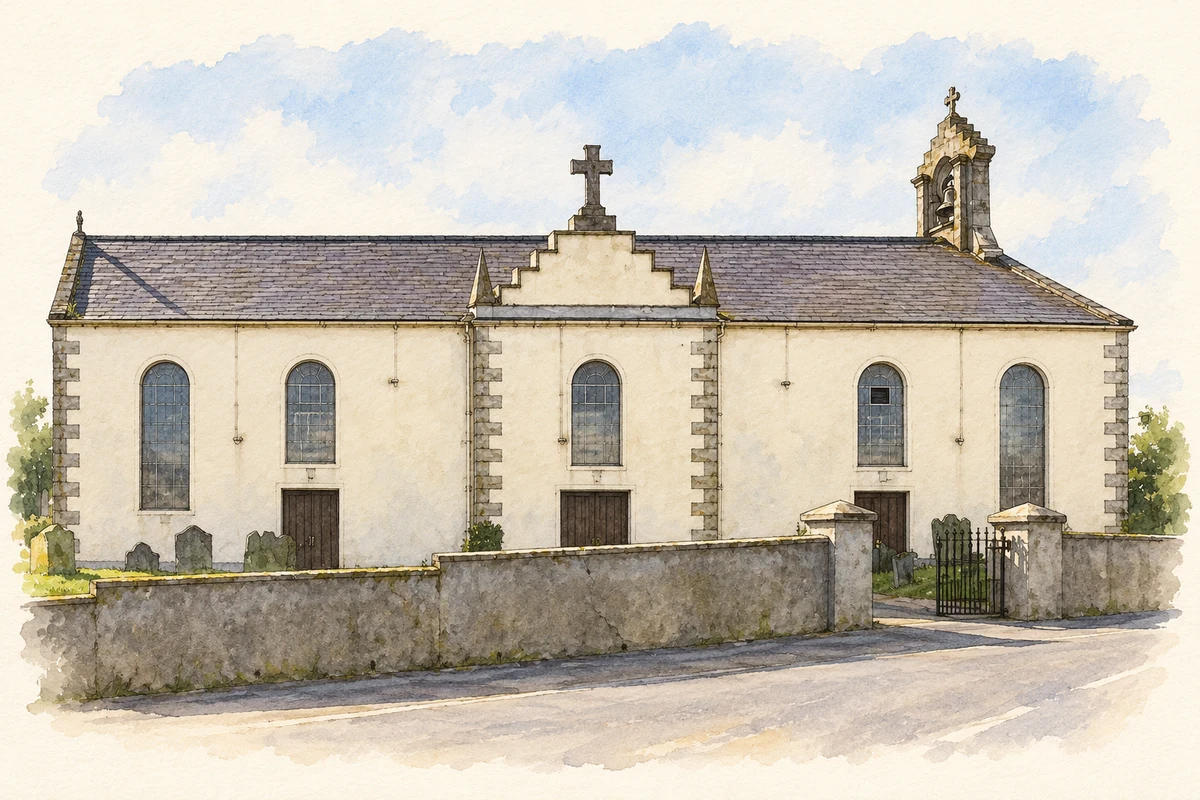
St Patrick’s Church, built in 1834, occupies an elevated position within Eglish village, overlooking the Oona Water. Its oval churchyard is enclosed by a retaining wall that reaches about four metres in places. An archaeological assessment notes that long use for burial helped create the height of the mound. [2]
Evidence for earlier worship
An early Christian cross-base was discovered in the car park west of the church during the 1980s. The archaeological report also records a medieval window jamb, a probable font and a possible capital in the graveyard. Together these finds suggest an earlier ecclesiastical site and a medieval stone church, although the precise sequence of churches remains uncertain. [2]
Geographic information
- Place type
- Population centre
- County
- Tyrone
- Barony
- Dungannon Middle
- Civil parish
- Clonfeacle
- Coordinates
- 54.44644, -6.79749 (approximate)
- Logainm ID
- 135063 ↗
Sources & further reading
- Logainm.ie — Eglish. Place names and geographic record, licensed under CC BY 4.0.
- Eglish, Roan: Centre for Archaeological Fieldwork Development Control Report 301 · Centre for Archaeological Fieldwork, Queen’s University Belfast
- Saint Patrick’s Church, Eglish, as photographed in 2006 illustration: based on a Eglish RC Church by Kenneth Allen. AI-assisted watercolour and ink adaptation; cream paper margins added, incidental clutter omitted and fine details simplified. Licence: CC BY-SA 2.0.
Name record retrieved 2026-10-25 · Source record modified 2010-04-19. How this page was prepared.