A reliable full-name meaning has not been established here. The recorded Irish and English forms are given without an unsupported translation.
Recorded forms
Gaillimh· Irish · main form
Galway· English · main form
Place & story
A ring with names inside
A worn gold ring in Galway City Museum carries Richard Joyce’s maker’s mark, RI, and two further sets of initials that suggest a marriage. Dating from about 1700, it joins two hands around a crowned heart. The object gives a tangible starting point for the Claddagh ring’s history: a particular craftsman and particular owners, whose full identities have not survived with it. Joyce is recorded in Shop Street in the 1724 Hearth Money roll, while marks on his silverware place his working career between 1691 and at least 1737.[2]
Folklore & tradition
The goldsmith’s return
James Hardiman’s History of Galway, published in 1820, records a remarkable story about Joyce. Captured by an Algerian corsair while sailing towards the West Indies, he was sold to a goldsmith in Algiers and learned his master’s trade. After fourteen years, the release of British captives following William III’s intervention gave him a way home. In Hardiman’s account, Joyce declined an offer of marriage to the goldsmith’s daughter and a share of his property, returned to Galway, married and established a successful business. This is the traditional biography attached to the city’s famous goldsmith.[3]
People & connections
Margaret Joyce and the Dominican women
Another Joyce object opens a different Galway story. A silver reliquary dated 18 June 1723 names Sister Margaret of the Rosary Joyce as the person who procured its contents for the Dominican convent. Its maker’s marks are Richard Joyce’s. The community had begun in New Tower Street in 1644, fled during the Cromwellian occupation, and was re-established in 1686 by Mary Lynch and Julian Nolan after their return from Spain. Their new home was the Slate Nunnery in Kirwan’s Lane; the sisters moved to Taylors Hill in 1845. The surviving silverwork links named women, religious exile and the city’s skilled trades.[4]
Galway city and suburbs — Census 2016 settlement footprint
Population within 2016 settlement boundaries
85,856people · 2022
Both counts use the 2016 settlement boundary, allowing like-for-like comparison. CSO supplies the 2022 count on this older boundary for comparison only. The official 2022 Built Up Area has different boundaries.
View population figures
Galway city and suburbs — Census 2016 settlement footprint — census population
Galway City, Galway — City administrative area, CSO 2006 report
2002–2006: city administrative area
72,414people · 2006
These are the historical areas published in the 2006 census report. Boundaries may differ between censuses and from modern settlements. Legal towns, environs and suburbs are shown separately; none has been combined into a modern settlement total.
View population figures
Galway City, Galway — City administrative area, CSO 2006 report — census population
Galway Suburbs, Galway — City suburbs only, CSO 2006 report
2002–2006: city suburbs only
315people · 2006
These are the historical areas published in the 2006 census report. Boundaries may differ between censuses and from modern settlements. Legal towns, environs and suburbs are shown separately; none has been combined into a modern settlement total.
View population figures
Galway Suburbs, Galway — City suburbs only, CSO 2006 report — census population
Galway City and Suburbs, Galway — City and suburbs, CSO 2006 report
2002–2006: city and suburbs
72,729people · 2006
These are the historical areas published in the 2006 census report. Boundaries may differ between censuses and from modern settlements. Legal towns, environs and suburbs are shown separately; none has been combined into a modern settlement total.
View population figures
Galway City and Suburbs, Galway — City and suburbs, CSO 2006 report — census population
Galway City, Galway — City administrative area, CSO 1996 report
1991–1996: city administrative area
57,241people · 1996
These are the historical areas published in the 1996 census report. Boundaries may differ between censuses and from modern settlements. Legal towns, environs and suburbs are shown separately; none has been combined into a modern settlement total.
View population figures
Galway City, Galway — City administrative area, CSO 1996 report — census population
Galway, Galway — City administrative area, CSO 1986 report
1981–1986: city administrative area
47,104people · 1986
Figures cover the historical town area printed in the 1986 report. Boundaries may have changed between censuses. Legal town, environs and suburb totals remain separate and differ from modern settlement boundaries.
View population figures
Galway, Galway — City administrative area, CSO 1986 report — census population
These figures use different area definitions. Read the boundary note before comparing them.
Galway City and Suburbs, Galway
Published census settlement populations
79,934people · 2016
Settlement boundaries changed during this period. Differences may reflect boundary changes as well as population change. Where a 2011 legal-town-and-environs count is shown, it has not been recalculated onto the 2016 settlement boundary.
View population figures
Galway City and Suburbs, Galway — census population
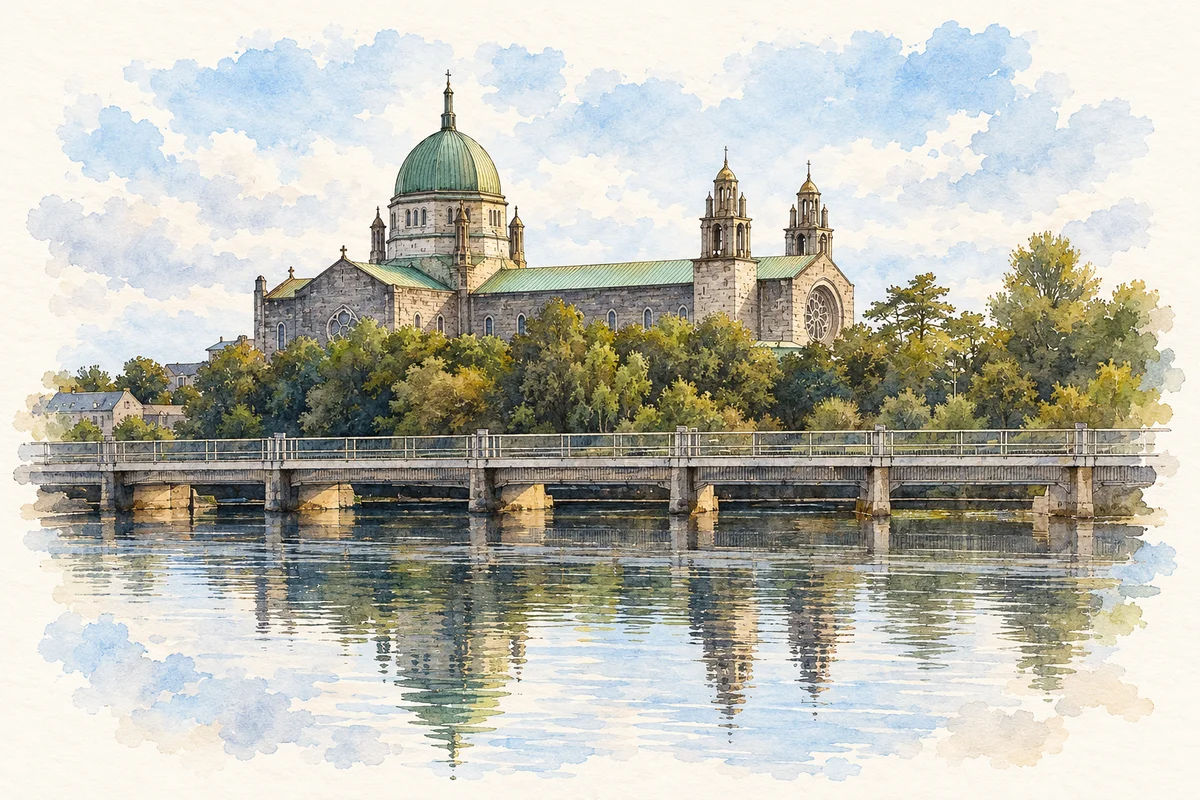
Galway Cathedral illustration: based on a reference photograph by Michael Deligan. AI-assisted watercolour and ink adaptation; clutter removed, cream paper margins added and fine details simplified. Licence: CC BY-SA 4.0.
 placenames