Clonard's name is closely associated with Finnian and the learning of the early Irish Church. Its later history includes a strategically important Boyne crossing and the battle fought here in July 1798.
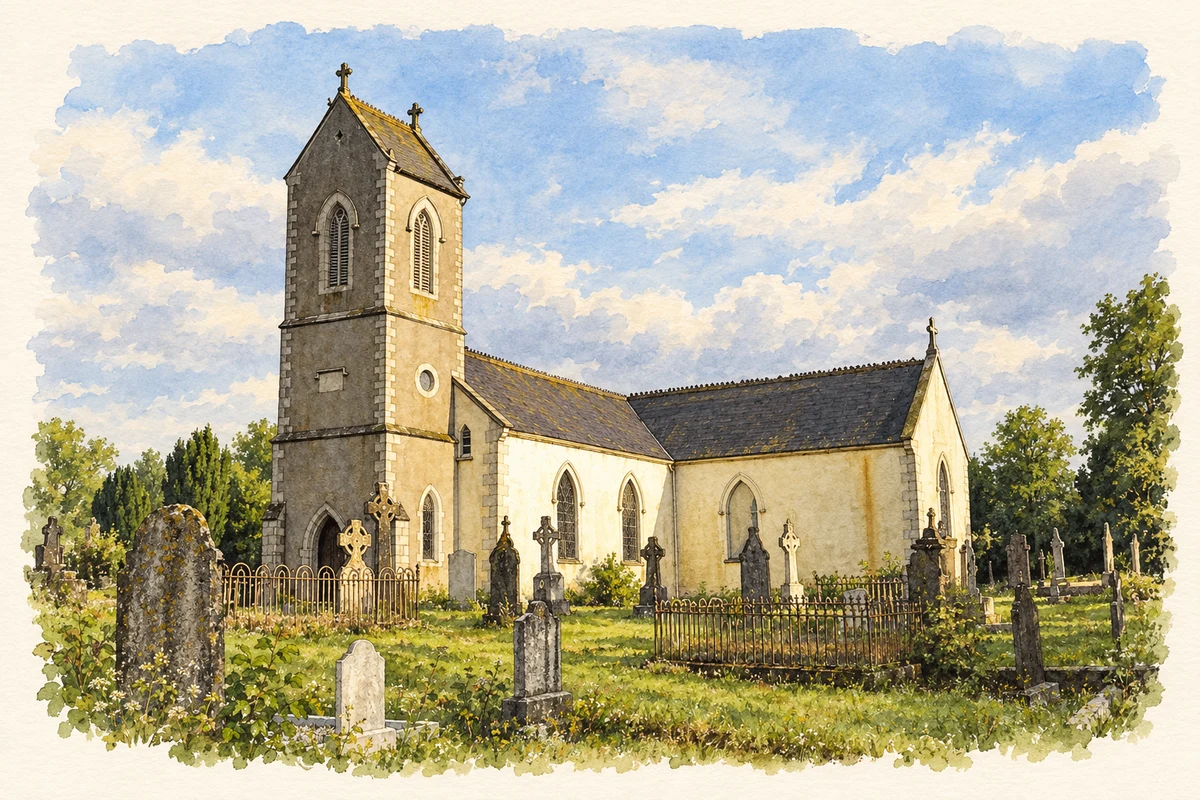
Illustration, St Finian’s Church, Clonard
⊕Recorded locationClonard53.45174° N · 7.02296° WInteractive map supplied by OpenStreetMap.
These Irish name elements are associated with this record in the Logainm glossary.
An element’s translation is a clue, rather than a complete explanation of the name. Its form and meaning depend on local history and the full Irish name.
Recorded forms
Cluain Ioraird· Irish · main form · validated name
Clonard· English · main form
Place & story
Finnian and the monastic school
Finnian is remembered as Clonard's founding saint and the teacher of celebrated early Irish churchmen. The Dictionary of Irish Biography traces his cult through the translation of relics in 776 and the later Irish and Latin Lives that developed his reputation. Its historical assessment places Clonard's rise to prominence in the later seventh century. The saint's reputation and the traditions surrounding his pupils became central to the monastery's identity. They help explain why a small Meath settlement retained such a substantial place in accounts of early Irish learning.[2]
St Finian's Catholic church
The Catholic church was built in the mid-nineteenth century, replacing an earlier building on the site. Its belfry was added in 1870. Stone holy-water fonts beside the original entrances carry the date 1807 and the name of their donor, local landowner R. Herbert. Later additions continued the dedication to the village's saint: stained-glass windows showing events in Finnian's life were installed in 1957, and life-size figures of Finnian and Etchen were carved in Bolzano, Italy. The church therefore preserves objects from several periods of local worship.[3]
The battle of July 1798
During the rebellion, insurgents advancing through the district attacked the Tyrrell family's fortified house at Clonard. Samuel Lewis's later account describes Lieutenant Tyrrell and twenty-seven yeomen resisting until reinforcements arrived from Kinnegad and Mullingar, forcing the attackers to withdraw. The council's heritage trail dates the battle to 11 July 1798 and records the graves of men killed in the fighting. A mass grave was enclosed by a stone wall in 1873, and a Celtic cross and slab were erected for the first centenary.[4][3]
A church preserved on paper
A drawing dated 23 October 1794 records an earlier church at Clonard. Catalogued by the National Library of Ireland as Austin Cooper's work after Thomas Ashworth, it shows a tall, tower-like building with varied windows and a bellcote. Details of a window and a baptismal font appear alongside it. The image preserves evidence of the ecclesiastical landscape before the nineteenth-century church buildings and alterations.[5]
Both counts use the 2016 settlement boundary, allowing like-for-like comparison. CSO supplies the 2022 count on this older boundary for comparison only. The official 2022 Built Up Area has different boundaries.
View population figures
Clonard — Census 2016 settlement footprint — census population
These are the historical areas published in the 2006 census report. Boundaries may differ between censuses and from modern settlements. Legal towns, environs and suburbs are shown separately; none has been combined into a modern settlement total.
View population figures
Clonard, Meath — Census town, CSO 2006 report — census population
These figures use different area definitions. Read the boundary note before comparing them.
Clonard, Meath
Published census settlement populations
347people · 2016
Settlement boundaries changed during this period. Differences may reflect boundary changes as well as population change. Where a 2011 legal-town-and-environs count is shown, it has not been recalculated onto the 2016 settlement boundary.
 placenames