These Irish name elements are associated with this record in the Logainm glossary.
An element’s translation is a clue, rather than a complete explanation of the name. Its form and meaning depend on local history and the full Irish name.
Recorded forms
Cnoc an Tóchair· Irish · main form · validated name
Knocktopher· English · main form
Place & story
The medieval parish church
The surviving tower and north wall belong to the medieval parish church founded by Matthew FitzGriffin in the late twelfth century. Its Romanesque doorway is earlier than the tower, while the north wall retains a fifteenth-century window with much of its stone tracery. The tower's square lower stages rise to a later octagonal top. These changes distinguish a building developed over centuries from a ruin belonging to a single medieval campaign.[2]
Civilian figures carved in stone
Beneath the tower lies a late-fourteenth-century double effigy depicting civilians, rather than the knights or clergy more familiar from medieval monuments. Both figures wear long gowns and pointed shoes, and the woman has a distinctive head covering. A separate chest tomb beneath the north-wall window dates to 1622 and carries symbols of Christ's Passion. Together the monuments preserve different forms of commemoration within the reduced remains of the church.[2]
The Langrishe house beside the friary
Knocktopher Abbey is also the name of the country house built in 1866 for Sir James Langrishe, beside surviving fabric of the Carmelite friary founded in 1356 by James Butler, second Earl of Ormonde. Architect John McCurdy designed the house around a prominent tower, using limestone with granite details. Its steep roof, small gables and varied windows belong to Victorian architectural taste, even where the building's setting and name recall a much older religious foundation.[3]
From parliamentary borough to village
Knocktopher sent representatives to the Irish parliament from 1661 until the Union. By 1837 Samuel Lewis described a village of about eighty houses, with its former municipal privileges gone and its market and fairs discontinued. He nevertheless recorded a post service, police station and several schools. His account captures the difference between Knocktopher's earlier political standing and the everyday institutions that continued after it ceased to be a parliamentary borough.[4]
Both counts use the 2016 settlement boundary, allowing like-for-like comparison. CSO supplies the 2022 count on this older boundary for comparison only. The official 2022 Built Up Area has different boundaries.
View population figures
Knocktopher — Census 2016 settlement footprint — census population
These figures use different area definitions. Read the boundary note before comparing them.
Knocktopher, Kilkenny
Published census settlement populations
166people · 2016
Settlement boundaries changed during this period. Differences may reflect boundary changes as well as population change. Where a 2011 legal-town-and-environs count is shown, it has not been recalculated onto the 2016 settlement boundary.
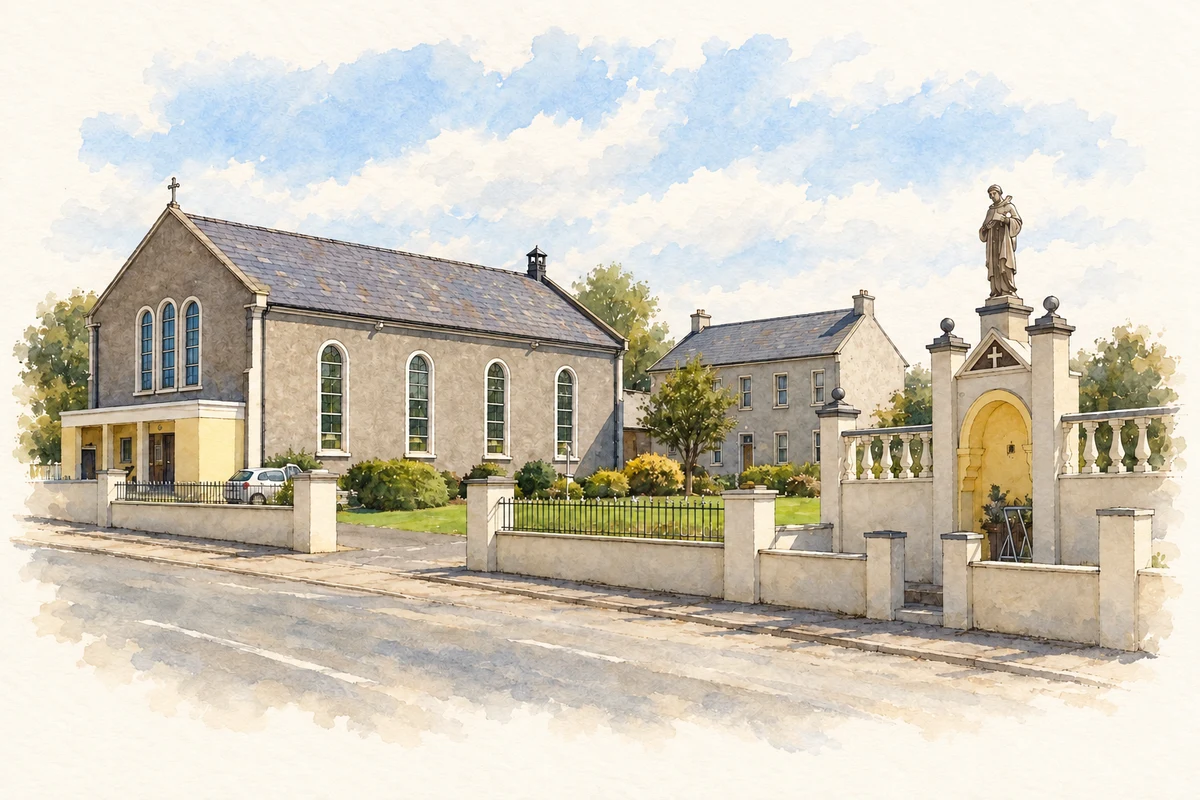
Saint Mary's Carmelite Church and Saint Albert gateway, Knocktopher illustration: based on a Knocktopher Church and statue of St Albert, Co.Kilkenny by Humphrey Bolton. AI-assisted watercolour and ink adaptation; cream paper margins added, incidental clutter omitted and fine details simplified. Licence: CC BY-SA 2.0.
 placenames