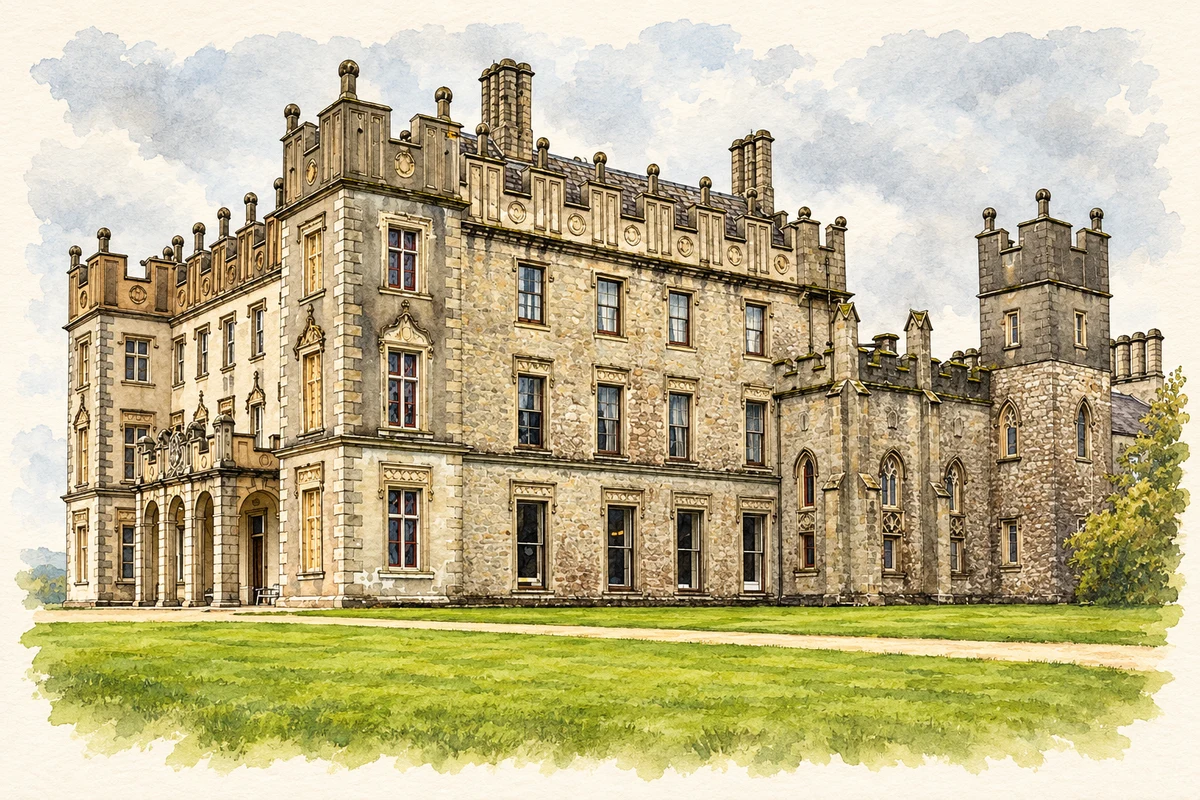
Borris's monumental viaduct and estate gateway frame a history that includes Arthur Kavanagh's political career and the work of generations of lacemakers.
Illustration, Borris House, Borris
⊕Recorded locationBorris52.60237° N · 6.92597° WInteractive map supplied by OpenStreetMap.
A reliable full-name meaning has not been established here. The recorded Irish and English forms are given without an unsupported translation.
Recorded forms
An Bhuiríos· Irish · main form · validated name
Borris· English · main form
Place & story
A Gothic entrance to the estate
The gateway to Borris House on Main Street dates from about 1813 and was designed by Richard Morrison. A broad arch, battlements, flanking turrets and buttressed walls create the appearance of a miniature fortification. The walls also screen a gate lodge, combining a practical estate entrance with a conspicuous architectural statement at the edge of the town.[2]
Sixteen arches for the railway
The former railway viaduct at Borris carries sixteen limestone arches across the landscape. Built around 1860 to a design by William Le Fanu, it demonstrates the scale of the engineering needed to bring the railway through this part of Carlow. Its repeated arches remain a distinctive landmark after the railway itself ceased operation.[3]
People & connections
Arthur Kavanagh of Borris House
Arthur Macmorrough Kavanagh was born at Borris House in 1831 with severely shortened arms and legs. He learned to write, ride and sail, later managing the estate and entering parliament. Elected for Wexford in 1866 and Carlow in 1868, he supported improvements to shipping and railways and subsidised the local railway connection. His politics remained unionist, and he lost his seat in 1880 amid changing attitudes to landownership. His career joins personal adaptation with the contested position of a substantial landlord in nineteenth-century Irish public life.[4]
Lacemaking as local employment
Lady Harriet Kavanagh established lacemaking at Borris in the nineteenth century to provide income for local women. Her daughter-in-law Frances later managed and developed the industry. Borris lace uses tape to define a flowing pattern, with decorative needlework filling the spaces between it. Household textiles and clothing found customers in Britain, continental Europe and America. After a long decline, renewed interest grew from workshops held in 2016 and the formation of Borris Lacemakers. Their work continues a craft whose history includes both skilled domestic labour and changing international fashions.[5]
Both counts use the 2016 settlement boundary, allowing like-for-like comparison. CSO supplies the 2022 count on this older boundary for comparison only. The official 2022 Built Up Area has different boundaries.
View population figures
Borris — Census 2016 settlement footprint — census population
These are the historical areas published in the 2006 census report. Boundaries may differ between censuses and from modern settlements. Legal towns, environs and suburbs are shown separately; none has been combined into a modern settlement total.
View population figures
Borris, Carlow — Census town, CSO 2006 report — census population
These are the historical areas published in the 1996 census report. Boundaries may differ between censuses and from modern settlements. Legal towns, environs and suburbs are shown separately; none has been combined into a modern settlement total.
View population figures
Borris, Carlow — Census town, CSO 1996 report — census population
Figures cover the historical town area printed in the 1986 report. Boundaries may have changed between censuses. Legal town, environs and suburb totals remain separate and differ from modern settlement boundaries.
View population figures
Borris, Carlow — Census town, CSO 1986 report — census population
These figures use different area definitions. Read the boundary note before comparing them.
Borris, Carlow
Published census settlement populations
652people · 2016
Settlement boundaries changed during this period. Differences may reflect boundary changes as well as population change. Where a 2011 legal-town-and-environs count is shown, it has not been recalculated onto the 2016 settlement boundary.
 placenames