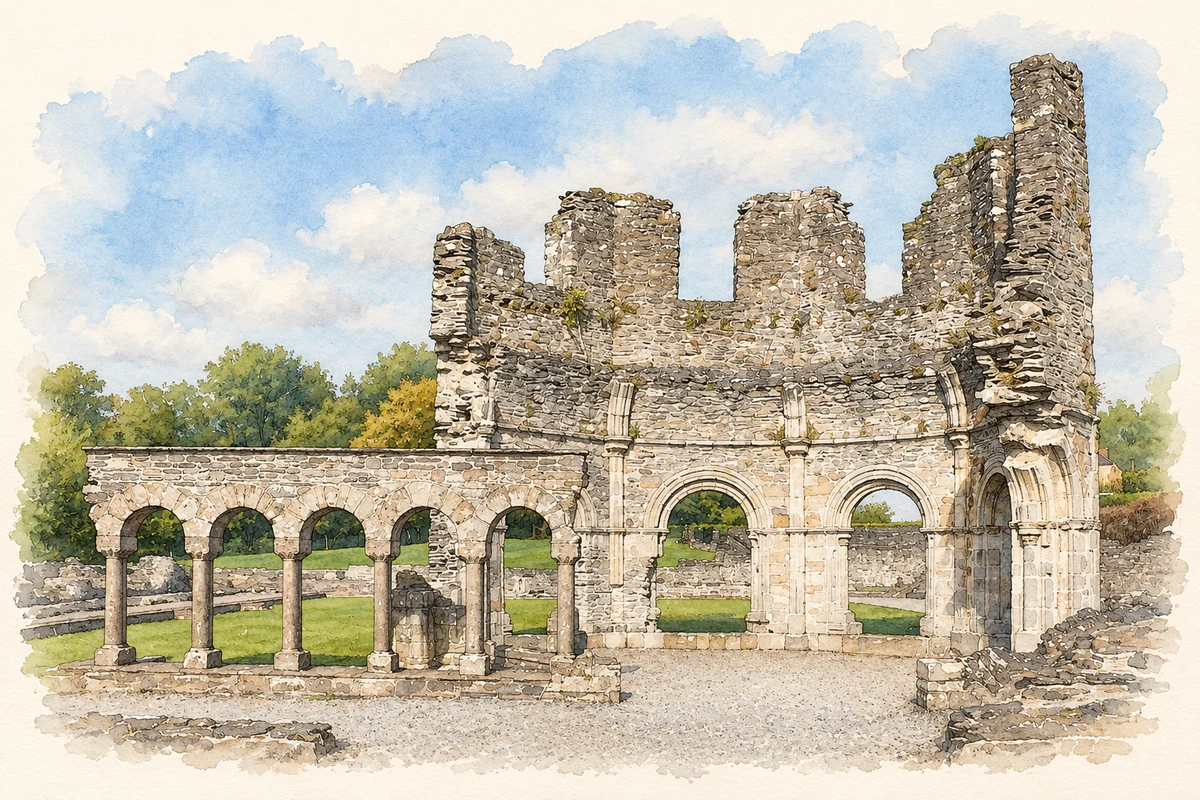
Tullyallen stands within the historic landscape of Mellifont, with a layered parish church site and a direct connection to the founder of the Dundalk Democrat.
Illustration, Old Mellifont Abbey lavabo, near Tullyallen
⊕Recorded locationTullyallen53.73861° N · 6.41908° WInteractive map supplied by OpenStreetMap.
These Irish name elements are associated with this record in the Logainm glossary.
An element’s translation is a clue, rather than a complete explanation of the name. Its form and meaning depend on local history and the full Irish name.
Recorded forms
Tulaigh Álainn· Irish · main form · validated name
Tullyallen· English · main form
Place & story
Old Mellifont in the surrounding countryside
Old Mellifont Abbey, near Tullyallen, was founded in 1142 by Malachy of Armagh with monks sent from Clairvaux. The Office of Public Works identifies it as Ireland's first Cistercian monastery. The surviving octagonal lavabo was a washing place within the monastic complex, giving a glimpse of daily routines as well as architectural ambition. Mellifont later passed into private hands. Its association with the settlement ending the Nine Years War in 1603 belongs to that later history, not to an uninterrupted monastic occupation.[2]
A church built beside older remains
Our Lady of the Assumption church dates from 1898 and was designed by W. H. Byrne. Its stonework, rounded arches and decorated windows draw on Romanesque forms. The graveyard also contains the remains of a medieval chapel, including fifteenth-century tracery, so the site holds several periods of local worship. The present tower's upper stage and spire were added in 2001. Their appearance should not be used to date the whole building, just as the medieval remains do not make the nineteenth-century church itself medieval.[3]
People & connections
Joseph Cartan and the local press
Joseph Cartan was born into a Tullyallen farming family in 1811. After working in journalism and operating businesses in Dundalk, he established the Dundalk Democrat and People's Journal in 1849. The newspaper supported nationalism and tenant-right causes, and his combative editorials brought legal trouble as well as influence. Cartan retired from journalism in 1872 and later lived in Drogheda, supporting local charities and the Catholic church. When he died in 1891, he was buried at Tullyallen, returning his story to the community where it began.[4]
Both counts use the 2016 settlement boundary, allowing like-for-like comparison. CSO supplies the 2022 count on this older boundary for comparison only. The official 2022 Built Up Area has different boundaries.
View population figures
Tullyallen — Census 2016 settlement footprint — census population
These are the historical areas published in the 2006 census report. Boundaries may differ between censuses and from modern settlements. Legal towns, environs and suburbs are shown separately; none has been combined into a modern settlement total.
View population figures
Tullyallen, Louth — Census town, CSO 2006 report — census population
These are the historical areas published in the 1996 census report. Boundaries may differ between censuses and from modern settlements. Legal towns, environs and suburbs are shown separately; none has been combined into a modern settlement total.
View population figures
Tullyallen, Louth — Census town, CSO 1996 report — census population
Figures cover the historical town area printed in the 1986 report. Boundaries may have changed between censuses. Legal town, environs and suburb totals remain separate and differ from modern settlement boundaries.
View population figures
Tullyallen, Louth — Census town, CSO 1986 report — census population
These figures use different area definitions. Read the boundary note before comparing them.
Tullyallen, Louth
Published census settlement populations
1,547people · 2016
Settlement boundaries changed during this period. Differences may reflect boundary changes as well as population change. Where a 2011 legal-town-and-environs count is shown, it has not been recalculated onto the 2016 settlement boundary.
Cartan, Joseph · Frances Clarke, Dictionary of Irish Biography
Old Mellifont Abbey lavabo, near Tullyallen, County Louth illustration: based on a Mellifont Abbey Lavabo and Cloister Arcades 2013 09 27 by Andreas F. Borchert. AI-assisted watercolour and ink adaptation; cream paper margins added, incidental clutter omitted and fine details simplified. Licence: CC BY-SA 4.0.
 placenames