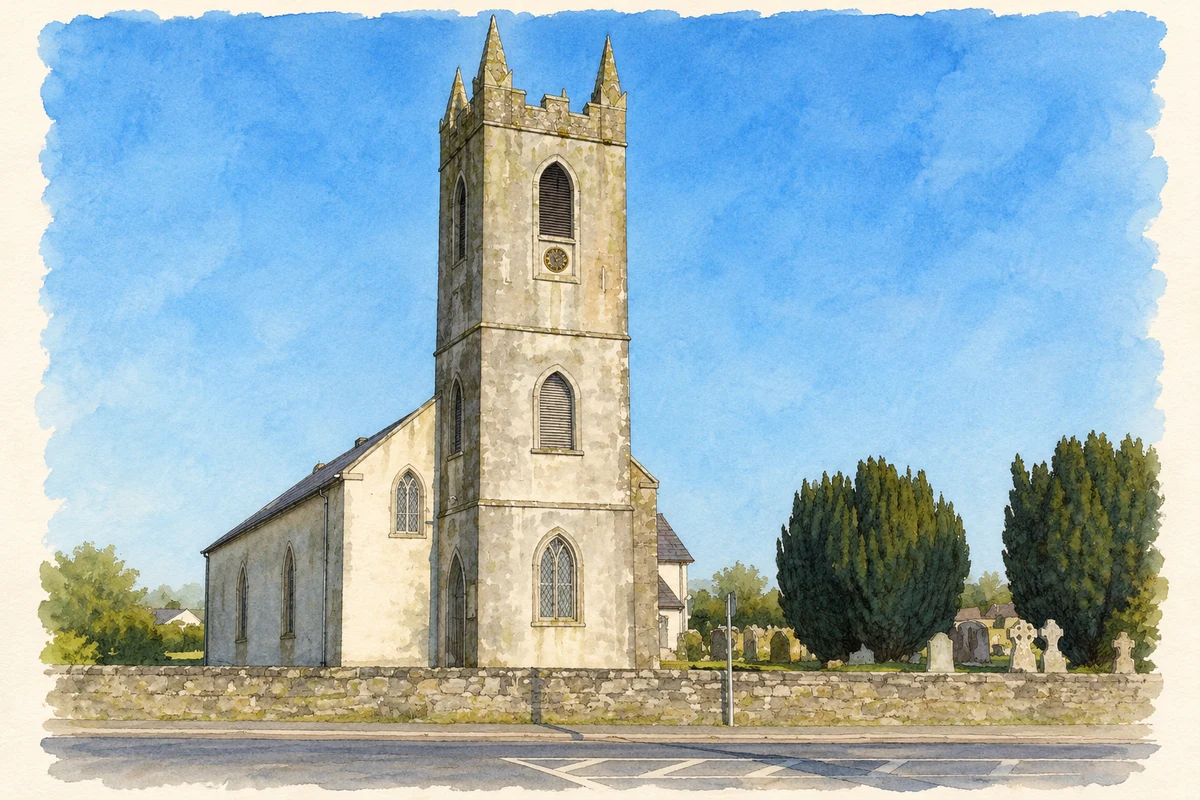
Fennagh's terraces preserve a distinctive nineteenth-century estate village, while its church and a modern wolf sculpture tell different parts of its local history.
Illustration, All Saints Church, Fennagh
⊕Recorded locationFennagh52.71398° N · 6.84760° WInteractive map supplied by OpenStreetMap.
A reliable full-name meaning has not been established here. The recorded Irish and English forms are given without an unsupported translation.
Recorded forms
Fionnmhach· Irish · main form · validated name
Fennagh· English · main form
Fenagh· English · main form · local name
Place & story
A landscape recorded before the Famine
Samuel Lewis described Fennagh in 1837 as a village with views towards Mount Leinster, surrounded by planted grounds and country houses. His wider parish account records granite quarries and predominantly cultivated farmland, alongside mountain and bog. Its population of 4,324 belonged to the parish, which extended into County Wicklow, rather than to the village alone. The distinction matters when reading this early description: Lewis was recording a large rural district as well as the settlement on the road between Bagnalstown and Newtownbarry.[2]
The estate cottages
Fennagh's granite terraces give its village streets a recognisable character. The National Inventory of Architectural Heritage attributes the six cottages numbered 16–21 to W. Butler and dates them to about 1862. Window hood mouldings articulate their low, three-bay fronts. Another Butler terrace, numbered 7–15 and dated 1862, uses a taller central house and projecting angled fronts at its centre and ends to vary the roofline and street frontage. Later alterations to windows and individual houses are part of the surviving ensemble.[3][4]
All Saints and its changing fabric
All Saints' Church has a tower with stone dressings and pinnacles, and a sundial dated 1810. The heritage inventory places its origins around 1790, with major changes about 1865: the roof and window openings were altered and a chancel added. Interior work around 1952 retained a collection of memorials. The building therefore records successive generations of parish use, rather than a single unchanged architectural scheme.[5]
Remembering the wolf
Emma Jane Rushworth's sculpture The Last Wolf stands at the entrance to Jenny's Lane, Rathercan, beside Ballydarton House. Carlow Tourism connects it with the local Watson family's remembered association with the killing of an Irish wolf on Mount Leinster. The sculpture gives this story a modern public form; the claim that the animal was Ireland's final wolf is best treated as a local commemorative tradition, rather than a securely established national last occurrence.[6]
Both counts use the 2016 settlement boundary, allowing like-for-like comparison. CSO supplies the 2022 count on this older boundary for comparison only. The official 2022 Built Up Area has different boundaries.
View population figures
Fennagh — Census 2016 settlement footprint — census population
These figures use different area definitions. Read the boundary note before comparing them.
Fennagh, Carlow
Published census settlement populations
402people · 2016
Settlement boundaries changed during this period. Differences may reflect boundary changes as well as population change. Where a 2011 legal-town-and-environs count is shown, it has not been recalculated onto the 2016 settlement boundary.
 placenames