Delvin's castle and churches preserve several periods of local building, while Brinsley McNamara's first novel brought the town into an enduring literary controversy.
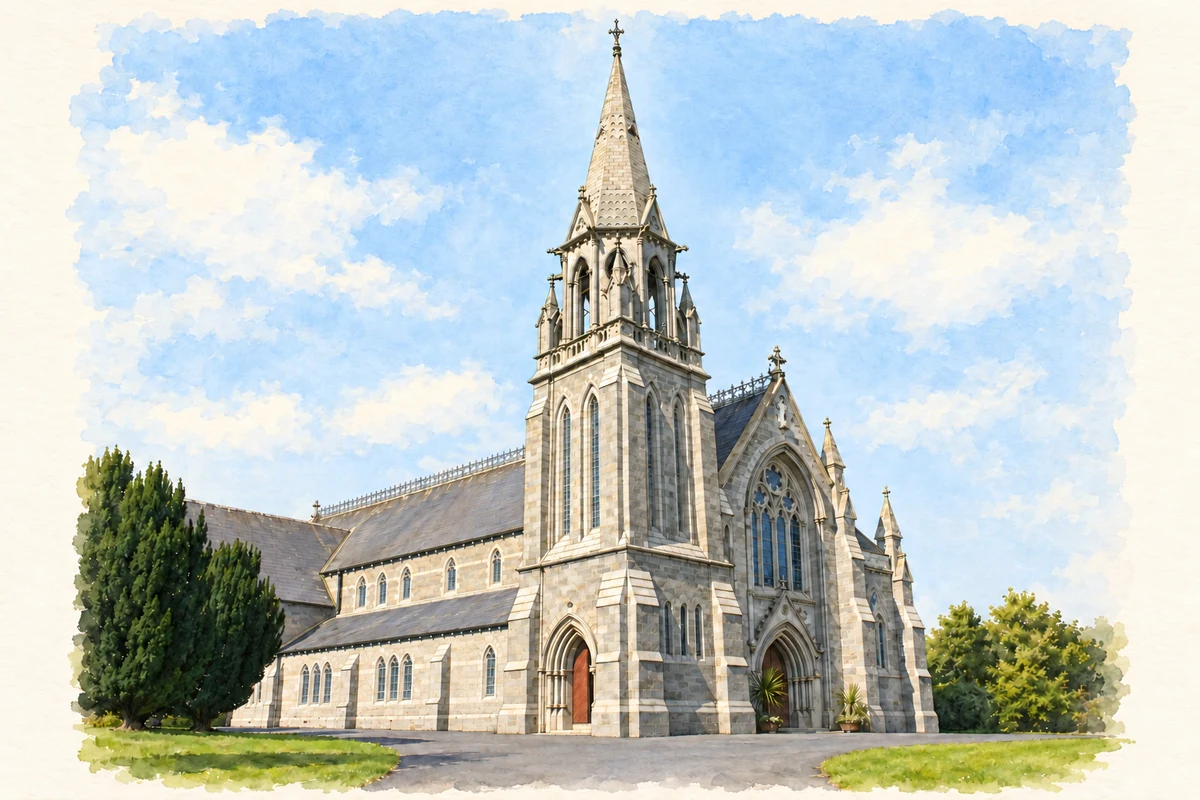
Illustration, Church of the Assumption, Delvin
⊕Recorded locationDelvin53.61322° N · 7.08772° WInteractive map supplied by OpenStreetMap.
A reliable full-name meaning has not been established here. The recorded Irish and English forms are given without an unsupported translation.
Recorded forms
Dealbhna· Irish · main form · validated name
Delvin· English · main form
Place & story
The castle's towers and prison cells
The surviving stone castle at Delvin dates from the fifteenth century and was built by the Nugent family. It originally had a rectangular central block with a round tower at each corner. Two towers remain at their original five-storey height. Within the lower part, a vaulted space was divided into four cells when the castle served as a gaol. These alterations add a later penal use to a building first designed as a fortified residence, showing how an older stronghold could be adapted to new purposes.[2]
People & connections
The Valley of the Squinting Windows
John Weldon, who wrote as Brinsley McNamara, attended his father's school at Delvin and later joined the Abbey Theatre as an actor. He returned to Delvin to write and completed his first novel in 1916. Published as The Valley of the Squinting Windows, it provoked anger among people who believed its unflattering fictional community represented their own town. Weldon's father, James, was suspected of authorship, and both he and his school were boycotted. The controversy became inseparable from the novel's reputation and gives Delvin a particular place in the history of Irish fiction and its local reception.[3]
Three periods in Saint Mary's
The ruined Saint Mary's Church combines a fortified medieval belfry of about 1550 with a hall rebuilt around 1810 and a transept added around 1860. The later work was designed by Joseph Welland. Differences in the limestone masonry help distinguish these phases, while pointed windows, carved surrounds and the tower's stone stair preserve details of their construction. Its graveyard and street boundary complete the setting. The building records several centuries of adaptation on one religious site, with the older tower retained as the church changed around it.[4]
Both counts use the 2016 settlement boundary, allowing like-for-like comparison. CSO supplies the 2022 count on this older boundary for comparison only. The official 2022 Built Up Area has different boundaries.
View population figures
Delvin — Census 2016 settlement footprint — census population
These are the historical areas published in the 2006 census report. Boundaries may differ between censuses and from modern settlements. Legal towns, environs and suburbs are shown separately; none has been combined into a modern settlement total.
View population figures
Delvin, Westmeath — Census town, CSO 2006 report — census population
These are the historical areas published in the 1996 census report. Boundaries may differ between censuses and from modern settlements. Legal towns, environs and suburbs are shown separately; none has been combined into a modern settlement total.
View population figures
Delvin, Westmeath — Census town, CSO 1996 report — census population
Figures cover the historical town area printed in the 1986 report. Boundaries may have changed between censuses. Legal town, environs and suburb totals remain separate and differ from modern settlement boundaries.
View population figures
Delvin, Westmeath — Census town, CSO 1986 report — census population
These figures use different area definitions. Read the boundary note before comparing them.
Delvin, Westmeath
Published census settlement populations
740people · 2016
Settlement boundaries changed during this period. Differences may reflect boundary changes as well as population change. Where a 2011 legal-town-and-environs count is shown, it has not been recalculated onto the 2016 settlement boundary.
 placenames