These Irish name elements are associated with this record in the Logainm glossary.
An element’s translation is a clue, rather than a complete explanation of the name. Its form and meaning depend on local history and the full Irish name.
Recorded forms
Cill Bheagáin· Irish · main form · validated name
Kilbeggan· English · main form
Place & story
Water, steam and the distillery yard
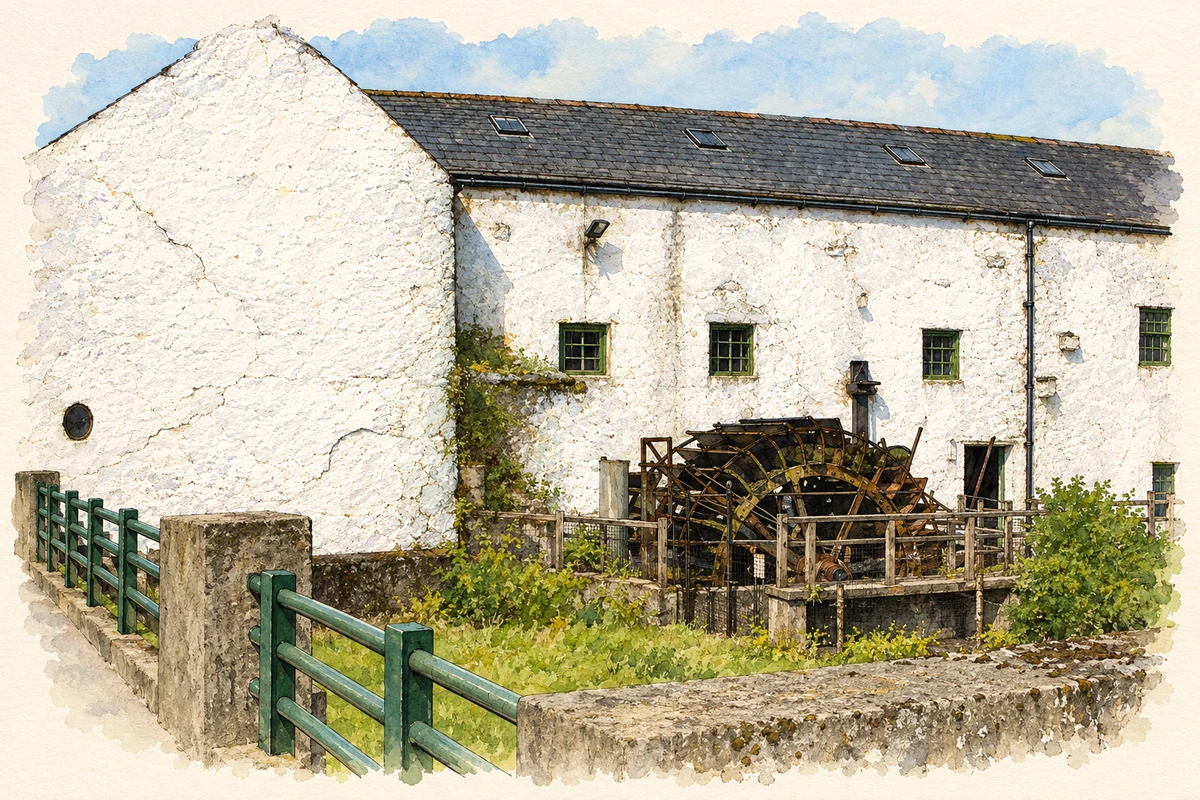
The distillery beside the Brosna contains buildings and equipment accumulated from the eighteenth century into the twentieth. The National Inventory of Architectural Heritage records its courtyard, waterwheel, mill race and surviving machinery made from iron, copper and timber. These features reveal several generations of power and production within one complex. Its founding is associated with 1757, but the visible buildings are not all of that date. The layered site is evidence of repeated expansion and adaptation rather than an unchanged eighteenth-century factory.[2]
People & connections
Mary Anne Locke takes charge
After John Locke died in 1868, his wife Mary Anne Theresa Locke managed the business until around 1880. Born into the Devereux distilling family in Wexford, she oversaw investment, extended production periods and a substantial increase in output. She also helped establish Kilbeggan's Convent of Mercy, providing land and financial support. Her role is recorded in the Dictionary of Irish Biography's account of the Locke family. The distillery's familiar family name therefore represents important female business leadership as well as successive generations of male proprietors.[3]
The workers who helped save the works
An RTÉ report broadcast in May 1983 documented the restoration campaign after the distillery's mid-twentieth-century closure. Former worker Gus Marshall chaired the restoration fund, and local tradespeople offered their skills without charge. The report recorded plans for an industrial museum and the challenge of returning old machinery to working condition. It captures the project while its outcome was still uncertain. The surviving complex owes much to that practical community effort, which treated the town's former workplace as something worth repairing and explaining to later visitors.[4]
Both counts use the 2016 settlement boundary, allowing like-for-like comparison. CSO supplies the 2022 count on this older boundary for comparison only. The official 2022 Built Up Area has different boundaries.
View population figures
Kilbeggan — Census 2016 settlement footprint — census population
Kilbeggan, Westmeath — Census town, CSO 2006 report
2002–2006: census town
822people · 2006
These are the historical areas published in the 2006 census report. Boundaries may differ between censuses and from modern settlements. Legal towns, environs and suburbs are shown separately; none has been combined into a modern settlement total.
View population figures
Kilbeggan, Westmeath — Census town, CSO 2006 report — census population
Kilbeggan, Westmeath — Census town, CSO 1996 report
1991–1996: census town
627people · 1996
These are the historical areas published in the 1996 census report. Boundaries may differ between censuses and from modern settlements. Legal towns, environs and suburbs are shown separately; none has been combined into a modern settlement total.
View population figures
Kilbeggan, Westmeath — Census town, CSO 1996 report — census population
Kilbeggan, Westmeath — Census town, CSO 1986 report
1981–1986: census town
603people · 1986
Figures cover the historical town area printed in the 1986 report. Boundaries may have changed between censuses. Legal town, environs and suburb totals remain separate and differ from modern settlement boundaries.
View population figures
Kilbeggan, Westmeath — Census town, CSO 1986 report — census population
These figures use different area definitions. Read the boundary note before comparing them.
Kilbeggan, Westmeath
Published census settlement populations
1,288people · 2016
Settlement boundaries changed during this period. Differences may reflect boundary changes as well as population change. Where a 2011 legal-town-and-environs count is shown, it has not been recalculated onto the 2016 settlement boundary.
Waterwheel at Kilbeggan Distillery, County Westmeath illustration: based on a Locke's Distillery by Rick Crowley. AI-assisted watercolour and ink adaptation; cream paper margins added, incidental clutter omitted and fine details simplified. Licence: CC BY-SA 2.0.
 placenames