These Irish name elements are associated with this record in the Logainm glossary.
An element’s translation is a clue, rather than a complete explanation of the name. Its form and meaning depend on local history and the full Irish name.
Recorded forms
Cúil Dabhcha· Irish · main form · validated name
Culdaff· English · main form
Place & story
The bridge over the Culdaff River
New Bridge, at the south-western approach to Culdaff, dates to around 1800. Its two principal arches are separated by a broad pier that takes advantage of a natural island in the river. Dressed stones frame the arches, while an additional overflow opening helped water pass during higher flows. The bridge belongs to the period when expanded rural roads created demand for many new crossings. Its survival preserves both a route into the village and the work of its stone masons.[2]
A mill and its adjoining house
South of the village, a former miller's house survives beside the remains of a water-powered mill. The house dates to about 1780; its whitewashed rubble walls and timber windows contrast with the roofless industrial structure alongside. The mill processed corn and later served corn and flax threshing. A surviving metal waterwheel, wheel pit and traces of the watercourses record how the Culdaff River supplied power. This complex reveals a working riverside economy beyond the village's church and street frontage.[3]
People & connections
A golden-wedding memorial
The village's cast-iron pump was presented by Mr and Mrs Young to mark their golden wedding in 1908. Its plaque records the gift, giving a personal occasion a lasting public form. The pump stands beneath a small slated canopy carried on four metal posts, with a stone runoff channel and basin. It combined an everyday water supply with commemoration, making a family anniversary part of the shared equipment of village life.[4]
Saint Buadan’s church
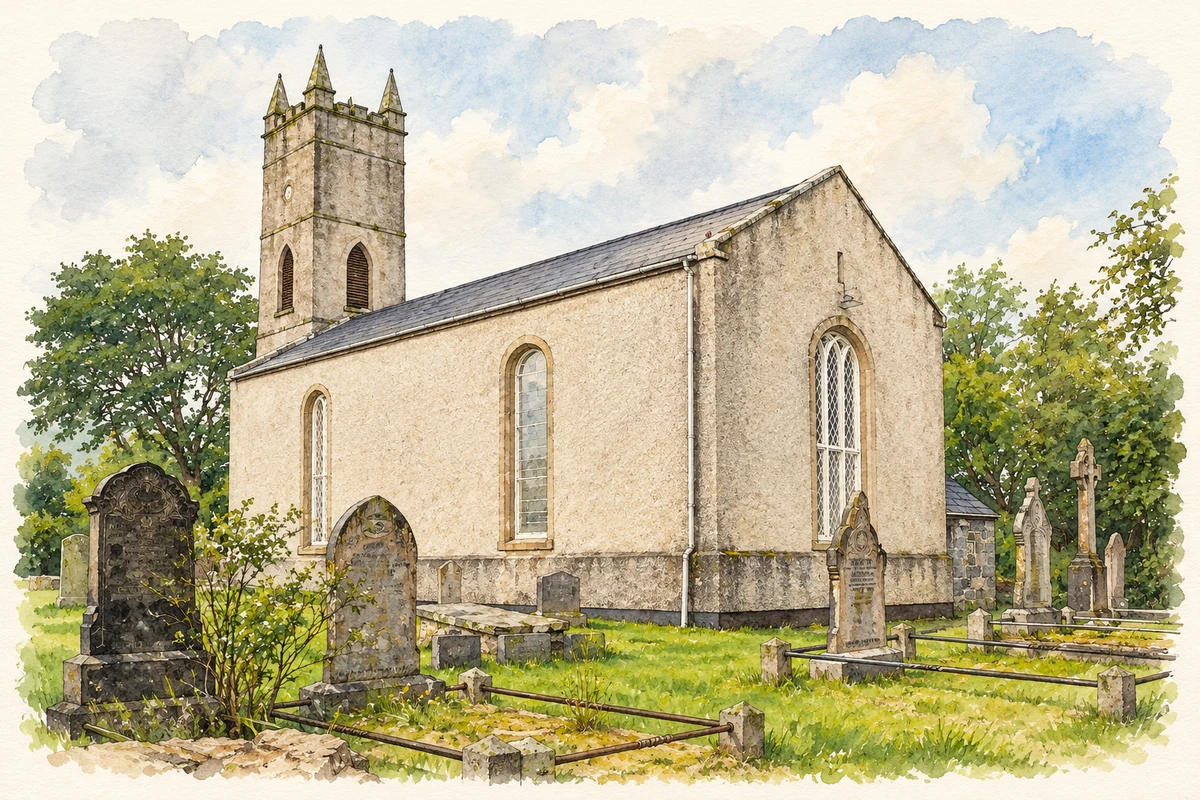
Saint Buadan's Church of Ireland building originated in the mid-eighteenth century and was extended in 1828. Its square tower, pinnacles and slate sundial dated 1820 are distinctive features. The inventory gives alternative original dates, 1739 and 1747, so a single precise foundation year is uncertain. Older gravestones in the churchyard predate the present building, preserving evidence of burial here before the church took its current form.[5]
Both counts use the 2016 settlement boundary, allowing like-for-like comparison. CSO supplies the 2022 count on this older boundary for comparison only. The official 2022 Built Up Area has different boundaries.
View population figures
Culdaff — Census 2016 settlement footprint — census population
These are the historical areas published in the 2006 census report. Boundaries may differ between censuses and from modern settlements. Legal towns, environs and suburbs are shown separately; none has been combined into a modern settlement total.
View population figures
Culdaff, Donegal — Census town, CSO 2006 report — census population
These figures use different area definitions. Read the boundary note before comparing them.
Culdaff, Donegal
Published census settlement populations
237people · 2016
Settlement boundaries changed during this period. Differences may reflect boundary changes as well as population change. Where a 2011 legal-town-and-environs count is shown, it has not been recalculated onto the 2016 settlement boundary.
 placenames