These Irish name elements are associated with this record in the Logainm glossary.
An element’s translation is a clue, rather than a complete explanation of the name. Its form and meaning depend on local history and the full Irish name.
Recorded forms
Dún Fionnachaidh· Irish · main form · validated name
Dunfanaghy· English · main form
Place & story
The market beside the bay
The former market house carries an inscription naming Alexander Robert Stewart of Ards as its builder in 1845. It stands on land reclaimed from Sheephaven Bay, with the pier behind it. Originally, an arcade of broad arches opened along its front; later alterations filled them in. The building brought estate investment into a central public space, providing a focus for the buying and selling of local produce. Its relationship with the square and waterfront remains legible despite changes to the openings.[2]
What survives of the workhouse
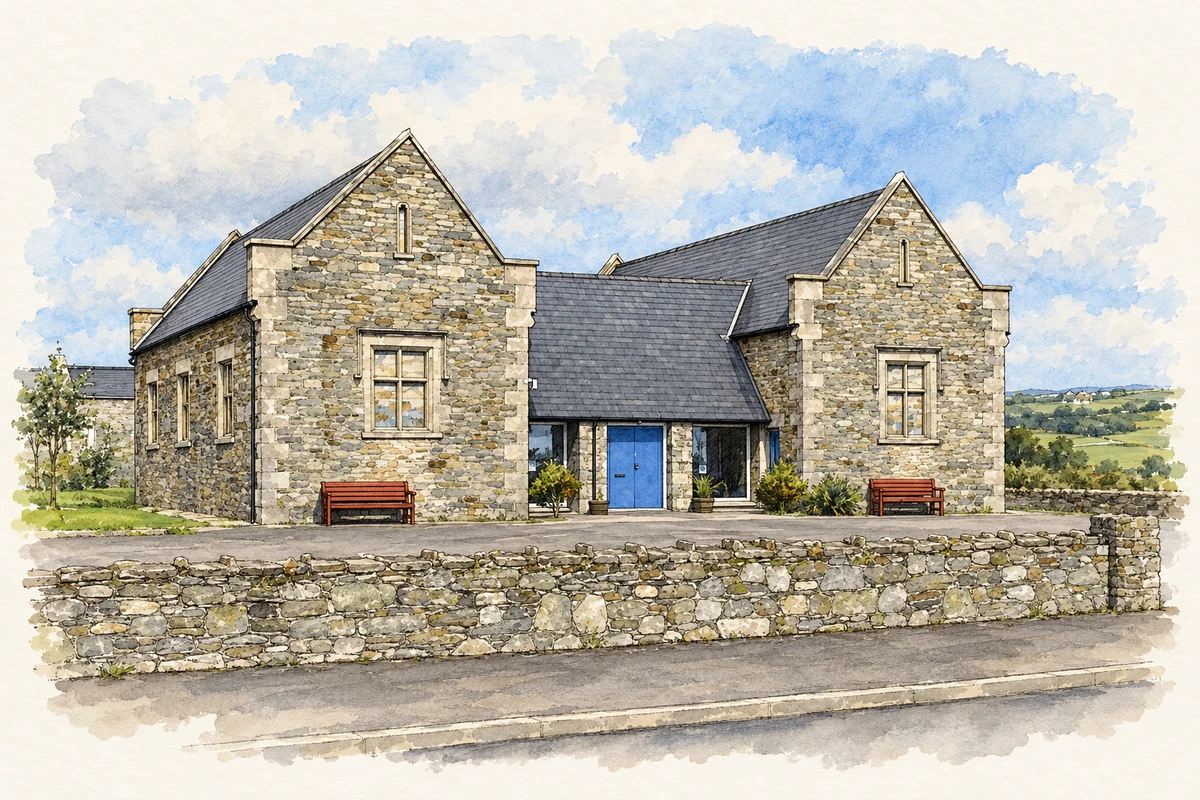
The paired entrance buildings of Dunfanaghy Union Workhouse survive as a heritage centre, joined by a modern link. George Wilkinson designed the institution, which was planned for 300 people and first admitted inmates in June 1845. The main workhouse behind the gatehouses was subsequently demolished. The surviving blocks retain dressed stone around their windows and gables: carefully designed public architecture attached to an institution remembered for poverty and the Great Famine. The heritage conversion opened in 1995.[3]
People & connections
Frank Egginton and the landscape
Landscape painter Frank Egginton first visited Donegal in 1930. When he exhibited at the Royal Hibernian Academy in 1932, he gave a Dunfanaghy address and showed Donegal landscapes and a cottage interior. Watercolour remained his preferred medium, although he later painted in oils as well. The Kenny Gallery’s biographical account identifies his home at the time of his death in 1990 as the Mill, Dunfanaghy. These documented addresses connect the town directly with his career.[4]
Folklore & tradition
Song and storytelling at the mill
At nearby Castlebane, southwest of the town, the architectural inventory records a tradition that people waiting for grain to be milled passed the time with songs, poems, stories and dancing. The former corn mill retains an iron undershot waterwheel and is attributed to the Stewart family around 1789. The account describes a remembered social custom attached to a working building; it does not identify a particular tale or performer.[5]
Both counts use the 2016 settlement boundary, allowing like-for-like comparison. CSO supplies the 2022 count on this older boundary for comparison only. The official 2022 Built Up Area has different boundaries.
View population figures
Dunfanaghy — Census 2016 settlement footprint — census population
Dunfanaghy, Donegal — Census town, CSO 2006 report
2002–2006: census town
316people · 2006
These are the historical areas published in the 2006 census report. Boundaries may differ between censuses and from modern settlements. Legal towns, environs and suburbs are shown separately; none has been combined into a modern settlement total.
View population figures
Dunfanaghy, Donegal — Census town, CSO 2006 report — census population
Dunfanaghy, Donegal — Census town, CSO 1996 report
1991–1996: census town
290people · 1996
These are the historical areas published in the 1996 census report. Boundaries may differ between censuses and from modern settlements. Legal towns, environs and suburbs are shown separately; none has been combined into a modern settlement total.
View population figures
Dunfanaghy, Donegal — Census town, CSO 1996 report — census population
Dunfanaghy, Donegal — Census town, CSO 1986 report
1981–1986: census town
314people · 1986
Figures cover the historical town area printed in the 1986 report. Boundaries may have changed between censuses. Legal town, environs and suburb totals remain separate and differ from modern settlement boundaries.
View population figures
Dunfanaghy, Donegal — Census town, CSO 1986 report — census population
These figures use different area definitions. Read the boundary note before comparing them.
Dunfanaghy, Donegal
Published census settlement populations
298people · 2016
Settlement boundaries changed during this period. Differences may reflect boundary changes as well as population change. Where a 2011 legal-town-and-environs count is shown, it has not been recalculated onto the 2016 settlement boundary.
Surviving entrance block of Dunfanaghy Workhouse illustration: based on a Dunfanaghy Workhouse by Rossographer. AI-assisted watercolour and ink adaptation; cream paper margins added, incidental clutter omitted and fine details simplified. Licence: CC BY-SA 2.0.
 placenames