 placenames
Abbeylara
Mainistir Leathrátha
Abbeylara’s medieval abbey remains central to its identity, alongside a modern church with New York connections and a barrack adapted for village commerce.
The name
These Irish name elements are associated with this record in the Logainm glossary.
An element’s translation is a clue, rather than a complete explanation of the name. Its form and meaning depend on local history and the full Irish name.
Recorded forms
- Mainistir Leathrátha · Irish · main form · validated name
- Abbeylara · English · main form
Place & story
A Cistercian house and its later history
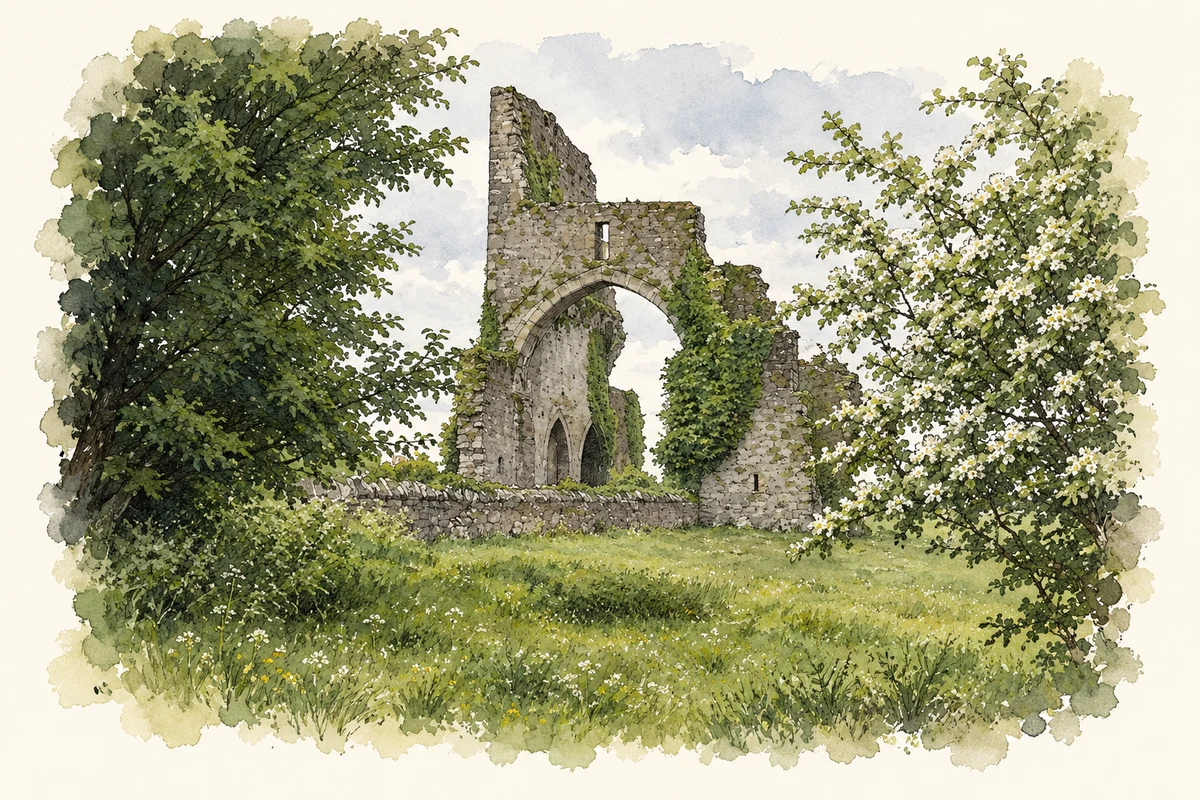
Richard de Tuite founded Abbeylara’s Cistercian abbey in 1205. Dedicated to the Virgin Mary, it became a daughter house of Saint Mary’s Abbey in Dublin, whose monks colonised it in 1214. The surviving ruins show changes and repairs over time; papal permissions in 1410 and 1435 allowed money to be raised for restoration through indulgences. The monastery had been dissolved by 1550, and its lands were leased to Richard Nugent, Baron Delvin, in 1552. A historic burial ground surrounds the remains. [2]
Saint Bernard’s and a New York connection
Saint Bernard’s Catholic Church dates from 1959. Its rock-faced limestone walls and traditional church plan are combined with a modern entrance canopy and a bright interior beneath a barrel-vaulted ceiling. The separate bell tower commemorates John Drumgoole, born in Abbeylara in 1816, who later founded the Mission of the Immaculate Virgin in New York. That institution provided the tower, while the Staten Island Catholic community donated the marble altar. The building makes a local connection with emigrant charitable work visible in stone. [3]
From police barrack to confectionery and hardware
The corner building at the centre of Abbeylara began around 1830 as a police barrack. After the Royal Irish Constabulary was disbanded in 1922, the serving sergeant bought the premises and opened a confectionery and hardware business. Alterations around 1925 introduced a shopfront and entrance porch. Decorative brackets and a cornice frame the commercial frontage, while coloured glass survives in a doorway. Its distinctive clustered chimneys and slate roof belong to a building whose public role changed with Independence. [4]
Geographic information
Sources & further reading
- Logainm.ie — Abbeylara. Place names and geographic record, licensed under CC BY 4.0.
- Abbeylara Cistercian Abbey · Longford County Council, Longford Tourism
- Saint Bernard’s Catholic Church: NIAH 13306006 · National Inventory of Architectural Heritage
- Abbeylara Police Barrack: NIAH 13306003 · National Inventory of Architectural Heritage
- Cistercian abbey ruins, Abbeylara, County Longford illustration: based on a Cistercian Abbey ruins, Abbeylara by Jonathan Billinger. AI-assisted watercolour and ink adaptation; cream paper margins added, incidental clutter omitted and fine details simplified. Licence: CC BY-SA 2.0.
Name record retrieved 2026-10-25 · Source record modified 2025-01-10. How this page was prepared.