These Irish name elements are associated with this record in the Logainm glossary.
An element’s translation is a clue, rather than a complete explanation of the name. Its form and meaning depend on local history and the full Irish name.
Recorded forms
Cnoc an Chrochaire· Irish · main form · validated name
Knockcroghery· English · main form
Place & story
Families making pipes
A community heritage account published by Roscommon County Council identifies Thomas Buckley as a pipe maker in the 1749 Elphin census. By Isaac Weld’s visit in 1832, pipe manufacture supported several village families. Clay initially came from local sources, with Devon supplies arriving by sea and rail later in the nineteenth century. The Curley, Fitzgerald, Lyons and Cunnane families appear among the makers in 1911. Knockcroghery was unusual in sustaining this trade outside a large urban centre.[2]
The burning reaches Parliament
The destruction of Knockcroghery was raised in the House of Commons on 23 June 1921. Joseph Devlin asked about masked men burning homes while residents fled in nightclothes. Denis Henry’s reply, based on a police report, acknowledged that armed, disguised men had entered at about one in the morning on 21 June and prevented occupants from saving their possessions. The exchange records official knowledge of the attack within days, alongside Devlin’s demand for an impartial inquiry.[3]
Houses on a factory site
A pair of main-street houses built in 1923 replaced a single-storey thatched clay-pipe factory destroyed in the burning. The architectural inventory records them with a shopfront, sash windows and rendered chimneystacks. Their traditional appearance can disguise their place in the village’s reconstruction: they are buildings of the 1920s occupying the site of an earlier manufacturing workplace.[4]
People & connections
Ethel Kelly revives the craft
The council’s heritage account records that Ethel Kelly revived traditional clay-pipe making in the 1990s on the site of Andrew Curley’s factory. The earlier industry had declined alongside the cigarette and did not recover after the 1921 destruction. The revival gave the old manufacturing site a new purpose as a place for demonstrating a craft that had once provided household livelihoods throughout the village.[2]
Both counts use the 2016 settlement boundary, allowing like-for-like comparison. CSO supplies the 2022 count on this older boundary for comparison only. The official 2022 Built Up Area has different boundaries.
View population figures
Knockcroghery — Census 2016 settlement footprint — census population
These figures use different area definitions. Read the boundary note before comparing them.
Knockcroghery, Roscommon
Published census settlement populations
351people · 2016
Settlement boundaries changed during this period. Differences may reflect boundary changes as well as population change. Where a 2011 legal-town-and-environs count is shown, it has not been recalculated onto the 2016 settlement boundary.
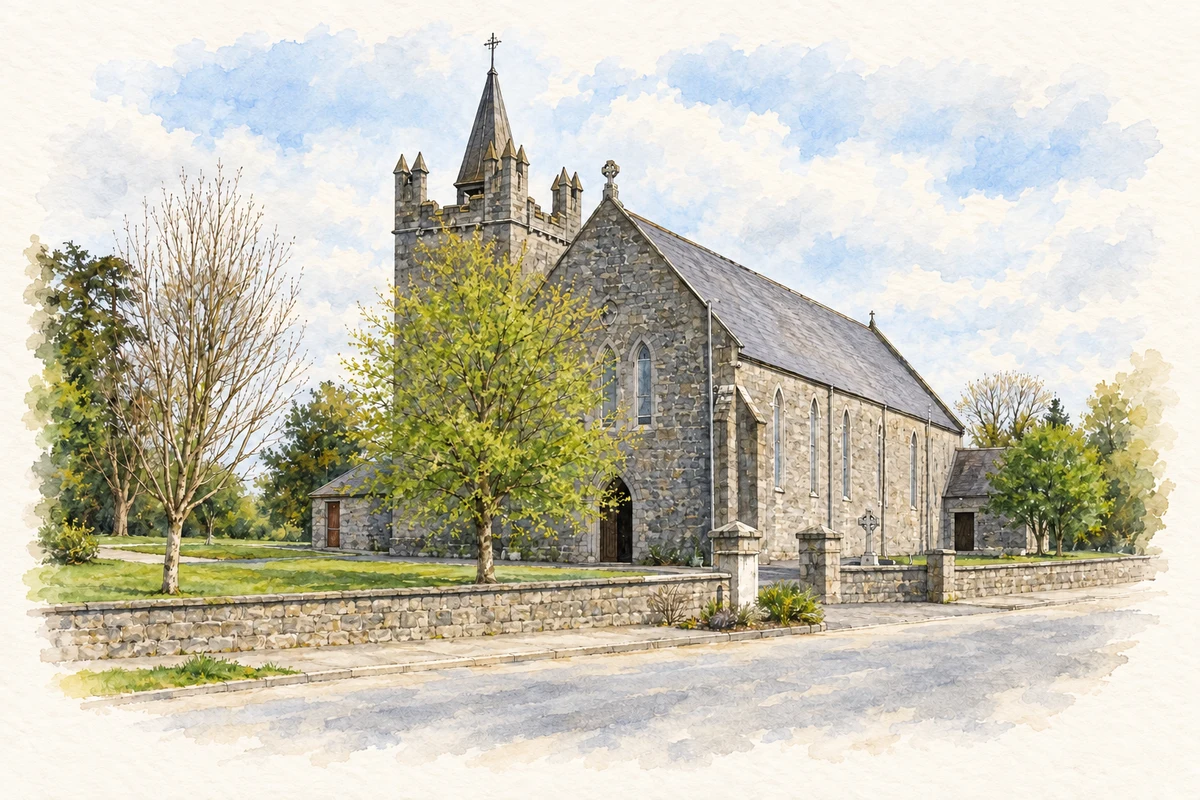
Saint Patrick's Church, Knockcroghery illustration: based on a Catholic Church, Knockcroghery. by Brian Shaw. AI-assisted watercolour and ink adaptation; cream paper margins added, incidental clutter omitted and fine details simplified. Licence: CC BY-SA 2.0.
 placenames