Feakle's cultural history reaches from Brian Merriman's poetry to stories of Biddy Early and the East Clare music festival. Its twentieth-century record also includes rural housing experiments and an attempt to open a path towards a ceasefire.
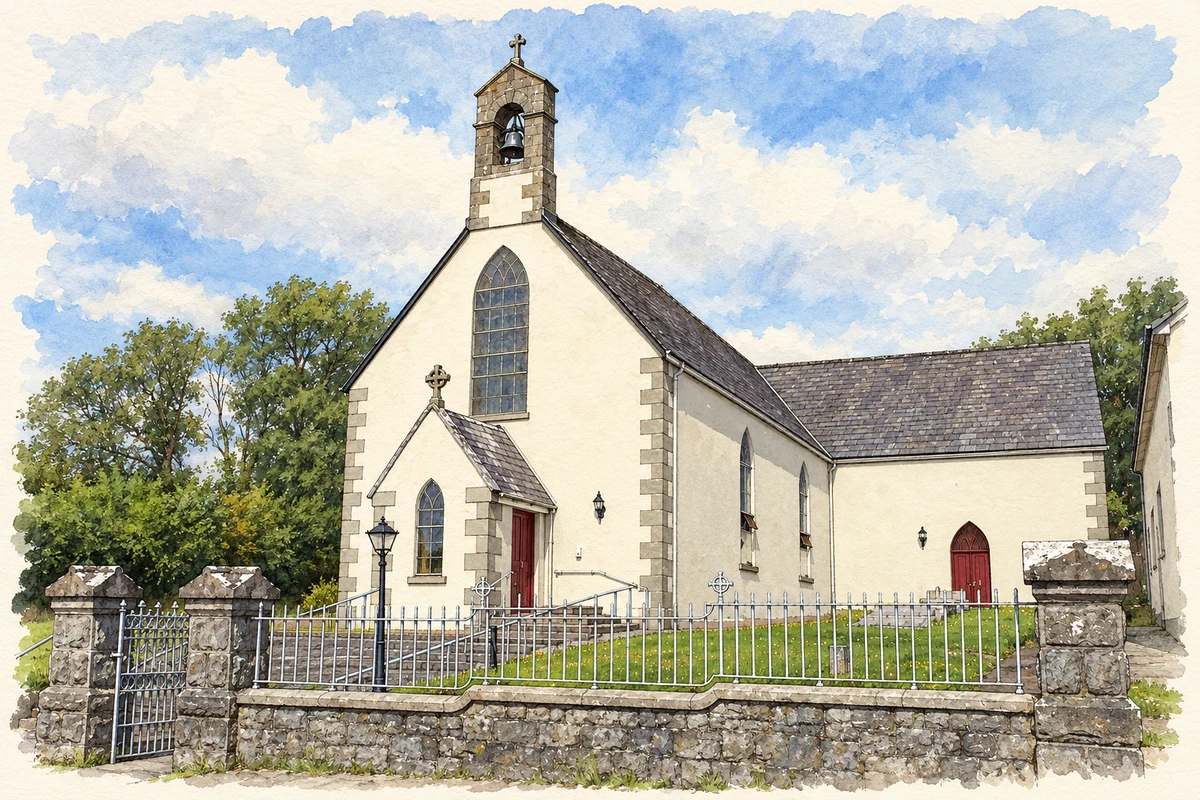
Illustration, St Mary's Church, Feakle
⊕Recorded locationFeakle52.92483° N · 8.64929° WInteractive map supplied by OpenStreetMap.
A reliable full-name meaning has not been established here. The recorded Irish and English forms are given without an unsupported translation.
Recorded forms
An Fhiacail· Irish · main form · validated name
Feakle· English · main form
Place & story
People & connections
Brian Merriman's teaching and farming
Brian Merriman moved to Feakle parish as a child and later ran a school at Knocknageeha. For about twenty years he taught and farmed at Derryvinna near the village. Lough Graney and its surroundings formed the setting for his long Irish-language poem Cúirt an Mheán Oíche, The Midnight Court. He married Kathleen Collins in 1787 and moved with his family to Limerick in 1802 or 1803, teaching mathematics there. After his death in 1805 he was buried in Feakle, bringing his story back to the parish where he had spent much of his life.[2]
Folklore & tradition
Biddy Early in Gregory's collection
Lady Gregory recorded Mr Fahy's belief that Biddy Early's dead son returned to give her healing powers. Her 1920 collection places Early's former home between Feakle and Tulla. The story belongs to the reputation surrounding a local woman whose visitors remembered both her generosity and her supposed knowledge.[3]
An East Clare festival grows
Festival chairman Gary Pepper recalled that the first Feakle festival in 1988 honoured Dr Bill and Tony Loughnane. Its original three-day programme combined an opening night, a concert, a céilí and three workshops. By its twenty-fifth anniversary in 2012 it had expanded to six days, using the church, school rooms, houses and community venues. Musicians from other traditions joined local players. The festival's growth made teaching and participation central to the gathering, alongside the concerts which brought visitors into the village.[4]
Sixteen houses in 1973
RTÉ reported the opening of sixteen houses in Feakle on 20 September 1973, the first completed estate of the Rural Housing Organisation. Father Harry Bohan and local people had established the organisation three years earlier to help families remain in rural villages. Taoiseach Liam Cosgrave planted a tree at the opening, and Bishop Michael Harty blessed the houses. The scheme combined local initiative with housing loans and bank finance, offering a practical response to the movement of young families towards larger towns.[5]
The 1974 ceasefire discussions
In December 1974 Protestant clergymen met Provisional IRA and Sinn Féin representatives at Smyth's Village Hotel. In a contemporary RTÉ interview, Bishop Arthur Butler explained that the purpose was to seek a ceasefire and a peaceful resolution through negotiation. Gardaí learned of the meeting and raided it; the IRA representatives had escaped. The encounter gave Feakle a place in the history of attempts to establish communication across the Northern Ireland conflict.[6]
Both counts use the 2016 settlement boundary, allowing like-for-like comparison. CSO supplies the 2022 count on this older boundary for comparison only. The official 2022 Built Up Area has different boundaries.
View population figures
Feakle — Census 2016 settlement footprint — census population
These are the historical areas published in the 2006 census report. Boundaries may differ between censuses and from modern settlements. Legal towns, environs and suburbs are shown separately; none has been combined into a modern settlement total.
View population figures
Feakle, Clare — Census town, CSO 2006 report — census population
These are the historical areas published in the 1996 census report. Boundaries may differ between censuses and from modern settlements. Legal towns, environs and suburbs are shown separately; none has been combined into a modern settlement total.
View population figures
Feakle, Clare — Census town, CSO 1996 report — census population
Figures cover the historical town area printed in the 1986 report. Boundaries may have changed between censuses. Legal town, environs and suburb totals remain separate and differ from modern settlement boundaries.
View population figures
Feakle, Clare — Census town, CSO 1986 report — census population
These figures use different area definitions. Read the boundary note before comparing them.
Feakle, Clare
Published census settlement populations
105people · 2016
Settlement boundaries changed during this period. Differences may reflect boundary changes as well as population change. Where a 2011 legal-town-and-environs count is shown, it has not been recalculated onto the 2016 settlement boundary.
 placenames