These Irish name elements are associated with this record in the Logainm glossary.
An element’s translation is a clue, rather than a complete explanation of the name. Its form and meaning depend on local history and the full Irish name.
Recorded forms
Droichead Abhann Ó gCearnaigh· Irish · main form · validated name
Six-mile-bridge· English · main form
Sixmilebridge· English · main form
Place & story
Boats from Amsterdam
Sixmilebridge developed around a crossing of the O'Garney River. Clare Libraries' local history describes boats from Amsterdam reaching almost to the town during the seventeenth and eighteenth centuries. Milling attracted settlers of Dutch origin, while the Ievers family helped organise the growing settlement. The two sides of the river acquired different names: Ieverstown to the south and O'Brien's Town to the north. Water carried goods as well as turning machinery, connecting this inland crossing with wider trading networks.[2]
Bridges changed the route
The building of D'Esterre's Bridge at Rosmanagher in 1784 ended the river trade described in the library's account. Bunratty Bridge, completed in 1804, then diverted the main westward road away from Sixmilebridge. These changes reduced both waterborne commerce and passing road traffic. The crossing that had helped the town grow remained its central landmark, but newer crossings elsewhere altered its position within the region.[2]
A town recorded in transition
Lewis described 229 houses in the town in 1831. By his 1837 account, the former Friday market had ceased and the market house had lost its roof. Boats could still navigate the O'Garney from Bunratty to within half a mile of the town. The 1839 Ordnance Survey notes also record cultivation around Sixmilebridge: wheat, oats, potatoes and vegetables grew on small holdings. Two schools together taught 196 boys and eighty girls, preserving a glimpse of everyday life alongside the decline in trade.[3][4]
Both counts use the 2016 settlement boundary, allowing like-for-like comparison. CSO supplies the 2022 count on this older boundary for comparison only. The official 2022 Built Up Area has different boundaries.
View population figures
Sixmilebridge — Census 2016 settlement footprint — census population
Sixmilebridge, Clare — Census town, CSO 2006 report
2002–2006: census town
1,659people · 2006
These are the historical areas published in the 2006 census report. Boundaries may differ between censuses and from modern settlements. Legal towns, environs and suburbs are shown separately; none has been combined into a modern settlement total.
View population figures
Sixmilebridge, Clare — Census town, CSO 2006 report — census population
Sixmilebridge, Clare — Census town, CSO 1996 report
1991–1996: census town
1,144people · 1996
These are the historical areas published in the 1996 census report. Boundaries may differ between censuses and from modern settlements. Legal towns, environs and suburbs are shown separately; none has been combined into a modern settlement total.
View population figures
Sixmilebridge, Clare — Census town, CSO 1996 report — census population
Sixmilebridge, Clare — Census town, CSO 1986 report
1981–1986: census town
1,182people · 1986
Figures cover the historical town area printed in the 1986 report. Boundaries may have changed between censuses. Legal town, environs and suburb totals remain separate and differ from modern settlement boundaries.
View population figures
Sixmilebridge, Clare — Census town, CSO 1986 report — census population
These figures use different area definitions. Read the boundary note before comparing them.
Sixmilebridge, Clare
Published census settlement populations
2,625people · 2016
Settlement boundaries changed during this period. Differences may reflect boundary changes as well as population change. Where a 2011 legal-town-and-environs count is shown, it has not been recalculated onto the 2016 settlement boundary.
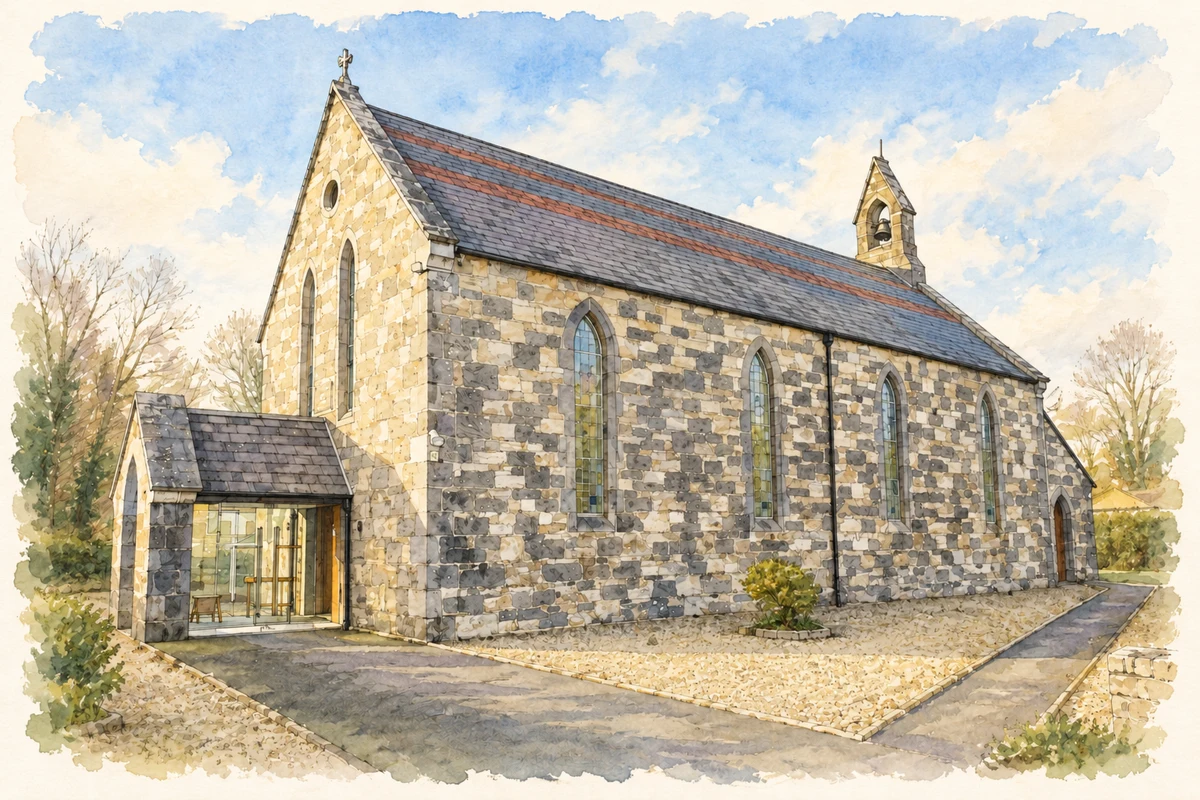
Sixmilebridge Library, former church illustration: based on a Little Church Sixmilebridge by The Banner. AI-assisted watercolour and ink adaptation; cream paper margins added, incidental clutter omitted and fine details simplified. Licence: CC BY-SA 3.0.
 placenames