These Irish name elements are associated with this record in the Logainm glossary.
An element’s translation is a clue, rather than a complete explanation of the name. Its form and meaning depend on local history and the full Irish name.
Recorded forms
An Tulach· Irish · main form · validated name
Tulla· English · main form
Place & story
Folklore & tradition
Mochulla’s bull and the stone men
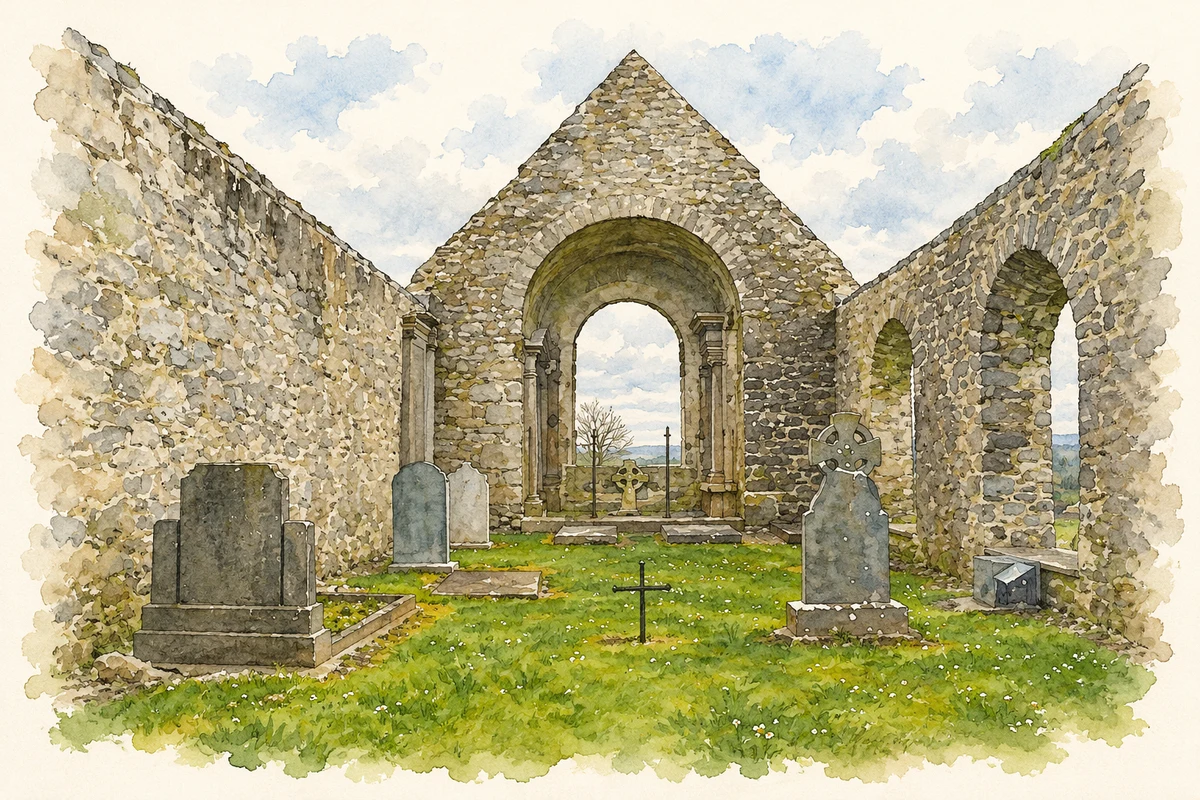
Thomas Johnson Westropp recorded a story in 1892 from road workers near Carrahan and Clooney about Saint Mochulla building Tulla church. In their version, the saint sent his bull to collect food; when thieves attacked it, its cry reached him and his curse turned the attackers into stone figures. Westropp associated the tale with pillars on Classagh Hill and compared it with a medieval saint's Life, whose version differed. His account documents the local circulation of a legend, rather than a historical explanation for the stones or proof of a miracle.[2]
People & connections
The Tulla Céilí Band
Formed in 1946, the Tulla Céilí Band included fiddlers Paddy Canny and P. J. Hayes among its founding musicians. The organisers of the 2012 Masters of Tradition festival described its international touring and recordings, including The Claddagh Ring and A Celebration of 50 Years. They also identified its performances at the Willie Clancy Summer School as major occasions in its calendar. The band connects Tulla's name with an east Clare musical tradition sustained through ensemble playing, dancing, recordings and performances well beyond the town itself.[3]
From convent to cultural centre
The former Saint Joseph's Convent on Chapel Street was built in 1883. The architectural inventory records a substantial two-storey building with a projecting bay window, slate roof and red-brick chimney stacks. It later became Cnoc na Gaoithe, a centre associated with traditional music, song and dance. The building's changing use gives a physical setting to Tulla's cultural life while retaining evidence of its earlier religious and educational role. Its nineteenth-century construction should be distinguished from the much older ecclesiastical traditions associated with the hill and Saint Mochulla.[4][5]
Both counts use the 2016 settlement boundary, allowing like-for-like comparison. CSO supplies the 2022 count on this older boundary for comparison only. The official 2022 Built Up Area has different boundaries.
View population figures
Tulla — Census 2016 settlement footprint — census population
These are the historical areas published in the 2006 census report. Boundaries may differ between censuses and from modern settlements. Legal towns, environs and suburbs are shown separately; none has been combined into a modern settlement total.
View population figures
Tulla, Clare — Census town, CSO 2006 report — census population
These are the historical areas published in the 1996 census report. Boundaries may differ between censuses and from modern settlements. Legal towns, environs and suburbs are shown separately; none has been combined into a modern settlement total.
View population figures
Tulla, Clare — Census town, CSO 1996 report — census population
Figures cover the historical town area printed in the 1986 report. Boundaries may have changed between censuses. Legal town, environs and suburb totals remain separate and differ from modern settlement boundaries.
View population figures
Tulla, Clare — Census town, CSO 1986 report — census population
These figures use different area definitions. Read the boundary note before comparing them.
Tulla, Clare
Published census settlement populations
661people · 2016
Settlement boundaries changed during this period. Differences may reflect boundary changes as well as population change. Where a 2011 legal-town-and-environs count is shown, it has not been recalculated onto the 2016 settlement boundary.
 placenames