 placenames
Ballincollig
Baile an Chollaigh
Ballincollig’s industrial landscape along the Lee connects the manufacture of explosives with canals, workers’ housing and a guarded barracks complex.
The name
These Irish name elements are associated with this record in the Logainm glossary.
An element’s translation is a clue, rather than a complete explanation of the name. Its form and meaning depend on local history and the full Irish name.
Recorded forms
- Baile an Chollaigh · Irish · main form · validated name
- Ballincollig · English · main form
Place & story
The gunpowder works on the Lee
Charles Leslie and John Travers developed Ballincollig’s gunpowder mills in 1794, using a weir and canal to harness water power. The British Board of Ordnance purchased the works in 1805 and expanded production for the Napoleonic Wars. After closure following the war, private owners reopened the mills in 1835. Manufacturing finally ceased in 1903. Cork City Council’s heritage account records surviving process buildings, walls and watercourses within the later regional park, preserving the scale of an industry once central to the settlement. [2]
The barracks guarding the mills
The former barracks building now called Parnell House dates from about 1810. Its two-storey frontage has a central projecting section, sash windows and a hipped roof. It forms part of a group arranged around a courtyard, built to provide security for the powder mills to the north. The National Inventory of Architectural Heritage links these surviving military buildings with both the mills and Oriel House, giving the town centre a direct architectural connection to wartime production. [3]
Thomas Tobin’s management
Thomas Tobin came from Liverpool to manage the Ballincollig mills in 1834. The workforce grew from about 200 in 1837 to more than 500 in the 1850s, making the works a major employer. He also built houses for employees. His later Cork public roles included harbour commissioner and involvement in the 1852 National Exhibition. Ballincollig was the industrial base of this career; he was born in Liverpool and was buried at Inniscarra after his death in 1881. [4]
Geographic information
- Place type
- Town
- County
- Cork
- Barony
- Muskerry East
- Civil parish
- Carrigrohane
- Civil parish
- Kilnaglory
- Coordinates
- 51.88980, -8.59559 (approximate)
- Logainm ID
- 1416555 ↗
Sources & further reading
- Logainm.ie — Ballincollig. Place names and geographic record, licensed under CC BY 4.0.
- Ballincollig Gunpowder Mills · Cork City Council
- Parnell House, register 20842008 · National Inventory of Architectural Heritage
- Tobin, Sir Thomas · Linde Lunney, Dictionary of Irish Biography
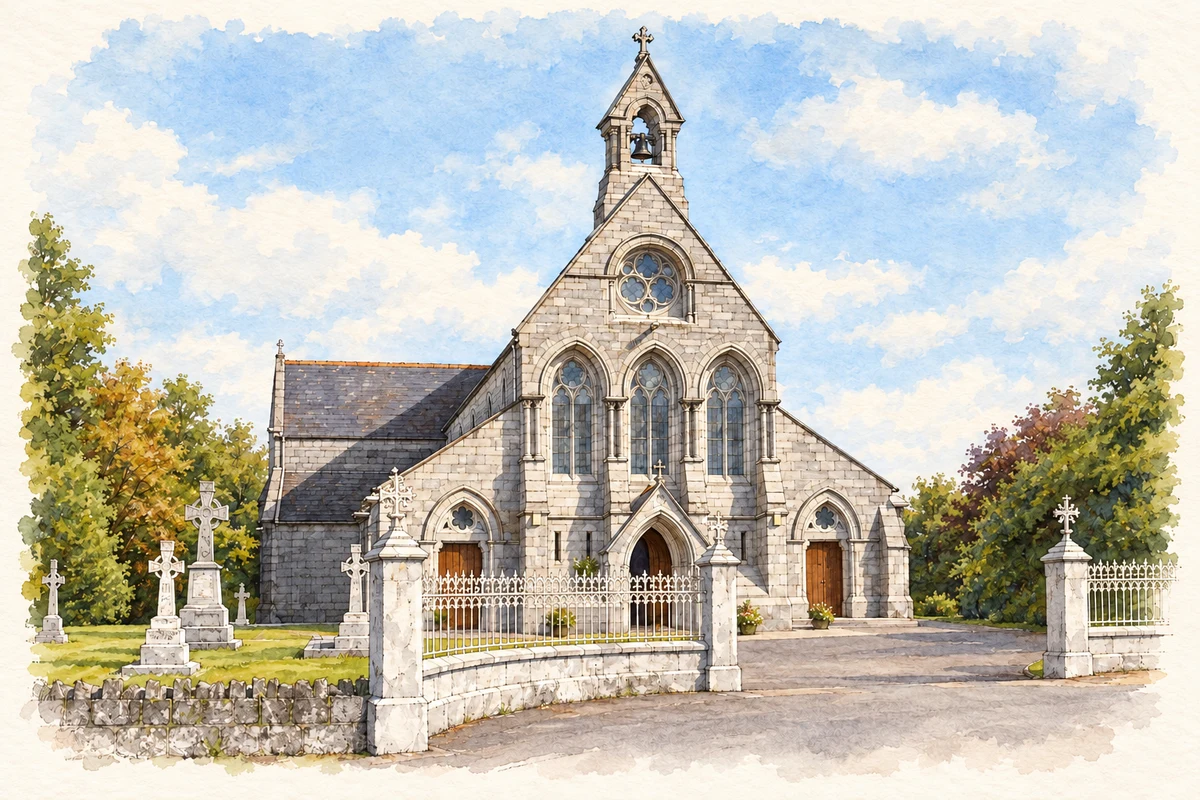
- St Mary and St John Church, Ballincollig illustration: based on a St. Mary and St. Johns Church, Ballincollig by Ian Paterson. AI-assisted watercolour and ink adaptation; cream paper margins added, incidental clutter omitted and fine details simplified. Licence: CC BY-SA 2.0.
Name record retrieved 2026-10-25 · Source record modified 2025-01-10. How this page was prepared.