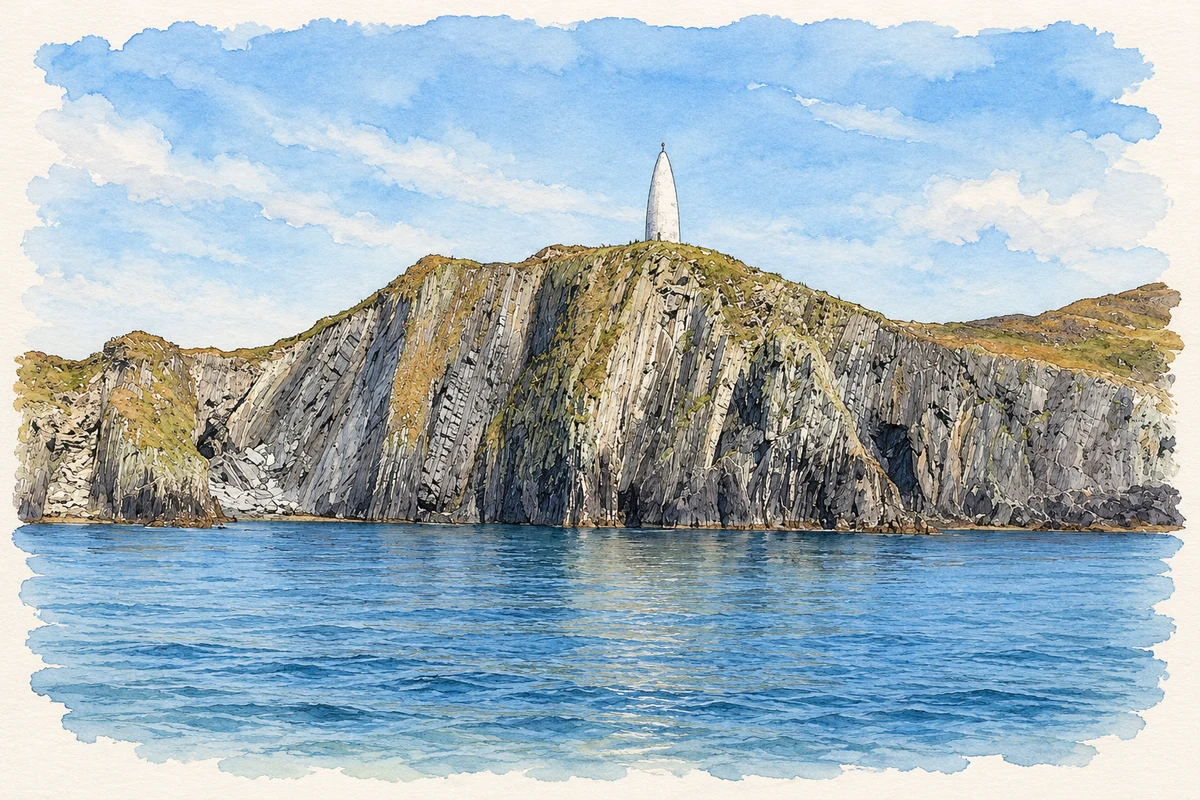
Baltimore's harbour is watched over by a restored medieval hall house and a white coastal beacon. The slave raid of 1631 left a lasting place in its history and in Thomas Davis's poetry.
Illustration, Baltimore Beacon above the harbour entrance
⊕Recorded locationBaltimore51.48189° N · 9.37140° WInteractive map supplied by OpenStreetMap.
These Irish name elements are associated with this record in the Logainm glossary.
An element’s translation is a clue, rather than a complete explanation of the name. Its form and meaning depend on local history and the full Irish name.
Recorded forms
Dún na Séad· Irish · main form · validated name
Baltimore· English · main form
Place & story
Dún na Séad restored
Baltimore Castle, also called Dún na Séad, is a thirteenth-century hall house overlooking the village and harbour. Its history includes occupation by the O'Driscolls, whose seafaring influence extended through this part of West Cork. Patrick and Bernie McCarthy bought the building in 1997 when it was ruinous. They spent eight years restoring it and made it their home in 2005. The restored roof and Great Hall give the harbour a complete historic building after centuries in which the castle stood as a shell.[2]
The raid of June 1631
On 20 June 1631 corsairs from Algiers attacked Baltimore and carried more than a hundred inhabitants into slavery. Two local men, Thomas Corlew and John Davis, were killed. Attempts to secure naval help failed to intercept the raiders. Research into later ransom records identifies Joan Broadbroke and Ellen Hawkins among those eventually released, after fifteen years in captivity. Most captives' individual fates remain unknown. The attack profoundly unsettled the community, and many of those who stayed in West Cork moved inland towards Skibbereen.[3]
A white mark at the harbour entrance
The white stone beacon stands above the southern entrance to the harbour. Built around 1850, the present pillar is about fifteen metres tall, with its base roughly fifty metres above the sea. It marks an entrance that can otherwise be difficult for approaching vessels to distinguish. Earlier maps show that the headland had already served this purpose: a beacon appears on the 1786 Freke estate map, while the 1650 sDown Survey depicts a prominent structure there. The pillar is a daylight navigation mark and has no lamp.[4]
The raid becomes a poem
Thomas Davis turned the attack into The Sack of Baltimore, first published in The Nation on 5 July 1845. His poem begins with an imagined peaceful evening in the harbour before shifting to the violence of the raid and the captives' removal. It helped carry the event into nineteenth-century national literary memory. The quiet domestic scenes belong to Davis's imaginative reconstruction, written more than two centuries after the attack.[5][6]
Both counts use the 2016 settlement boundary, allowing like-for-like comparison. CSO supplies the 2022 count on this older boundary for comparison only. The official 2022 Built Up Area has different boundaries.
View population figures
Baltimore — Census 2016 settlement footprint — census population
These are the historical areas published in the 2006 census report. Boundaries may differ between censuses and from modern settlements. Legal towns, environs and suburbs are shown separately; none has been combined into a modern settlement total.
View population figures
Baltimore, Cork — Census town, CSO 2006 report — census population
These are the historical areas published in the 1996 census report. Boundaries may differ between censuses and from modern settlements. Legal towns, environs and suburbs are shown separately; none has been combined into a modern settlement total.
View population figures
Baltimore, Cork — Census town, CSO 1996 report — census population
Figures cover the historical town area printed in the 1986 report. Boundaries may have changed between censuses. Legal town, environs and suburb totals remain separate and differ from modern settlement boundaries.
View population figures
Baltimore, Cork — Census town, CSO 1986 report — census population
These figures use different area definitions. Read the boundary note before comparing them.
Baltimore, Cork
Published census settlement populations
323people · 2016
Settlement boundaries changed during this period. Differences may reflect boundary changes as well as population change. Where a 2011 legal-town-and-environs count is shown, it has not been recalculated onto the 2016 settlement boundary.
 placenames