A reliable full-name meaning has not been established here. The recorded Irish and English forms are given without an unsupported translation.
Recorded forms
An Bhlarna· Irish · main form · validated name
Blarney· English · main form
Place & story
Two towers joined in stone
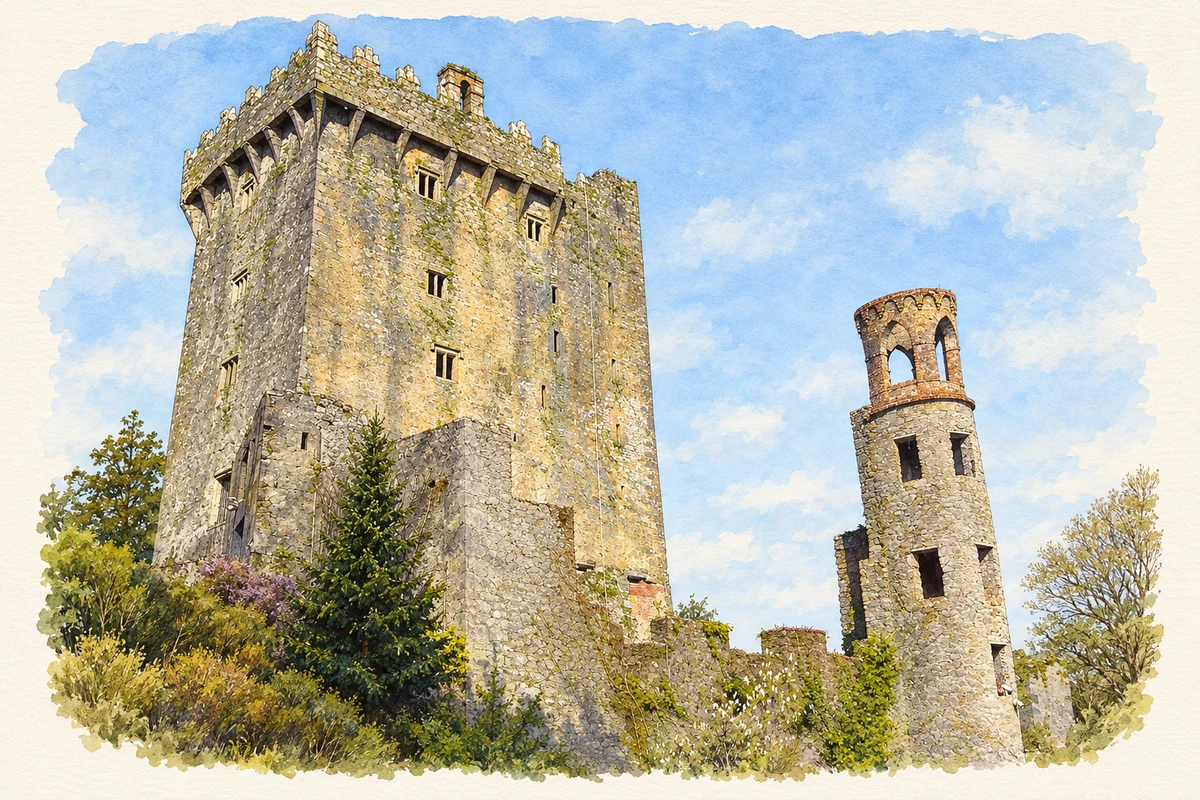
Blarney is an unusually large example of the tower houses built by Irish lords during the later medieval and early modern periods. Its fabric contains at least two towers; the second was added in the sixteenth century. A vertical line on the northern face shows where the building phases meet. The thick lower walls slope inward as they rise, giving the great mass its distinctive profile and helping stabilise the structure.[2]
Folklore & tradition
The stone that sweetens speech
Coyne and Willis's travel account, published around 1841, records the belief that kissing the Blarney Stone bestowed persuasive eloquence. It also captures disagreement among guides about which stone visitors should kiss. Some directed them to an accessible stone on the battlements; others favoured one below the parapet, requiring a much more awkward approach. The familiar promise of fluent speech was already central to the castle's attraction.[3]
Folklore & tradition
White cattle beneath the lake
The same account preserves two traditions about Blarney Lake. Enchanted white cattle were said to emerge at certain seasons and graze along its banks. Another story placed the Earl of Clancarty's treasure beneath the water, its hiding place entrusted to three MacCarthys. As each keeper died, another family member inherited the secret, to remain unrevealed until a MacCarthy again ruled Blarney. These stories gave the nearby water its own supernatural life alongside the celebrated stone.[3]
A geological souvenir
In 2014 the Hunterian Museum reported its analysis of a nineteenth-century microscope slide labelled as a sample of the Blarney Stone. Calcite and fossil fragments indicated limestone, supporting a local Carboniferous origin about 330 million years old. The slide belonged to geologist Matthew Forster Heddle's collection and came to light during cataloguing. Its survival added a small, tangible object to the history of the castle's many curious visitors.[4]
Both counts use the 2016 settlement boundary, allowing like-for-like comparison. CSO supplies the 2022 count on this older boundary for comparison only. The official 2022 Built Up Area has different boundaries.
View population figures
Blarney — Census 2016 settlement footprint — census population
These are the historical areas published in the 2006 census report. Boundaries may differ between censuses and from modern settlements. Legal towns, environs and suburbs are shown separately; none has been combined into a modern settlement total.
View population figures
Blarney, Cork — Census town, CSO 2006 report — census population
These are the historical areas published in the 1996 census report. Boundaries may differ between censuses and from modern settlements. Legal towns, environs and suburbs are shown separately; none has been combined into a modern settlement total.
View population figures
Blarney, Cork — Census town, CSO 1996 report — census population
Figures cover the historical town area printed in the 1986 report. Boundaries may have changed between censuses. Legal town, environs and suburb totals remain separate and differ from modern settlement boundaries.
View population figures
Blarney, Cork — Census town, CSO 1986 report — census population
These figures use different area definitions. Read the boundary note before comparing them.
Blarney, Cork
Published census settlement populations
2,539people · 2016
Settlement boundaries changed during this period. Differences may reflect boundary changes as well as population change. Where a 2011 legal-town-and-environs count is shown, it has not been recalculated onto the 2016 settlement boundary.
Blarney Castle illustration: based on a Blarney Castle by Guilhem D.. AI-assisted watercolour and ink adaptation; cream paper margins added, incidental clutter omitted and fine details simplified. Licence: CC BY 2.5; adapted illustration.
 placenames