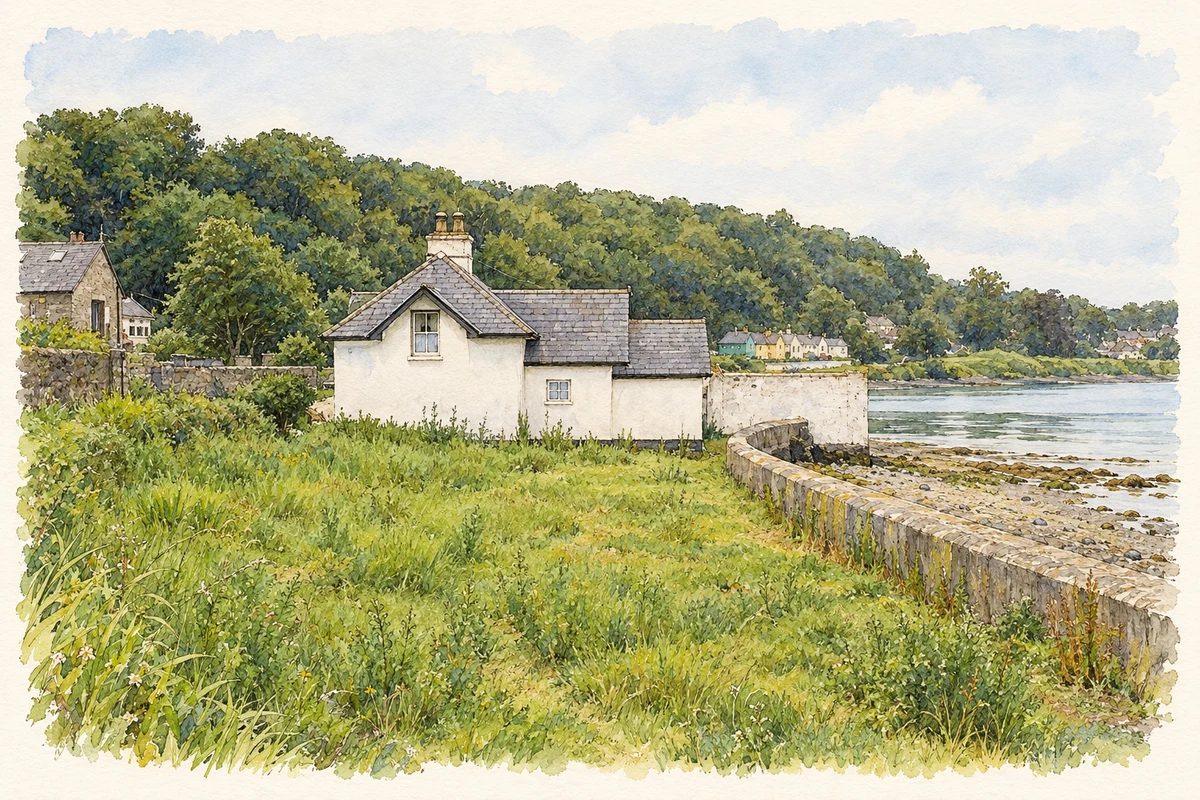
A reliable full-name meaning has not been established here. The recorded Irish and English forms are given without an unsupported translation.
Recorded forms
Cúirt Mhic Shéafraidh· Irish · main form · validated name
Courtmacsherry· English · main form
Place & story
A lifeboat service with interruptions
The RNLI dates Courtmacsherry's first lifeboat station to 1825, while noting that the service apparently lapsed around 1829 before another boat arrived in 1867. Coastguards and local boatmen continued risking their lives in open boats during the intervening years. On 7 May 1915 the lifeboat Kezia Gwilt responded when the Lusitania was torpedoed off the Old Head of Kinsale. The station's history records its arrival as the first rowed boat at the scene. These dates distinguish the early foundation from an uninterrupted modern service.[2]
Railway journeys along the coast
Courtmacsherry railway station opened in 1891 on the light railway connecting it with Timoleague. The village history records the end of regular passenger and goods services in 1947, followed by a more limited period of summer excursions and winter beet traffic. Final closure came in 1961. The railway's later years therefore cannot be described simply as either fully open or entirely closed after 1947. Its changing timetable reflected different uses of the line, from ordinary travel and freight to seasonal excursions and agricultural transport.[3]
People & connections
Patrick Keohane’s Antarctic journeys
Patrick Keohane, born in the Courtmacsherry area in 1879, served in the Royal Navy before joining Scott's Terra Nova Antarctic expedition. He supported the southern journey but was not one of the five men who reached the South Pole with Scott. In November 1912 he joined the search party that found the bodies of Scott, Wilson and Bowers. A later local commemoration placed Don Cronin's sculpture of Keohane at Lislee Court. His story connects a small Cork coastal community with polar exploration without implying that he accompanied Scott to the Pole itself.[3]
Both counts use the 2016 settlement boundary, allowing like-for-like comparison. CSO supplies the 2022 count on this older boundary for comparison only. The official 2022 Built Up Area has different boundaries.
View population figures
Courtmacsherry — Census 2016 settlement footprint — census population
Courtmacsherry, Cork — Census town, CSO 2006 report
2002–2006: census town
244people · 2006
These are the historical areas published in the 2006 census report. Boundaries may differ between censuses and from modern settlements. Legal towns, environs and suburbs are shown separately; none has been combined into a modern settlement total.
View population figures
Courtmacsherry, Cork — Census town, CSO 2006 report — census population
Courtmacsherry, Cork — Census town, CSO 1996 report
1991–1996: census town
224people · 1996
These are the historical areas published in the 1996 census report. Boundaries may differ between censuses and from modern settlements. Legal towns, environs and suburbs are shown separately; none has been combined into a modern settlement total.
View population figures
Courtmacsherry, Cork — Census town, CSO 1996 report — census population
Courtmacsherry, Cork — Census town, CSO 1986 report
1981–1986: census town
192people · 1986
Figures cover the historical town area printed in the 1986 report. Boundaries may have changed between censuses. Legal town, environs and suburb totals remain separate and differ from modern settlement boundaries.
View population figures
Courtmacsherry, Cork — Census town, CSO 1986 report — census population
These figures use different area definitions. Read the boundary note before comparing them.
Courtmacsherry, Cork
Published census settlement populations
590people · 2016
Settlement boundaries changed during this period. Differences may reflect boundary changes as well as population change. Where a 2011 legal-town-and-environs count is shown, it has not been recalculated onto the 2016 settlement boundary.
 placenames