These Irish name elements are associated with this record in the Logainm glossary.
An element’s translation is a clue, rather than a complete explanation of the name. Its form and meaning depend on local history and the full Irish name.
Recorded forms
Na Cealla Beaga· Irish · main form · validated name
Killybegs· English · main form
Place & story
Alexander Morton’s factory
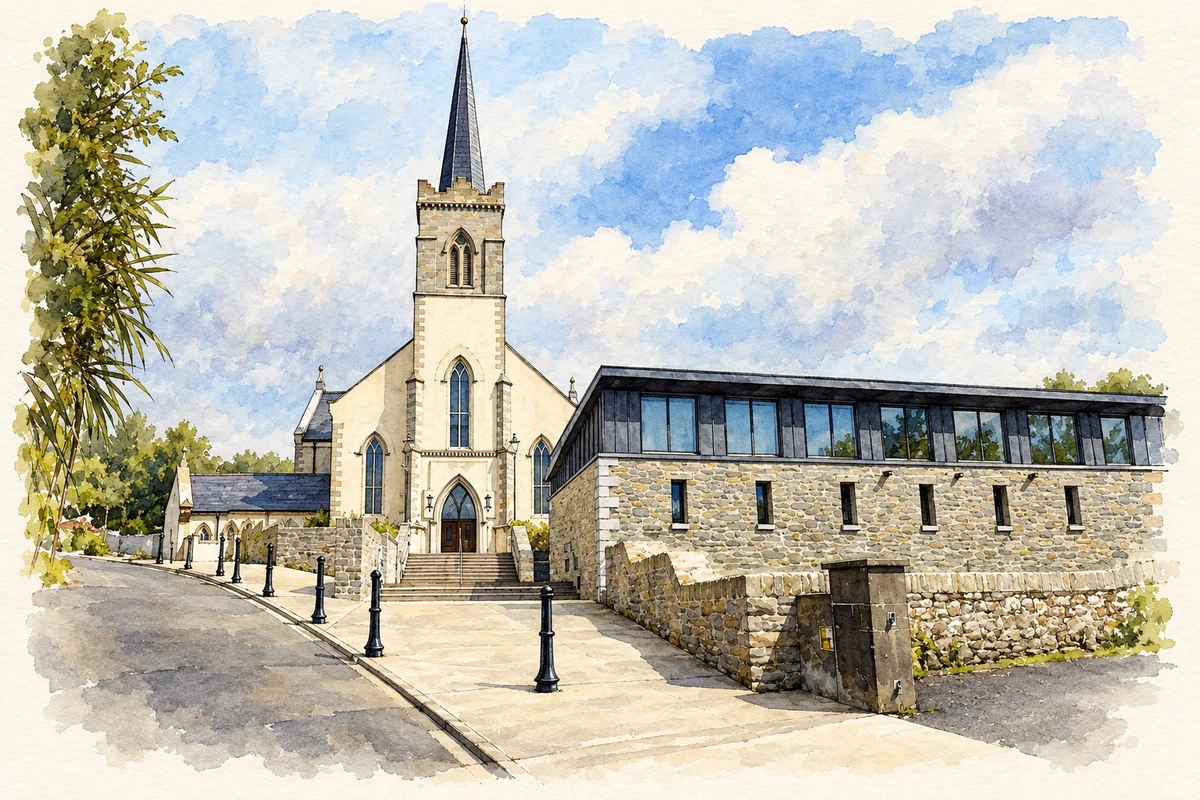
Scottish textile manufacturer Alexander Morton founded Donegal Carpets in 1898, with support from the Congested Districts Board. The Killybegs factory's stepped gables and substantial masonry still express the scale of the enterprise. The National Inventory of Architectural Heritage records that spinning and dyeing for the company's wider operations were carried out here. Local women made carpets to designs by figures including C. F. A. Voysey and Archibald Knox. The surviving looms connect the building with the hand-knotting process through which Donegal products reached prestigious houses and public buildings overseas.[2]
People & connections
The makers behind the famous carpets
Grace O'Boyle's We, the Makers project was commissioned in 2020 to research the Killybegs carpet factory through oral history, visual art and writing. Creative Ireland's project description emphasises the surviving weavers' knowledge and the large contribution women made across the Donegal factories. The initiative sought to record workers as skilled makers, alongside the better-known designers and clients. Its approach highlights an important local connection: the carpets' reputation depended on expertise held within the community, transmitted through work at the loom and remembered by those who practised it.[3]
Folklore & tradition
A storm, a landing and the holy well
The Killybegs Heritage Trail records a local story explaining the dedication of Saint Catherine's Well. In the tradition, monks caught in a storm pray to Catherine of Alexandria and reach safety at Killybegs. The story links the saint with a harbour community and its experience of danger at sea. It should be read as devotional folklore: the account does not establish that Egyptian monks founded a documented settlement here before Patrick. The well, old church and nearby tower-house remains form a historic group overlooking the harbour, with different layers of evidence and remembered belief.[4]
Both counts use the 2016 settlement boundary, allowing like-for-like comparison. CSO supplies the 2022 count on this older boundary for comparison only. The official 2022 Built Up Area has different boundaries.
View population figures
Killybegs — Census 2016 settlement footprint — census population
These are the historical areas published in the 2006 census report. Boundaries may differ between censuses and from modern settlements. Legal towns, environs and suburbs are shown separately; none has been combined into a modern settlement total.
View population figures
Killybegs, Donegal — Census town, CSO 2006 report — census population
These are the historical areas published in the 1996 census report. Boundaries may differ between censuses and from modern settlements. Legal towns, environs and suburbs are shown separately; none has been combined into a modern settlement total.
View population figures
Killybegs, Donegal — Census town, CSO 1996 report — census population
Figures cover the historical town area printed in the 1986 report. Boundaries may have changed between censuses. Legal town, environs and suburb totals remain separate and differ from modern settlement boundaries.
View population figures
Killybegs, Donegal — Census town, CSO 1986 report — census population
These figures use different area definitions. Read the boundary note before comparing them.
Killybegs, Donegal
Published census settlement populations
1,236people · 2016
Settlement boundaries changed during this period. Differences may reflect boundary changes as well as population change. Where a 2011 legal-town-and-environs count is shown, it has not been recalculated onto the 2016 settlement boundary.
 placenames