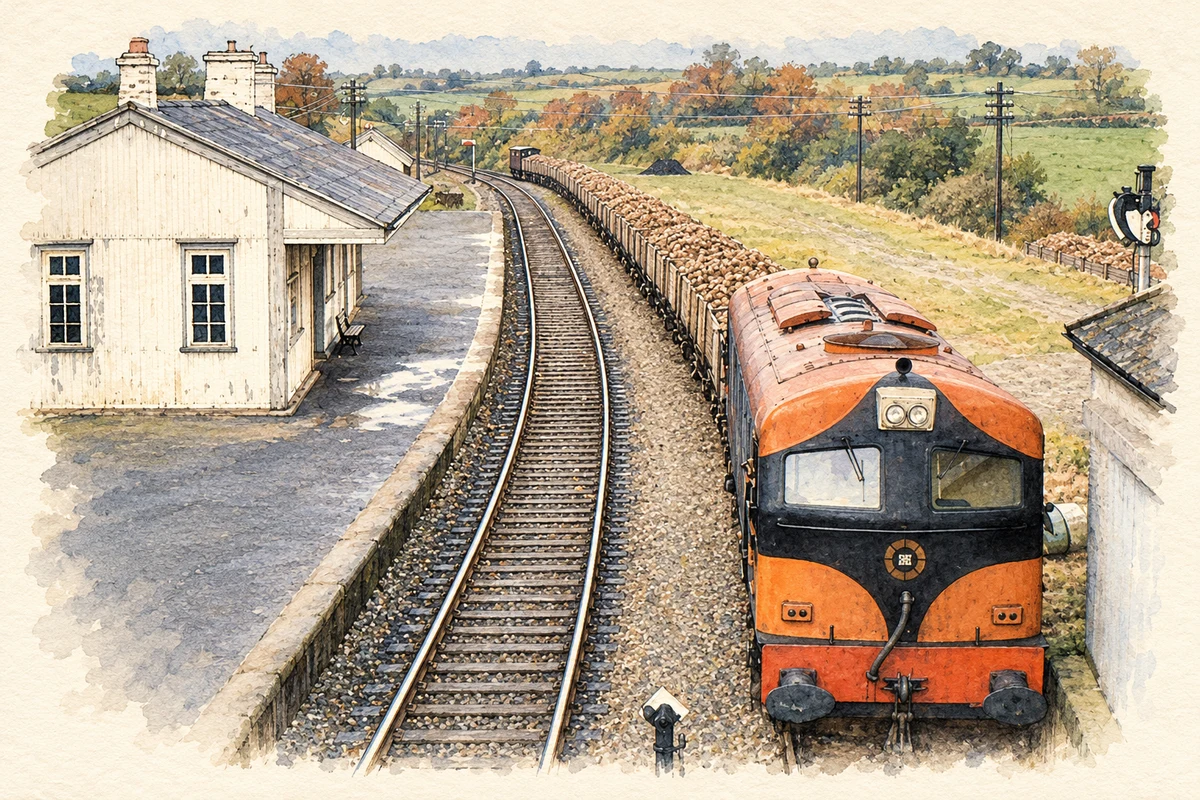
Ballycullane's local records preserve the names of village teachers, a torchlit welcome at the railway station and the final train journey filmed in 2010.
Illustration, Ballycullane station, 5 November 1982 — reconstruction
⊕Recorded locationBallycullane52.27958° N · 6.83780° WInteractive map supplied by OpenStreetMap.
These Irish name elements are associated with this record in the Logainm glossary.
An element’s translation is a clue, rather than a complete explanation of the name. Its form and meaning depend on local history and the full Irish name.
Recorded forms
Baile Uí Choileáin· Irish · main form · validated name
Ballycullane· English · main form
Place & story
From a shared school and chapel to amalgamation
Ballycullane National School's history records a small village school established in 1830 by Fr Peter Doyle and his curate, Rev Peter Barden. The building served as a classroom during the week and a place for Sunday Mass. Peter O'Brien and Mrs Neville were its teachers. Later boys' and girls' schools were combined in 1908, with David Fitzgibbon as principal and Mary Kate Larkin as assistant. Larkin subsequently became principal and remained until ill health forced her retirement in 1933. The account preserves the people behind successive changes in village education.[2]
The 1938 Garda station
Ballycullane's Garda station was built in 1938. Its five-bay, two-storey form, hipped roof and roughcast walls give it the appearance of a substantial house. Red-brick chimneywork, projecting eaves and recessed ground-floor window openings add architectural detail. The National Inventory of Architectural Heritage records it as a purpose-built station, representing the development of public buildings in the village during the early decades of the Irish state. Its scale makes it a recognisable part of the streetscape.[3]
People & connections
Michael Conway's torchlit return
In a statement taken in 1956, Volunteer Michael P.C. Conway recalled returning from imprisonment in February 1922. After receptions at Plymouth and Dublin, he travelled by rail through Wexford to Ballycullane. A crowd met the returning men at the station. Conway remembered candles lit in the windows and a torchlight procession escorting them home. His account gives the railway a place in the district's memory of independence, as the arrival point for a public welcome after imprisonment abroad.[4]
Filming the last train
In September 2010, filmmaker Colm Sheenan used Ballycullane station as the setting for a short film about the final journey of the Waterford–Rosslare train. A contemporary local report described his decision to explore the service's history through the surrounding rural community. Filming took place on the final journey, with editing planned afterwards. The report records a deliberate effort to preserve the community's experience of losing a railway connection through a new piece of local filmmaking.[5]
Both counts use the 2016 settlement boundary, allowing like-for-like comparison. CSO supplies the 2022 count on this older boundary for comparison only. The official 2022 Built Up Area has different boundaries.
View population figures
Ballycullane — Census 2016 settlement footprint — census population
Ballycullane, Wexford — Census town, CSO 2006 report
2002–2006: census town
219people · 2006
These are the historical areas published in the 2006 census report. Boundaries may differ between censuses and from modern settlements. Legal towns, environs and suburbs are shown separately; none has been combined into a modern settlement total.
View population figures
Ballycullane, Wexford — Census town, CSO 2006 report — census population
These figures use different area definitions. Read the boundary note before comparing them.
Ballycullane, Wexford
Published census settlement populations
318people · 2016
Settlement boundaries changed during this period. Differences may reflect boundary changes as well as population change. Where a 2011 legal-town-and-environs count is shown, it has not been recalculated onto the 2016 settlement boundary.
 placenames