These Irish name elements are associated with this record in the Logainm glossary.
An element’s translation is a clue, rather than a complete explanation of the name. Its form and meaning depend on local history and the full Irish name.
Recorded forms
Cúil Ghréine· Irish · main form · validated name
Coolgreany· English · main form
Place & story
Two sides of Main Street
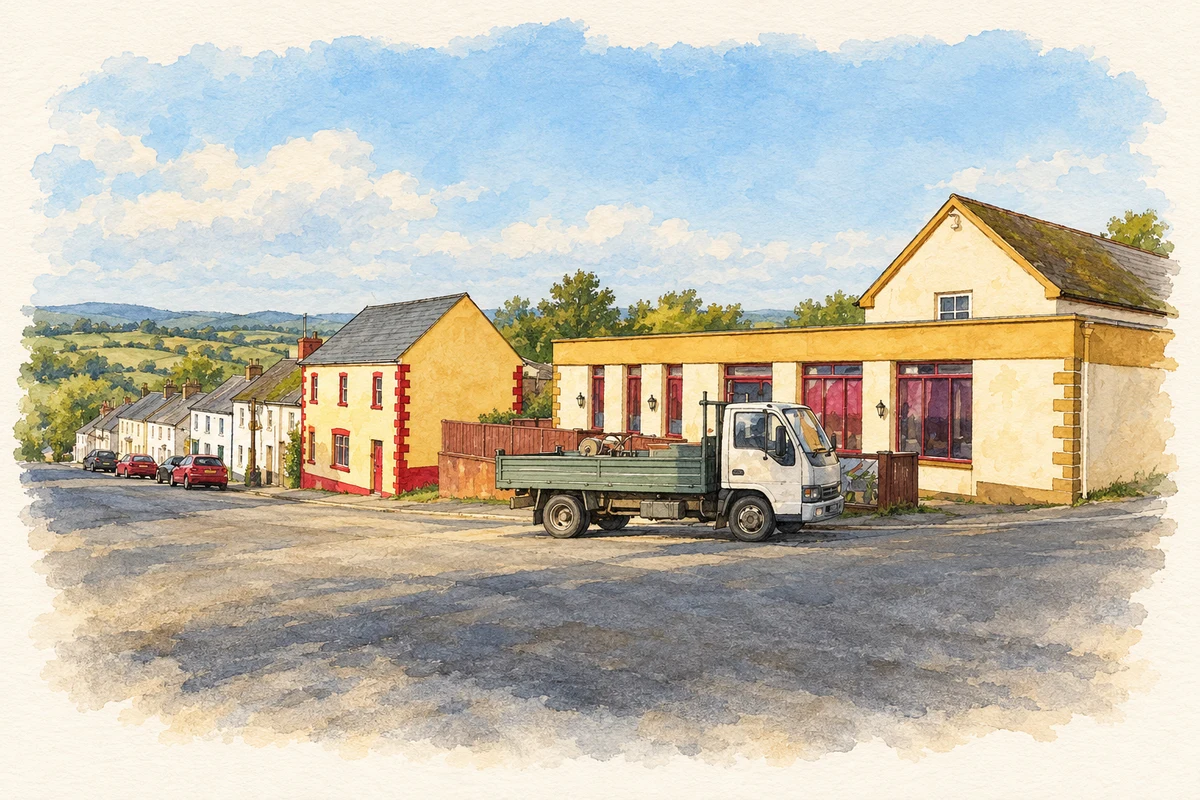
Coolgreany’s Main Street climbs from the stone bridge at the bottom of the village. Wexford County Council’s 2002 conservation assessment describes a contrast between two-storey buildings on the west and a long row of single-storey cottages on the east. A grassy strip with trees and a separate narrow roadway sets the cottages apart from through traffic. The bridge once carried the main Dublin–Wexford road. This combination of slope, open margin and contrasting building heights gives the village its distinctive form.[2]
The evictions through a camera
The Coolgreany eviction photographs document the removal of tenants from the Brooke estate in 1887. Museum curator Brenda Malone’s study of an album in the National Museum focuses on Mrs Darcy, photographed in her sickbed at Ballyfad during the July evictions. Malone identifies the dispute with the tenants’ adoption of the Plan of Campaign in December 1886, seeking a rent reduction. Copies of the album entered the National Museum in 1942 and National Library in 1992. The photographs preserve individual households within a larger conflict over land and rent.[3]
People & connections
James Liddy’s family home
Poet James Liddy lived intermittently in Coolgreany from 1941 to 2000, according to his publisher Arlen House. His collections included Blue Mountain and Wexford and Arcady, alongside criticism and prose. The Dictionary of Irish Biography records that his father worked as the local dispensary doctor and that Liddy retained the family house until 2002. He also held gatherings there for participants in the Gorey arts festival. Coolgreany was thus both a childhood home and a recurring base during a literary life extending between Ireland and America.[4][5]
Both counts use the 2016 settlement boundary, allowing like-for-like comparison. CSO supplies the 2022 count on this older boundary for comparison only. The official 2022 Built Up Area has different boundaries.
View population figures
Coolgreany — Census 2016 settlement footprint — census population
Coolgreany, Wexford — Census town, CSO 2006 report
2002–2006: census town
360people · 2006
These are the historical areas published in the 2006 census report. Boundaries may differ between censuses and from modern settlements. Legal towns, environs and suburbs are shown separately; none has been combined into a modern settlement total.
View population figures
Coolgreany, Wexford — Census town, CSO 2006 report — census population
Coolgreany, Wexford — Census town, CSO 1996 report
1991–1996: census town
356people · 1996
These are the historical areas published in the 1996 census report. Boundaries may differ between censuses and from modern settlements. Legal towns, environs and suburbs are shown separately; none has been combined into a modern settlement total.
View population figures
Coolgreany, Wexford — Census town, CSO 1996 report — census population
Coolgreany, Wexford — Census town, CSO 1986 report
1981–1986: census town
352people · 1986
Figures cover the historical town area printed in the 1986 report. Boundaries may have changed between censuses. Legal town, environs and suburb totals remain separate and differ from modern settlement boundaries.
View population figures
Coolgreany, Wexford — Census town, CSO 1986 report — census population
These figures use different area definitions. Read the boundary note before comparing them.
Coolgreany, Wexford
Published census settlement populations
376people · 2016
Settlement boundaries changed during this period. Differences may reflect boundary changes as well as population change. Where a 2011 legal-town-and-environs count is shown, it has not been recalculated onto the 2016 settlement boundary.
Liddy, James · Patrick Maume, Dictionary of Irish Biography
The Coolgreany Inn and village street illustration: based on a The Coolgreany Inn by Jonathan Billinger. AI-assisted watercolour and ink adaptation; cream paper margins added, incidental clutter omitted and fine details simplified. Licence: CC BY-SA 2.0.
 placenames