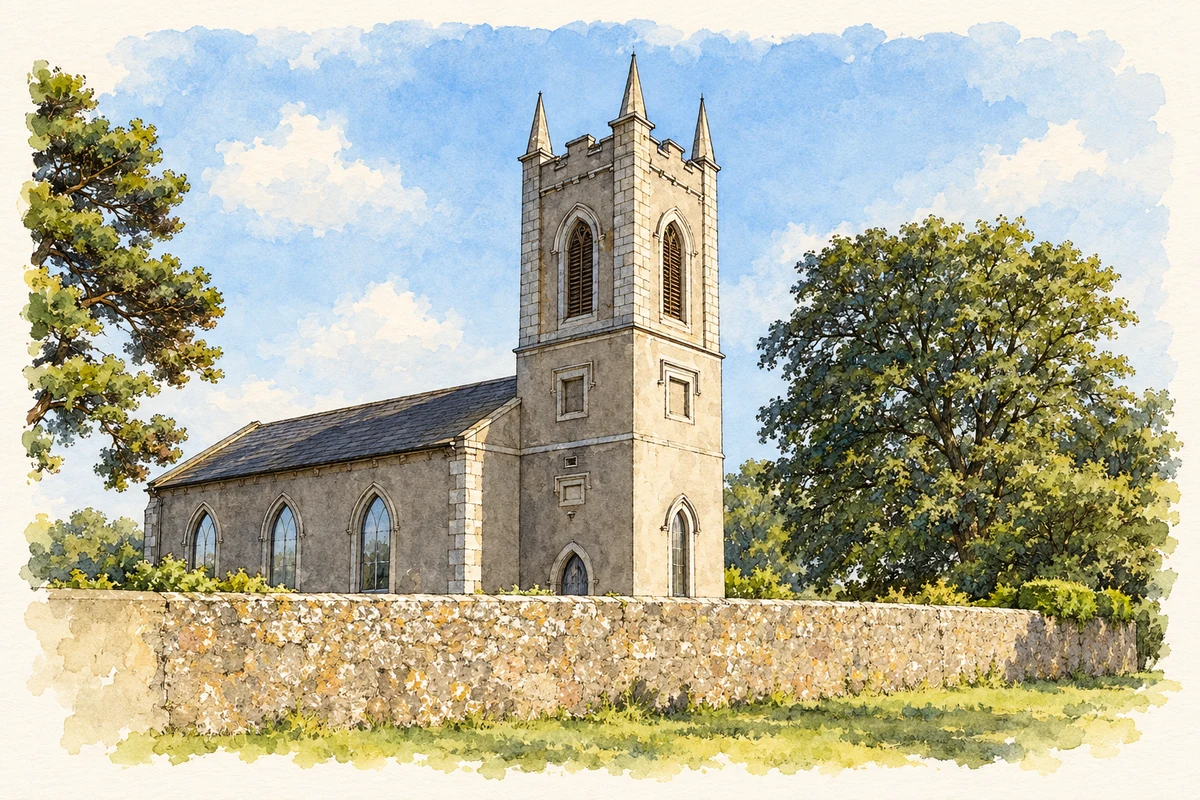
Taghmon's early church sites, traditions of Saint Munnu and connection with Henry Francis Lyte give the village a distinctive religious and literary history.
Illustration, St Munna's Church, Taghmon, County Wexford
⊕Recorded locationTaghmon52.32290° N · 6.65348° WInteractive map supplied by OpenStreetMap.
These Irish name elements are associated with this record in the Logainm glossary.
An element’s translation is a clue, rather than a complete explanation of the name. Its form and meaning depend on local history and the full Irish name.
Recorded forms
Teach Munna· Irish · main form · validated name
Taghmon· English · main form
Place & story
Crosses and several early church sites
Taghmon preserves several traces of its early ecclesiastical importance. The 2021 heritage audit records the head and base of a high cross in Saint Munn's Church of Ireland graveyard, where historical references to a parish church reach back to 1312. Other church and burial sites include Lady's Church and the Monachán. The surviving stones and separate enclosures show that the village's religious history extends beyond the present church buildings. They also give physical substance to a settlement long associated with Saint Munnu, also called Fintan.[2]
Folklore & tradition
Seven places marked in the woods
The saint's foundation story appears in Thomas Olden's nineteenth-century account of Munnu's Life. It tells how three white-clad men met him in woodland and announced that his religious settlement would stand there. They marked seven places for its principal buildings, and Munnu placed crosses on the spots. Another episode connects the monastery with the local chieftain Dimma, who offered land and asked in return for long life and burial among the monks. These are stories from the saint's hagiographical tradition, linking the foundation with sacred signs and the patronage of a local ruler.[3]
People & connections
Henry Francis Lyte at Saint Munn's
Henry Francis Lyte began his clerical career as curate of Saint Munn's, Taghmon, after ordination in 1815. His stay was brief: illness took him to France, and he later resigned and left Ireland. He eventually settled at Brixham in Devon. Lyte became best known for the hymns Praise, My Soul, the King of Heaven, written in 1834, and Abide with Me, written in 1847. Taghmon's connection belongs to the beginning of that career, before the compositions that made his name familiar in churches around the world.[4]
Both counts use the 2016 settlement boundary, allowing like-for-like comparison. CSO supplies the 2022 count on this older boundary for comparison only. The official 2022 Built Up Area has different boundaries.
View population figures
Taghmon — Census 2016 settlement footprint — census population
These are the historical areas published in the 2006 census report. Boundaries may differ between censuses and from modern settlements. Legal towns, environs and suburbs are shown separately; none has been combined into a modern settlement total.
View population figures
Taghmon, Wexford — Census town, CSO 2006 report — census population
These are the historical areas published in the 1996 census report. Boundaries may differ between censuses and from modern settlements. Legal towns, environs and suburbs are shown separately; none has been combined into a modern settlement total.
View population figures
Taghmon, Wexford — Census town, CSO 1996 report — census population
Figures cover the historical town area printed in the 1986 report. Boundaries may have changed between censuses. Legal town, environs and suburb totals remain separate and differ from modern settlement boundaries.
View population figures
Taghmon, Wexford — Census town, CSO 1986 report — census population
These figures use different area definitions. Read the boundary note before comparing them.
Taghmon, Wexford
Published census settlement populations
585people · 2016
Settlement boundaries changed during this period. Differences may reflect boundary changes as well as population change. Where a 2011 legal-town-and-environs count is shown, it has not been recalculated onto the 2016 settlement boundary.
St Munna's Church, Taghmon, County Wexford illustration: based on a St. Munna's church, Taghmon by Jonathan Thacker. AI-assisted watercolour and ink adaptation; cream paper margins added, incidental clutter omitted and fine details simplified. Licence: CC BY-SA 2.0.
 placenames