These Irish name elements are associated with this record in the Logainm glossary.
An element’s translation is a clue, rather than a complete explanation of the name. Its form and meaning depend on local history and the full Irish name.
Recorded forms
Carraig Álainn· Irish · main form · validated name
Carrigallen· English · main form
Place & story
A theatre built by its community
In 1987 Carrigallen’s drama company began building a dedicated theatre behind Saint Patrick’s Hall. Local fundraising and a FÁS training scheme supported the project, completed in 1989. A donated mill wheel displayed outside supplied the Corn Mill name. Seats came from a closed Drogheda cinema and curtain fittings from a vacant cinema in Sligo. The first production in the new building was God’s Gentry, directed by Gus Ward. These reused fittings and local contributions are part of the theatre’s own account of how it came into being.[2]
The church and its medieval neighbour
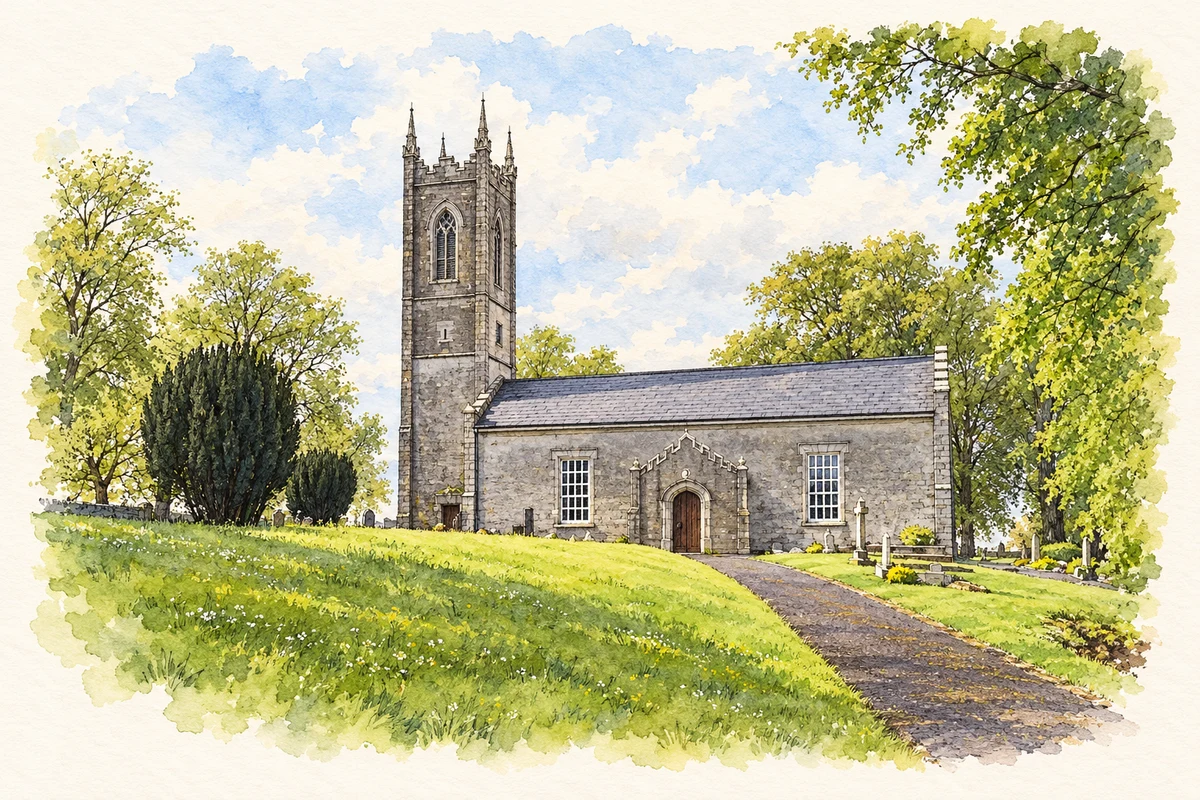
Carrigallen’s Church of Ireland church dates from 1814. Its west tower has three stages, pinnacles and battlements; similar decorative battlements appear on the porch and nave gables. In the surrounding graveyard stand the remains of a fifteenth-century church. The two buildings preserve different periods of worship at the same site, with the medieval remains standing beside the later Board of First Fruits style building.[3]
Saint Mary’s and the earlier chapels
The parish history dates Saint Mary’s Catholic church to 1846 and connects its construction with parish priest Patrick Magauran, a Carrigallen native. Its cruciform plan and Gothic windows followed less durable predecessors: a mud-walled chapel at Cornaughty, used from 1770 until 1839, and a chapel at Mullinadara destroyed in a storm. A plaque placed at Cornaughty in 2000 commemorated the earlier worship site. The present church was reroofed in 1931.[4]
Both counts use the 2016 settlement boundary, allowing like-for-like comparison. CSO supplies the 2022 count on this older boundary for comparison only. The official 2022 Built Up Area has different boundaries.
View population figures
Carrigallen — Census 2016 settlement footprint — census population
Carrigallen, Leitrim — Census town, CSO 2006 report
2002–2006: census town
303people · 2006
These are the historical areas published in the 2006 census report. Boundaries may differ between censuses and from modern settlements. Legal towns, environs and suburbs are shown separately; none has been combined into a modern settlement total.
View population figures
Carrigallen, Leitrim — Census town, CSO 2006 report — census population
Carrigallen, Leitrim — Census town, CSO 1996 report
1991–1996: census town
251people · 1996
These are the historical areas published in the 1996 census report. Boundaries may differ between censuses and from modern settlements. Legal towns, environs and suburbs are shown separately; none has been combined into a modern settlement total.
View population figures
Carrigallen, Leitrim — Census town, CSO 1996 report — census population
Carrigallen, Leitrim — Census town, CSO 1986 report
1981–1986: census town
278people · 1986
Figures cover the historical town area printed in the 1986 report. Boundaries may have changed between censuses. Legal town, environs and suburb totals remain separate and differ from modern settlement boundaries.
View population figures
Carrigallen, Leitrim — Census town, CSO 1986 report — census population
These figures use different area definitions. Read the boundary note before comparing them.
Carrigallen, Leitrim
Published census settlement populations
387people · 2016
Settlement boundaries changed during this period. Differences may reflect boundary changes as well as population change. Where a 2011 legal-town-and-environs count is shown, it has not been recalculated onto the 2016 settlement boundary.
Church of Ireland, Carrigallen illustration: based on a Church of Ireland, Carrigallen by Oliver Dixon. AI-assisted watercolour and ink adaptation; cream paper margins added, incidental clutter omitted and fine details simplified. Licence: CC BY-SA 2.0.
 placenames