Kilmessan’s former railway junction and St Mary’s church preserve different kinds of communal history, with a nearby literary connection through Lord Dunsany.
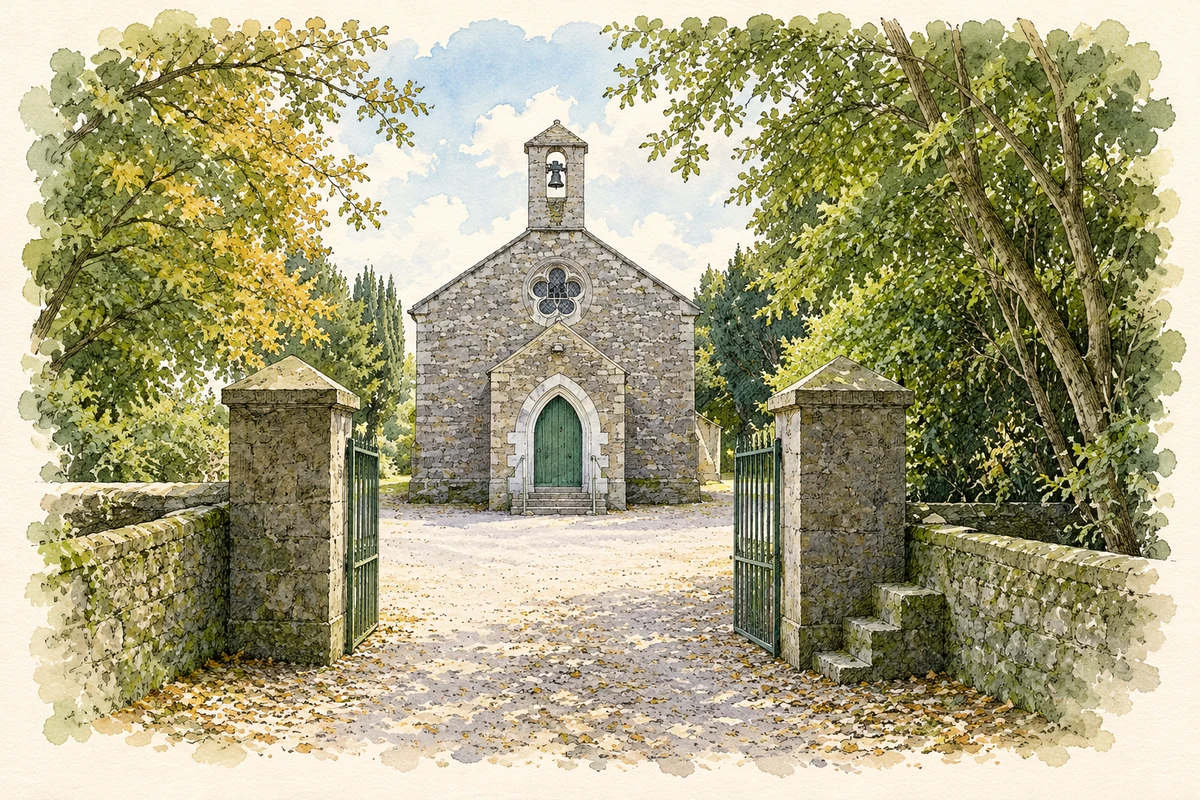
Illustration, Former Saint Mary's Church, Kilmessan
⊕Recorded locationKilmessan53.55919° N · 6.66069° WInteractive map supplied by OpenStreetMap.
These Irish name elements are associated with this record in the Logainm glossary.
An element’s translation is a clue, rather than a complete explanation of the name. Its form and meaning depend on local history and the full Irish name.
Recorded forms
Cill Mheasáin· Irish · main form · validated name
Kilmessan· English · main form
Place & story
A station that found a second use
Kilmessan Junction's station building dates from around 1862. Its projecting central gable and lower wings survive within the later hotel conversion. The National Inventory of Architectural Heritage records a group that also includes a signal box, warehouse and bridge. The warehouse retains limestone walls, brick details around openings and an arched entrance once suited to goods traffic. Together these buildings reveal the different activities concentrated at a railway junction. Their reuse retained more than a single station façade: parts of the wider working complex remain legible in the village.[2][3]
St Mary’s and its changing role
The former Church of Ireland church of St Mary was built in 1731 and renovated around 1820. Its stone walls, pointed windows, bellcote and enclosed graveyard preserve the scale of an eighteenth-century parish church altered in the Gothic manner. Local historian Noel French records its closure in 1966 and the opening of a branch library in the building in 1975. That later use gave a familiar communal building a different purpose. The architectural record and local chronology together trace a life extending beyond the period when it served its original congregation.[4][5]
People & connections
Remembering Lord Dunsany
Edward Plunkett, eighteenth Lord Dunsany, was born in London and lived for much of his life at the nearby family castle. The Navan and District Historical Society records his friendship and mentorship of the Meath poet Francis Ledwidge, alongside his own work in fiction, drama and poetry. After Dunsany died on 25 October 1957, he was buried in Kent, but a memorial service took place in Kilmessan ten days later. That service is a specific connection between the village and the writer's wider Meath life, without relocating his birthplace or burial here.[6]
Both counts use the 2016 settlement boundary, allowing like-for-like comparison. CSO supplies the 2022 count on this older boundary for comparison only. The official 2022 Built Up Area has different boundaries.
View population figures
Kilmessan — Census 2016 settlement footprint — census population
These are the historical areas published in the 2006 census report. Boundaries may differ between censuses and from modern settlements. Legal towns, environs and suburbs are shown separately; none has been combined into a modern settlement total.
View population figures
Kilmessan, Meath — Census town, CSO 2006 report — census population
These are the historical areas published in the 1996 census report. Boundaries may differ between censuses and from modern settlements. Legal towns, environs and suburbs are shown separately; none has been combined into a modern settlement total.
View population figures
Kilmessan, Meath — Census town, CSO 1996 report — census population
Figures cover the historical town area printed in the 1986 report. Boundaries may have changed between censuses. Legal town, environs and suburb totals remain separate and differ from modern settlement boundaries.
View population figures
Kilmessan, Meath — Census town, CSO 1986 report — census population
These figures use different area definitions. Read the boundary note before comparing them.
Kilmessan, Meath
Published census settlement populations
654people · 2016
Settlement boundaries changed during this period. Differences may reflect boundary changes as well as population change. Where a 2011 legal-town-and-environs count is shown, it has not been recalculated onto the 2016 settlement boundary.
Former Saint Mary's Church, Kilmessan illustration: based on a Church, Kilmessan, Co Meath by C O'Flanagan. AI-assisted watercolour and ink adaptation; cream paper margins added, incidental clutter omitted and fine details simplified. Licence: CC BY-SA 2.0.
 placenames