These Irish name elements are associated with this record in the Logainm glossary.
An element’s translation is a clue, rather than a complete explanation of the name. Its form and meaning depend on local history and the full Irish name.
Recorded forms
Lios Mór· Irish · main form · validated name
Lismore· English · main form
Place & story
A castle reshaped above the river
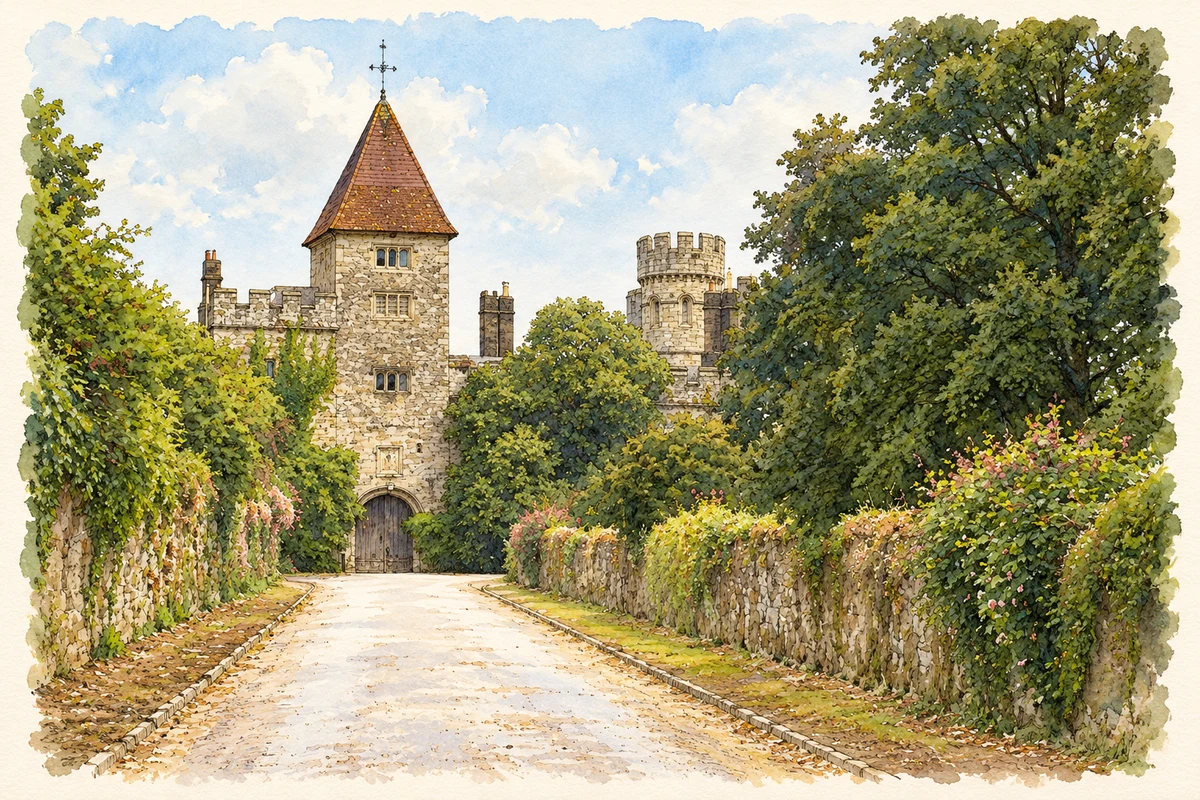
A castle has occupied Lismore's commanding site since Prince John's building of 1185. It subsequently served as a bishop's palace before passing to Walter Raleigh and, in 1602, to Richard Boyle. Its present appearance owes much to nineteenth-century work undertaken for the sixth Duke of Devonshire. Joseph Paxton helped transform the castle and gardens between 1840 and 1858. This long sequence of alteration joins a medieval stronghold to the ambitions and craftsmanship of a Victorian country-house estate.[2]
People & connections
Robert Boyle's first home
Robert Boyle was born at Lismore Castle on 25 January 1627, the fourteenth child of Richard Boyle and Catherine Fenton. His childhood began in Ireland before he was sent to Eton at eight. Later education took him through France and Italy and to Geneva. The natural philosopher's early movements show how the household at Lismore connected with a much wider European world, well before the experiments and publications that established his scientific reputation.[3]
The book behind the wall
The Book of Lismore was compiled in the late fifteenth century for Fínghean Mac Carthaigh and Caitilín at Kilbrittain in west Cork. It reached Lismore after its capture during the conflicts of the 1640s. Walled up in the castle, it was rediscovered during renovations in 1814, alongside an older crosier. Its contents bring Irish saints and heroic literature together with translations of European works, including Marco Polo's travels. The Chatsworth Settlement Trust donated the manuscript to University College Cork in 2020.[4][5]
Both counts use the 2016 settlement boundary, allowing like-for-like comparison. CSO supplies the 2022 count on this older boundary for comparison only. The official 2022 Built Up Area has different boundaries.
View population figures
Lismore — Census 2016 settlement footprint — census population
These are the historical areas published in the 2006 census report. Boundaries may differ between censuses and from modern settlements. Legal towns, environs and suburbs are shown separately; none has been combined into a modern settlement total.
View population figures
Lismore Legal Town, Waterford — Legal town, CSO 2006 report — census population
Lismore Environs, Waterford — Town environs only, CSO 2006 report
2002–2006: town environs only
450people · 2006
These are the historical areas published in the 2006 census report. Boundaries may differ between censuses and from modern settlements. Legal towns, environs and suburbs are shown separately; none has been combined into a modern settlement total.
View population figures
Lismore Environs, Waterford — Town environs only, CSO 2006 report — census population
These are the historical areas published in the 1996 census report. Boundaries may differ between censuses and from modern settlements. Legal towns, environs and suburbs are shown separately; none has been combined into a modern settlement total.
View population figures
Lismore Legal Town, Waterford — Legal town, CSO 1996 report — census population
Lismore Environs, Waterford — Town environs only, CSO 1996 report
1991–1996: town environs only
366people · 1996
These are the historical areas published in the 1996 census report. Boundaries may differ between censuses and from modern settlements. Legal towns, environs and suburbs are shown separately; none has been combined into a modern settlement total.
View population figures
Lismore Environs, Waterford — Town environs only, CSO 1996 report — census population
Figures cover the historical town area printed in the 1986 report. Boundaries may have changed between censuses. Legal town, environs and suburb totals remain separate and differ from modern settlement boundaries.
View population figures
Lismore, Waterford — Legal town, CSO 1986 report — census population
Lismore, Waterford — Town environs only, CSO 1986 report
1981–1986: town environs only
382people · 1986
Figures cover the historical town area printed in the 1986 report. Boundaries may have changed between censuses. Legal town, environs and suburb totals remain separate and differ from modern settlement boundaries.
View population figures
Lismore, Waterford — Town environs only, CSO 1986 report — census population
These figures use different area definitions. Read the boundary note before comparing them.
Lismore, Waterford — 2011 legal town and environs; 2016 census settlement
Published census settlement populations
1,374people · 2016
Settlement boundaries changed during this period. Differences may reflect boundary changes as well as population change. Where a 2011 legal-town-and-environs count is shown, it has not been recalculated onto the 2016 settlement boundary.
View population figures
Lismore, Waterford — 2011 legal town and environs; 2016 census settlement — census population
Approach and gatehouse, Lismore Castle illustration: based on a Lismore Castle by Pam Brophy. AI-assisted watercolour and ink adaptation; cream paper margins added, incidental clutter omitted and fine details simplified. Licence: CC BY-SA 2.0.
 placenames