Loughglinn's history combines the Dillon estate, the early life of Fenian Edward Duffy and a local setting in Douglas Hyde's collection of folk stories.
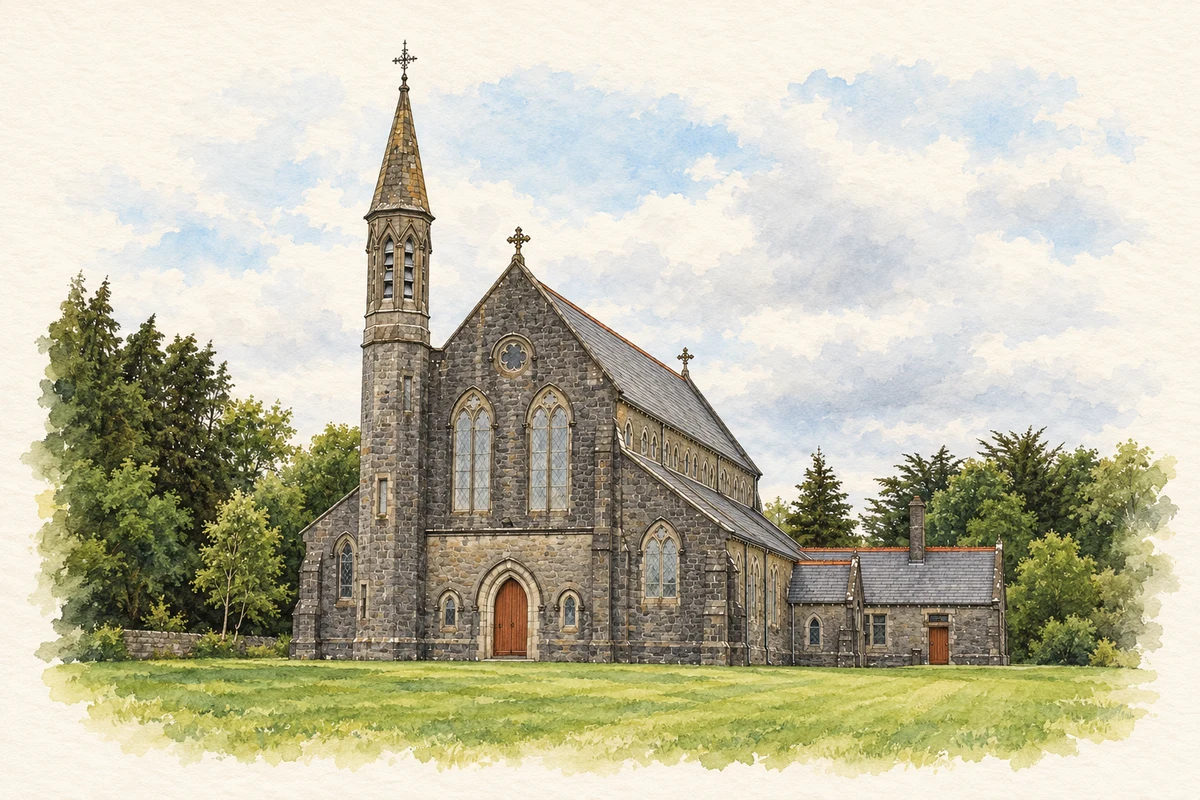
Illustration, Church of Our Lady of Good Counsel, Loughglinn
⊕Recorded locationLoughglinn53.82247° N · 8.56373° WInteractive map supplied by OpenStreetMap.
These Irish name elements are associated with this record in the Logainm glossary.
An element’s translation is a clue, rather than a complete explanation of the name. Its form and meaning depend on local history and the full Irish name.
Recorded forms
Loch Glinne· Irish · main form · validated name
Loughglinn· English · main form
Loughglynn· English · main form · local name
Place & story
A house altered by extension and fire
Loughglinn House was built around 1715 and extended around 1820. Its appearance changed again after a fire in 1904, when the uppermost floor was removed. The surviving house has a five-bay front over a basement, limestone walls and a central projecting entrance with Doric columns. Bay windows face the garden, and a Venetian window marks a side elevation. Later known as the convent of the Franciscan Missionaries of Mary, the building preserves successive phases of estate and religious use within the same substantial structure.[2]
People & connections
Edward Duffy, from schoolroom to Fenian organising
Edward Duffy was born around 1840 at Loughglinn, where his father was a national schoolteacher. Educated in his father's school, he worked there as a monitor before becoming a shop assistant in Castlerea around 1856. Apprenticeship in Limerick and employment at Pim's drapery in Dublin followed. In Dublin he joined the Fenian movement during its early recruitment campaigns. Those stages connect a local schoolteacher's household with the commercial workplaces through which young men entered national political networks in the 1860s.[3]
Folklore & tradition
The hags in Driminuch wood
Douglas Hyde's Beside the Fire includes The Hags of the Long Teeth, set at Loch Glynn and Driminuch wood. Visiting hunters pursue a hare to a woodland house guarded by a black dog that catches their bullets. Their appeal for clerical help begins a tale of enchantment, a hidden castle beneath the lake and eventual release. When the spell ends, seven dead vultures become white swans. Hyde's recorded story gives the local wood and lake a place within a much larger supernatural world.[4]
Both counts use the 2016 settlement boundary, allowing like-for-like comparison. CSO supplies the 2022 count on this older boundary for comparison only. The official 2022 Built Up Area has different boundaries.
View population figures
Loughglinn — Census 2016 settlement footprint — census population
Loughglinn, Roscommon — Census town, CSO 2006 report
2002–2006: census town
208people · 2006
These are the historical areas published in the 2006 census report. Boundaries may differ between censuses and from modern settlements. Legal towns, environs and suburbs are shown separately; none has been combined into a modern settlement total.
View population figures
Loughglinn, Roscommon — Census town, CSO 2006 report — census population
Loughglinn, Roscommon — Census town, CSO 1996 report
1991–1996: census town
186people · 1996
These are the historical areas published in the 1996 census report. Boundaries may differ between censuses and from modern settlements. Legal towns, environs and suburbs are shown separately; none has been combined into a modern settlement total.
View population figures
Loughglinn, Roscommon — Census town, CSO 1996 report — census population
Loughglinn, Roscommon — Census town, CSO 1986 report
1981–1986: census town
175people · 1986
Figures cover the historical town area printed in the 1986 report. Boundaries may have changed between censuses. Legal town, environs and suburb totals remain separate and differ from modern settlement boundaries.
View population figures
Loughglinn, Roscommon — Census town, CSO 1986 report — census population
These figures use different area definitions. Read the boundary note before comparing them.
Loughglinn, Roscommon
Published census settlement populations
184people · 2016
Settlement boundaries changed during this period. Differences may reflect boundary changes as well as population change. Where a 2011 legal-town-and-environs count is shown, it has not been recalculated onto the 2016 settlement boundary.
 placenames