These Irish name elements are associated with this record in the Logainm glossary.
An element’s translation is a clue, rather than a complete explanation of the name. Its form and meaning depend on local history and the full Irish name.
Recorded forms
Goirtín· Irish · main form · validated name
Gorteen· English · main form
Gurteen· English · main form · local name
Place & story
A centre built by the community
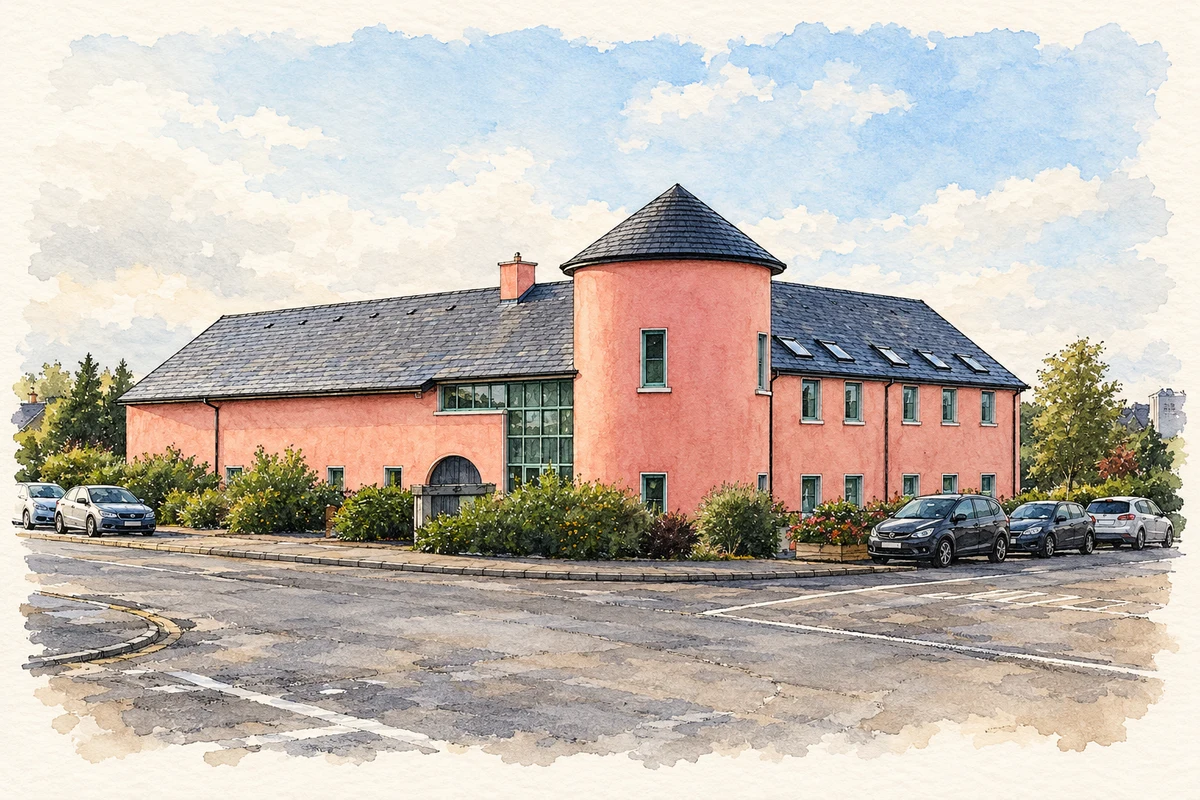
The Coleman Irish Music Centre opened in Gurteen in 1999, following six years of fundraising by a company established in 1993. Its directors came from the community, local businesses and Sligo County Council. The local farmers’ co-operative donated the site. In 2006 the centre became a regional Comhaltas resource centre serving Sligo, Mayo, Leitrim, Roscommon and Fermanagh. Its development gave the village a place for teaching, performance and access to musical archives.[2]
People & connections
Michael Coleman’s wider musical world
The centre commemorates Michael Coleman, born in 1891 at Knockgrania in nearby Killavil, rather than in the village itself. He emigrated to America in 1914 and established a recording career in New York. The centre’s history records approximately eighty commercial recordings during the 1920s and 1930s. The discs carried his fiddle playing back to listeners in Ireland and helped transmit the music of South Sligo far beyond its original setting. Coleman died in New York in 1945.[3]
Saint Patrick’s and George Goldie
Saint Patrick’s Catholic church belongs to a much earlier chapter in Gurteen’s public building. The Irish Architectural Archive lists it among the works of English architect George Goldie, recording construction beginning in 1866 and the official opening on 25 November that year. Canon Roger Brennan commissioned the work. The present diocesan parish directory continues to identify Saint Patrick’s as Gurteen’s church, alongside churches at Cloonloo and Killaraght within the wider parish.[4][5]
Both counts use the 2016 settlement boundary, allowing like-for-like comparison. CSO supplies the 2022 count on this older boundary for comparison only. The official 2022 Built Up Area has different boundaries.
View population figures
Gurteen — Census 2016 settlement footprint — census population
These are the historical areas published in the 2006 census report. Boundaries may differ between censuses and from modern settlements. Legal towns, environs and suburbs are shown separately; none has been combined into a modern settlement total.
View population figures
Gurteen, Sligo — Census town, CSO 2006 report — census population
These are the historical areas published in the 1996 census report. Boundaries may differ between censuses and from modern settlements. Legal towns, environs and suburbs are shown separately; none has been combined into a modern settlement total.
View population figures
Gurteen, Sligo — Census town, CSO 1996 report — census population
Figures cover the historical town area printed in the 1986 report. Boundaries may have changed between censuses. Legal town, environs and suburb totals remain separate and differ from modern settlement boundaries.
View population figures
Gurteen, Sligo — Census town, CSO 1986 report — census population
These figures use different area definitions. Read the boundary note before comparing them.
Gurteen, Sligo
Published census settlement populations
393people · 2016
Settlement boundaries changed during this period. Differences may reflect boundary changes as well as population change. Where a 2011 legal-town-and-environs count is shown, it has not been recalculated onto the 2016 settlement boundary.
Coleman Music Centre, Gurteen illustration: based on a Gurteen Cross and Colman Music Centre by Djm-leighpark. AI-assisted watercolour and ink adaptation; cream paper margins added, incidental clutter omitted and fine details simplified. Licence: CC BY-SA 4.0.
 placenames