These Irish name elements are associated with this record in the Logainm glossary.
An element’s translation is a clue, rather than a complete explanation of the name. Its form and meaning depend on local history and the full Irish name.
Recorded forms
Tobar an Choire· Irish · main form · validated name
Tobercurry· English · main form
Tubbercurry· English · main form · local name
Place & story
A village of thatched houses
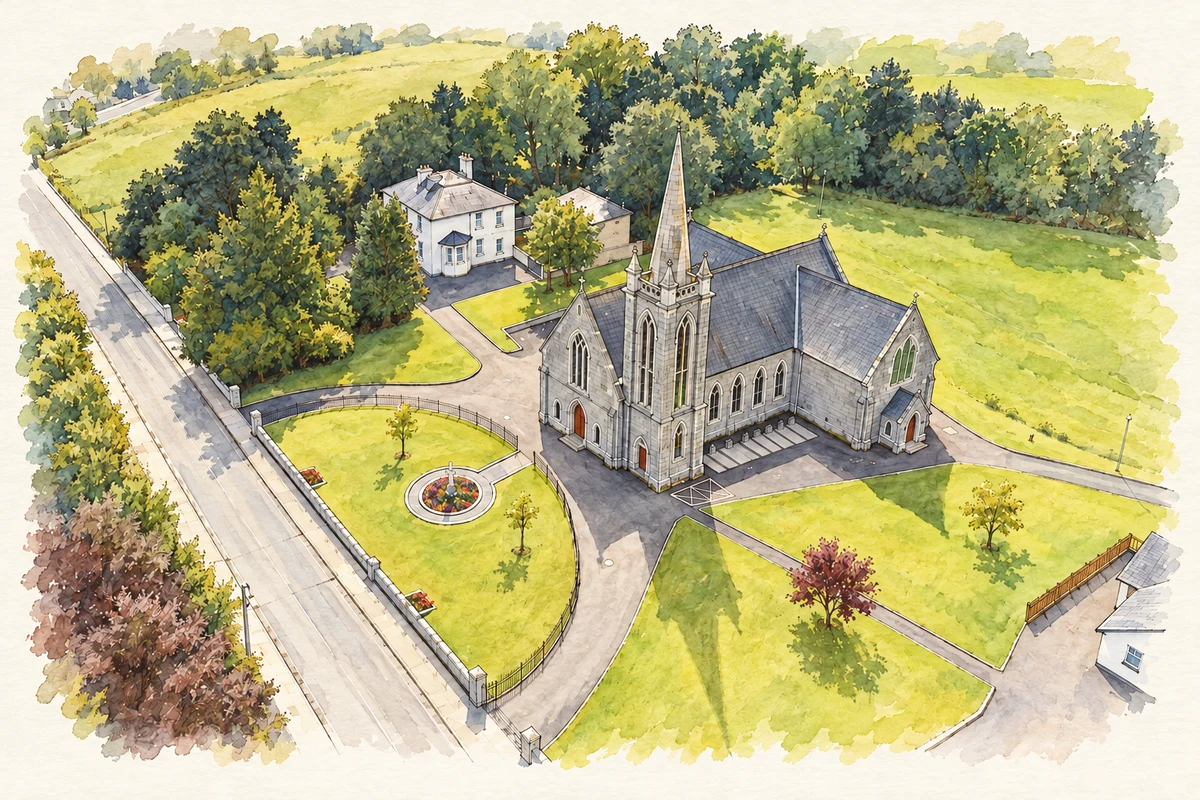
Lewis described Tubbercurry in 1837 as a village on the Boyle–Ballina road, with ninety houses of which only fifteen had slate roofs. Monday was market day, and several annual fairs supported its trading role. A penny post linked it with Ballymote. The church, built in 1830 from local limestone, had an octagonal tower and occupied elevated ground. These details capture a compact service centre whose surviving market identity predates its later industrial and cultural ventures.[2]
People & connections
Four founders and a musical school
The South Sligo Summer School first opened on 12 July 1987. Rita Flannery, Geraldine Murtagh, Michael Severs and Marie Flannery developed it from the local Tobar Co-op initiative during a period of unemployment and emigration. Traditional music was identified as one of the area's strengths. Classes, concerts and céilís brought musicians and learners into the town, with particular attention to Sligo fiddle and flute styles. Former students subsequently became teachers, making the school itself part of the tradition's transmission.[3]
The Gallagher family's factories
Manufacturing also shaped modern Tubbercurry. A 2015 council discussion recognised the Gallagher family of Cashel, Curry, for founding businesses including Basta and Tool and Gauge. Councillors proposed an artwork or monument acknowledging their contribution to employment in South Sligo. The recorded proposal offers a useful reminder that the town's identity includes engineering and industry alongside agriculture, fairs and music.[4]
Both counts use the 2016 settlement boundary, allowing like-for-like comparison. CSO supplies the 2022 count on this older boundary for comparison only. The official 2022 Built Up Area has different boundaries.
View population figures
Tubbercurry — Census 2016 settlement footprint — census population
These are the historical areas published in the 2006 census report. Boundaries may differ between censuses and from modern settlements. Legal towns, environs and suburbs are shown separately; none has been combined into a modern settlement total.
View population figures
Tubbercurry, Sligo — Census town, CSO 2006 report — census population
These are the historical areas published in the 1996 census report. Boundaries may differ between censuses and from modern settlements. Legal towns, environs and suburbs are shown separately; none has been combined into a modern settlement total.
View population figures
Tubbercurry, Sligo — Census town, CSO 1996 report — census population
Figures cover the historical town area printed in the 1986 report. Boundaries may have changed between censuses. Legal town, environs and suburb totals remain separate and differ from modern settlement boundaries.
View population figures
Tubbercurry, Sligo — Census town, CSO 1986 report — census population
These figures use different area definitions. Read the boundary note before comparing them.
Tubbercurry, Sligo
Published census settlement populations
1,986people · 2016
Settlement boundaries changed during this period. Differences may reflect boundary changes as well as population change. Where a 2011 legal-town-and-environs count is shown, it has not been recalculated onto the 2016 settlement boundary.
Church of St John the Evangelist, Tobercurry, County Sligo illustration: based on a Tubbercurry Catholic Church.png by Digi-Telly. AI-assisted watercolour and ink adaptation; cream paper margins added, incidental clutter omitted and fine details simplified. Licence: CC BY-SA 4.0.
 placenames