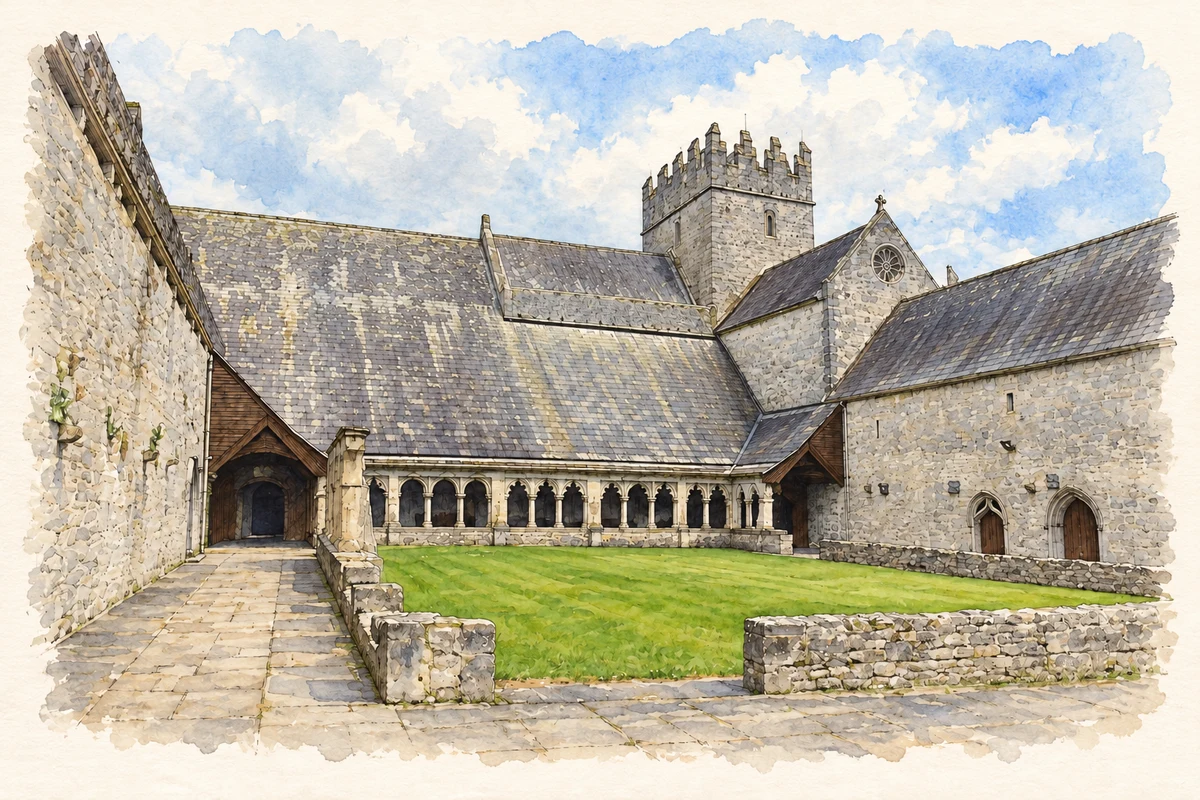
Holycross Abbey's carved stonework, surviving wall painting and twentieth-century restoration connect medieval devotion with a living parish on the River Suir.
Illustration, Holycross Abbey cloister and church
⊕Recorded locationHolycross52.63798° N · 7.87374° WInteractive map supplied by OpenStreetMap.
These Irish name elements are associated with this record in the Logainm glossary.
An element’s translation is a clue, rather than a complete explanation of the name. Its form and meaning depend on local history and the full Irish name.
Recorded forms
Mainistir na Croiche· Irish · main form · validated name
Holycross· English · main form
Place & story
A church shaped by pilgrimage
Holycross developed as a Cistercian monastery beside the Suir under the patronage of Dónal Mór Ó Briain in the late twelfth century. Pilgrims came to venerate a relic believed to be part of the True Cross. The Butlers of Ormond supported major building work in the fifteenth century, and much of the surviving architecture belongs to that period. The parish's history also records a second cross relic associated with Ormond. These devotional objects and successive patrons help explain the scale and richness of the church that developed here.[2][5]
Carving, painting and the infirmary
The abbey's elaborate sedilia, the stone seats provided for clergy near the altar, are among its most distinctive medieval features. A surviving fresco adds a different form of decoration to the carved stone. Beside the restored parish church stand the infirmary ruins, which remain in the care of the Office of Public Works. This distinction reflects the different histories of the buildings: the church was returned to worship, while nearby remains preserve part of the wider monastic complex in an unroofed state.[2]
The celebration in 1975
RTÉ recorded the abbey's reopening celebrations in 1975, when around three thousand people gathered. A procession of altar boys and monks moved from the old parish church to the restored abbey, accompanied by a hymn and the ringing of Saint Gabriel's bell. The report described four years of restoration costing about £300,000, presented as a contribution to European Architectural Heritage Year. A cross relic was brought for the occasion, with part to remain in the church. The ceremony marked the return of a ruined medieval building to regular parish life.[3]
The riverside mill
The former watermill beside the Suir dates from about 1780 and retains evidence of earlier building phases. Its millrace, undershot wheel, surviving machinery and millstones record the use of the river for production as well as the abbey's religious setting. A carved grotesque head survives above the northern doorway. The national architectural survey notes that the earlier fabric may point to a monastic predecessor, although the standing structure is principally an eighteenth-century industrial building.[4]
Both counts use the 2016 settlement boundary, allowing like-for-like comparison. CSO supplies the 2022 count on this older boundary for comparison only. The official 2022 Built Up Area has different boundaries.
View population figures
Holycross — Census 2016 settlement footprint — census population
Holycross, North Tipperary and South Tipperary — Census town, CSO 2006 report
2002–2006: census town
700people · 2006
These are the historical areas published in the 2006 census report. Boundaries may differ between censuses and from modern settlements. Legal towns, environs and suburbs are shown separately; none has been combined into a modern settlement total.
View population figures
Holycross, North Tipperary and South Tipperary — Census town, CSO 2006 report — census population
Holycross, North Tipperary and South Tipperary — Census town, CSO 1996 report
1991–1996: census town
447people · 1996
These are the historical areas published in the 1996 census report. Boundaries may differ between censuses and from modern settlements. Legal towns, environs and suburbs are shown separately; none has been combined into a modern settlement total.
View population figures
Holycross, North Tipperary and South Tipperary — Census town, CSO 1996 report — census population
These figures use different area definitions. Read the boundary note before comparing them.
Holycross, North Tipperary and South Tipperary
Published census settlement populations
715people · 2016
Settlement boundaries changed during this period. Differences may reflect boundary changes as well as population change. Where a 2011 legal-town-and-environs count is shown, it has not been recalculated onto the 2016 settlement boundary.
View population figures
Holycross, North Tipperary and South Tipperary — census population
Holycross Abbey cloister and church illustration: based on a Holycross Abbey, cloister and abbey church by Jonathan Thacker. AI-assisted watercolour and ink adaptation; cream paper margins added, incidental clutter omitted and fine details simplified. Licence: CC BY-SA 2.0.
 placenames