These Irish name elements are associated with this record in the Logainm glossary.
An element’s translation is a clue, rather than a complete explanation of the name. Its form and meaning depend on local history and the full Irish name.
Recorded forms
Baile na Lorgan· Irish · main form · validated name
Fivemiletown· English · main form
Place & story
People & connections
Mary Montgomery’s metalwork class
Mary Montgomery of Blessingbourne established a metalwork class in Fivemiletown in 1892, building on earlier needlework teaching. A contemporary account reproduced from the Morning Post describes her learning repoussé work in London before teaching locally. The 1907 Irish International Exhibition material names makers including Henry Busby, Samuel Carruth and Mathew Reid, with objects ranging from copper trays to brass door plates. The sales arrangements paid material and teaching costs first, then passed the balance to the workers. Those named craftspeople give the industry a human history beyond its patron's role.[2]
John and Mary Williams as designers
The Fivemiletown class also drew on the skills of John Williams, a founding craftsman of the Guild of Handicraft, and his sister Mary Williams. David Marshall's research for the Decorative Arts Society identifies their teaching and design contributions, including Mary's copper tankard design published in The Studio in 1899. John also worked with the Newton metalwork school in Cambridgeshire, and similarities between the schools' output can complicate later attributions. This wider network connected a Tyrone village with the Arts and Crafts movement through visiting teachers, designs and exhibitions.[3]
The last railway journey into a new year
The Clogher Valley Railway ran through Fivemiletown's narrow Main Street, linking the town with the wider valley. Headhunters Railway Museum's account of its closure describes a final railcar arriving shortly before midnight on 31 December 1941. After being turned at Fivemiletown, it set off again just after midnight, carrying passengers home as the railway's official existence ended. The museum distinguishes this last outing from the final steam service earlier that day. The surviving red-brick station is a reminder of a transport system whose route once shared the town's everyday street space.[4]
Both censuses use the same 2015 settlement boundary. These exact counts cover usual residents in the settlement, rather than local government districts or historic counties. Other NISRA tables may use approximate counts.
View population figures
FIVEMILETOWN — Settlement 2015 (N11000319) — census population
These are the town figures printed in the historical census reports, separate from the surrounding rural district and modern settlement. Some historical towns had no fixed boundary; a consistent footprint across years is not assumed.
View population figures
Fivemiletown — historical census town — census population
The published 2001 KS01 settlement count uses an earlier geography and disclosure-control methods. It is not rebased to the 2015 settlement used for 2011 and 2021. The geographic matching file can contain a different 2001 count; the figure shown here comes from KS01.
View population figures
Fivemiletown — KS01 Settlement (2005 geography) — census population
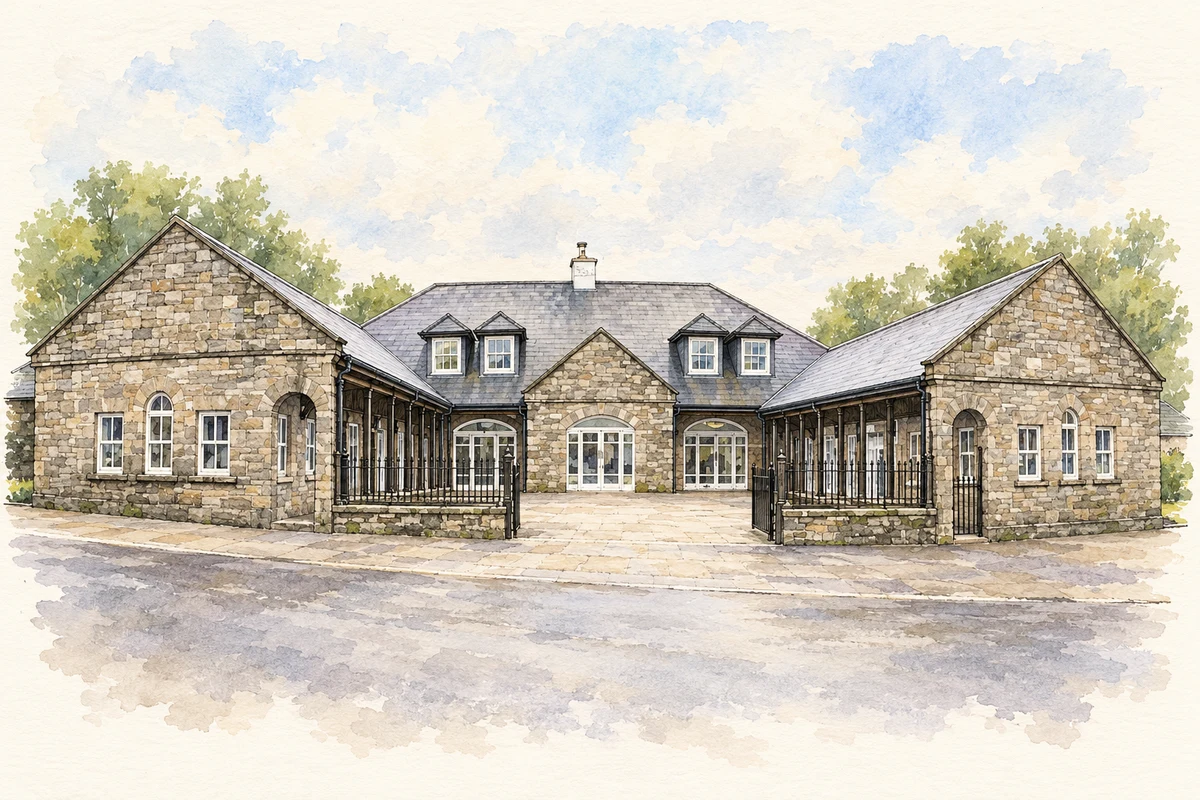
Fivemiletown Buttermarket illustration: based on a Fivemiletown Buttermarket by Kenneth Allen. AI-assisted watercolour and ink adaptation; cream paper margins added, incidental clutter omitted and fine details simplified. Licence: CC BY-SA 2.0.
 placenames